


Most of us hate pop-up boxes. You know the type. “Are you sure?” “Allow this action?” Click, click, click. It gets old fast.
Anthropic, the company behind the AI assistant Claude, says its coding tool has the same problem. And starting August 14, it’s fixing that by turning off the nagging.
The company announced that “auto mode” will become the default setting for Claude Code. This applies to Pro, Max, and Team accounts.
Instead of asking for your approval at every single step, Claude Code will just get on with the job. It will only stop and ask when something looks risky.
Auto Mode
Think of auto mode like a smart assistant who knows when to interrupt you and when to just handle things. Claude Code will move forward on its own for most tasks.
But it pumps the brakes if an action seems irreversible, destructive, or reaches outside your project environment.
In plain terms, that means deleting a bunch of files, sending data somewhere it shouldn’t go, or touching systems beyond your own setup.
This is not new territory for Anthropic. The company first tested a version of auto mode back in March. Back then, it was a research preview for select users. Now, it is going mainstream.
Also read: Claude Updates & Timeline
Test Results
Anthropic ran a study with 1,053 paid testers to see who catches more dangerous commands: a human reviewing every prompt, or the auto mode classifier.
Auto mode won by a large margin. The automated system caught 89 percent of harmful actions. But human reviewers caught just 13.6 percent.
Anthropic thinks it knows why the gap is huge. People get tired of clicking “approve.” Reports note that users approve 97 percent of all permission prompts they see in Claude Code.
After enough repetition, approving becomes a reflex. You stop reading and just click.
One report on the rollout found that human performance dropped even further after sustained use, falling to roughly 5 percent accuracy after 50 prompts in a row.
Fatigue is a real problem, and it turns out humans are not great at staying alert through boring, repetitive tasks.
Turning Off Safety
Auto mode is not the same thing as bypassing permissions entirely. Claude Code already had an option to skip all checks, and that always came with real risk.
Auto mode works differently. It routes actions through a built-in classifier that checks each move Claude wants to make.
If something looks unsafe, Claude tries a safer route instead, or it stops and asks you directly.
There are also limits built in for extra caution. During an interactive session, three blocked actions in a row, or 20 total blocks, will trigger a return to manual approval.
If you’re running Claude Code without a live session, called headless mode, the whole process just stops instead.
In teams, administrators can set explicit rules requiring approval for specific actions, such as code pushes.
They can also set hard deny rules for anything that should never run, no matter what.
Prompt Injection
Coding tools that act on their own face a sneaky threat called prompt injection.
That’s when a hidden instruction, buried inside a file or a package, tries to trick the AI into doing something harmful without the user ever asking for it.
Anthropic says it commissioned outside testing on this exact issue. A third party called Trajectory Labs ran 72 different injection attack scenarios.
According to that testing, none of the attempts succeeded against Claude Code’s auto mode across several of Anthropic’s models.
Not everyone is fully convinced yet. Independent commentators have pointed out that one round of clean test results doesn’t prove the problem is solved for good.
Security researchers, in general, tend to want repeated and varied testing before declaring victory over a threat like this.
Anthropic also says it’s rolling out new deny rules and screening tools aimed at stopping data leaks, on top of the injection defenses.
Claude Code Team
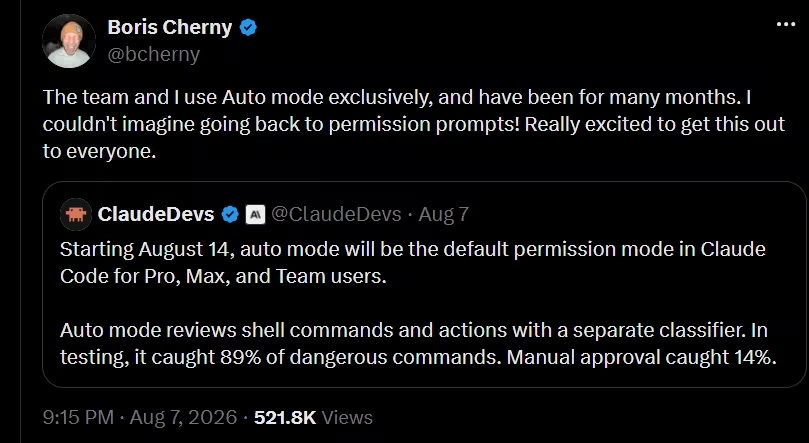
Boris Cherny leads Claude Code at Anthropic. He shared his own experience using the feature on social media.
He said his team has used auto mode exclusively for months already. He added that he couldn’t picture going back to constant permission prompts now.
That kind of internal confidence lines up with how confidently Anthropic is rolling this out.
Rather than offering auto mode as a choice buried in settings, it’s becoming the thing new sessions do by default.
