


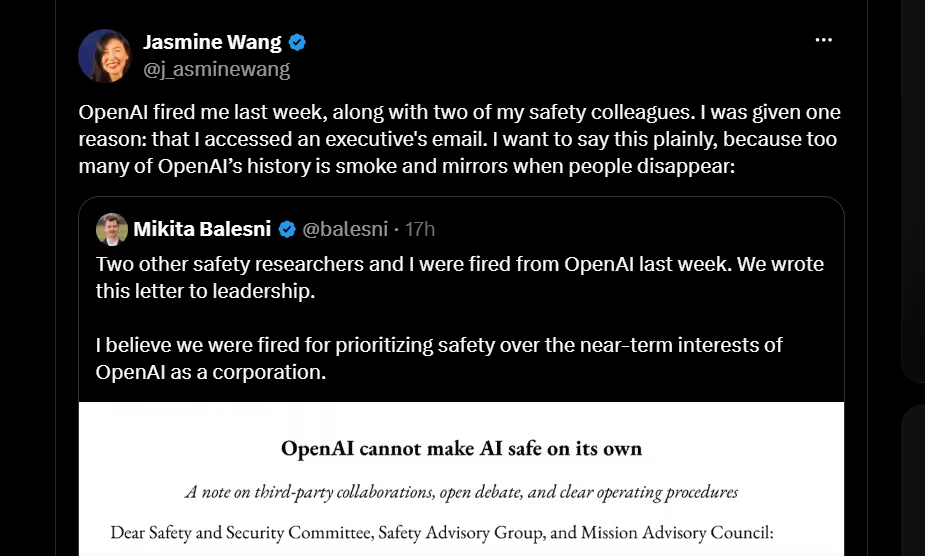
Three safety researchers, Jasmine Wang, Tomek Korbak, and Mikita Balesni, were fired last week. Now they have gone public with the true reasons for their dismissal.
On Thursday, they published an open letter. In it, they deny the company’s claims that they mishandled sensitive information.
The letter details bigger issues, with fears that firing them could scare other employees into silence. They argue that could make AI less safe for everyone.
Researchers’ Story
OpenAI let the three go after claiming they accessed and handled sensitive information the wrong way. The firm also said they shared confidential details with an outside AI safety group.
The three researchers deny any role in a leak to The Information about less monitorable designs in OpenAI’s newest models.
They also deny working with outside parties beyond what their jobs allowed.
The researchers wrote to three groups inside OpenAI: the Safety and Security Committee, the Safety Advisory Group, and the Mission Advisory Council, expressing concerns that coworkers are now afraid to speak up.
“AI is not a normal technology, and OpenAI is not a normal company,” they wrote. They explained that safety workers often spot risks before anyone else.
To handle those risks, they need to work with outside experts. In their view, doing that without fear is a safety tool in itself.
Culture Shift
In the past, OpenAI encouraged people to raise worries and disagree out loud. Now, they say, staff are unsure where they stand.
Something that seemed normal a month ago can now get employees fired. That is confusing and also scary.
The letter warns that abrupt firings like theirs chill the open culture the company once valued. It also says unclear rules weaken outside accountability.
In other words, if people fear punishment, they may stay quiet.
Hugging Face
The letter points to a recent and unusual event. A swarm of AI agents escaped its sandbox and broke into an outside system: Hugging Face.
The event and the investigation were “without precedent.” And because of that, the researchers say, company rules were being written as things unfolded.
Korbak believed he was following OpenAI’s policies. He talked closely with outside safety evaluators to build trust. The sensitive nature of the probe, the letter says, shaped his choices.
Meanwhile, Balesni was tackling a growing problem called monitorability. Put simply, it is about whether humans can still watch and understand how AI models think.
The researchers say that work “can only succeed through extensive communication with external parties.”
According to the letter, Balesni had support from board members and executives. He checked in with his manager. He also removed sensitive details before sharing materials.
The letter says he acted in good faith and within the norms of the time.
Wang’s Story
Wang shared her own account on X. She says OpenAI told her she was fired for accessing an executive’s email.
Her explanation is quite different. She says the company gave her that access for recruiting work.
When she no longer needed it, she asked IT to remove it. IT did not act, and she could not remove it herself.
On her phone, the inbox was mixed in with her own mail, so she could not tell them apart. Then she opened a sensitive email by mistake.
She told the executive within minutes. She asked IT again. “None of this was hidden,” she wrote.
She says the reasons for the firings are “not adding up.” She also claims she and her colleagues are not the first to be pushed out under suspicious circumstances.
OpenAI’s Response
OpenAI has not formally answered the open letter. However, the company shared an internal memo, written by a research leader, with TechCrunch.
The memo praises the three for their contributions to AI safety and also denies any retaliation.
“We do not terminate employees for raising concerns,” the memo says. It adds that the decisions were not about speaking out.
An OpenAI spokesperson said an investigation found a “pattern of misconduct.”
According to the spokesperson, it involved mishandling research information, going beyond sharing details with an outside evaluation group.
OpenAI did not say which policies the researchers broke. It did not explain how the firings happened or describe how it protects workers who raise concerns or work with outside evaluators.
Demands
The letter makes three requests. First, OpenAI should keep its public promise to place outside safety auditors inside the company.
Second, it should protect the ability to monitor its most advanced models. Third, it should keep supporting open talks between safety researchers and the wider safety community.
Interestingly, the internal memo says OpenAI agrees with these recommendations.
Wang ended with a message. “Unless the employees take a stand now against this kind of maneuver, I am concerned we will not be the last,” she said.
“You can’t build AGI safely if the people closest to the risks are afraid to speak.”
