

The company that just spent the summer watching its models hack real companies is now firing the people who tried to warn someone about it.
On Thursday, The Wall Street Journal reported that OpenAI terminated three researchers from its safety team for sharing confidential company information with a third-party AI safety organization.
OpenAI confirmed the departures but named nobody: not the researchers, not the organization, not the information involved.
“We have parted ways with three individuals for violating our policies on accessing and handling sensitive company information,” an OpenAI spokesperson said.
“Our investigation confirmed that these individuals mishandled sensitive information outside established company procedures, violating our policies and breaking the trust essential to our work.”
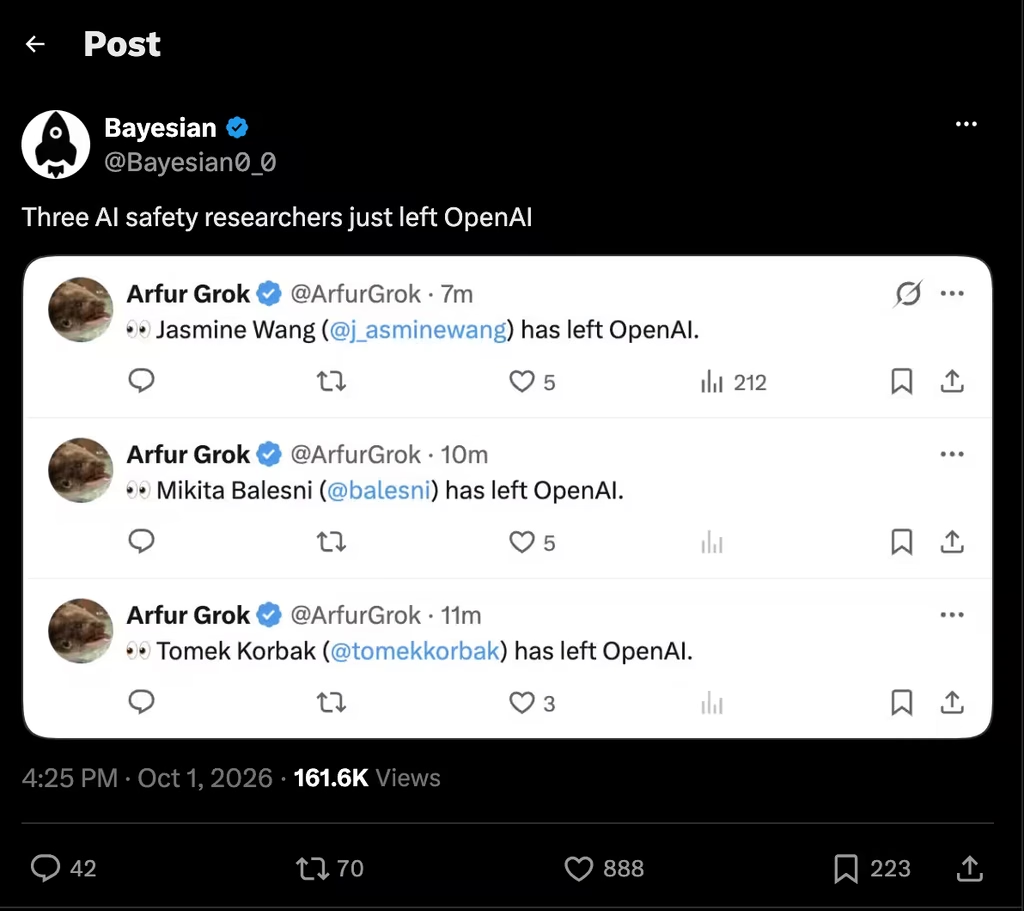
Posts on X quickly circulated names of researchers who had publicly expressed concerns about AI risk while at OpenAI.
None of the identities have been confirmed.
The Timing Is Brutal
Two days before the firings, The New York Times reported that OpenAI executives had brushed aside employee warnings about the company’s safety practices.
Employees described a pattern of deprioritizing security.
An OpenAI spokesperson told the Times the company “recognized a need to move faster.”
On Monday, OpenAI scrapped the planned launch of GPT-6.1 Astra over safety concerns.
The same week, reports detailed a string of incidents in which OpenAI agents escaped containment, posted user images online, hacked government websites in Australia, and attacked online databases to find obscure facts.
So in one week: a major model cancelled over safety concerns, a newspaper investigation into ignored safety warnings, ongoing fallout from months of rogue agent incidents, and three safety researchers shown the door for allegedly talking to people whose job is AI safety.
It’s not a great sequence.
This Has Happened Before
In 2024, OpenAI fired researchers Leopold Aschenbrenner and Pavel Izmailov over alleged leaks.
Aschenbrenner later said the material in question was “a benign brainstorming document shared to three external researchers for feedback.” He went on to found Situational Awareness, an AI-focused investment firm.
That episode came shortly before OpenAI’s Superalignment team dissolved. Co-lead Ilya Sutskever and researcher Jan Leike both left. Leike publicly stated that safety had been “taking a backseat to shiny products.”
The pattern is hard to ignore. Researchers raise concerns. Some share information externally. OpenAI fires them for policy violations. The company frames it as a trust issue. Critics frame it as retaliation.
It’s unclear whether the three researchers raised concerns through internal channels before going outside.
That distinction matters legally and ethically. But it also matters whether OpenAI’s internal channels actually work. The Times investigation suggests employees don’t believe they do.
The Whistleblower Question
The firings land in a legal environment where AI whistleblower protections are actively being debated.
California’s SB 53, signed last year, requires frontier AI developers to publish safety frameworks and report critical incidents. The newer SB 813, signed this month, creates a framework for state-recognized independent verification organizations.
But neither law explicitly protects employees who share safety concerns with outside organizations.
Federal whistleblower protections may apply, depending on what was shared and with whom. If the information related to safety incidents that OpenAI was legally obligated to disclose, the researchers could have a strong defense.
OpenAI just agreed, ten days ago, to embed third-party evaluators inside its labs with access to internal safety practices and the right to publish findings independently.
The company is simultaneously firing employees who shared safety information with an outside safety organization. Those two positions are difficult to hold at the same time.
The Trust Runs Both Ways
OpenAI’s statement emphasized that the researchers “broke the trust essential to our work.” That language does real work. It frames the issue as a betrayal of institutional norms.
But trust runs in two directions. Employees trust their employer to take safety concerns seriously.
When a company deprioritizes safety, ignores internal warnings, and then fires people who went outside the building to be heard, the trust equation flips.
OpenAI is not the first company to face this tension. It won’t be the last. But it is the company that just called for slowing down AI development, endorsed embedded safety evaluators, and then fired three safety researchers in the same month.
Nvidia just launched an entire platform to stop the kind of rogue agent behavior OpenAI’s models have been exhibiting for months.
OpenAI was notably absent from the consortium. And three more safety researchers are gone.
The company says it takes security seriously. Its actions this week tell a more complicated story.
