
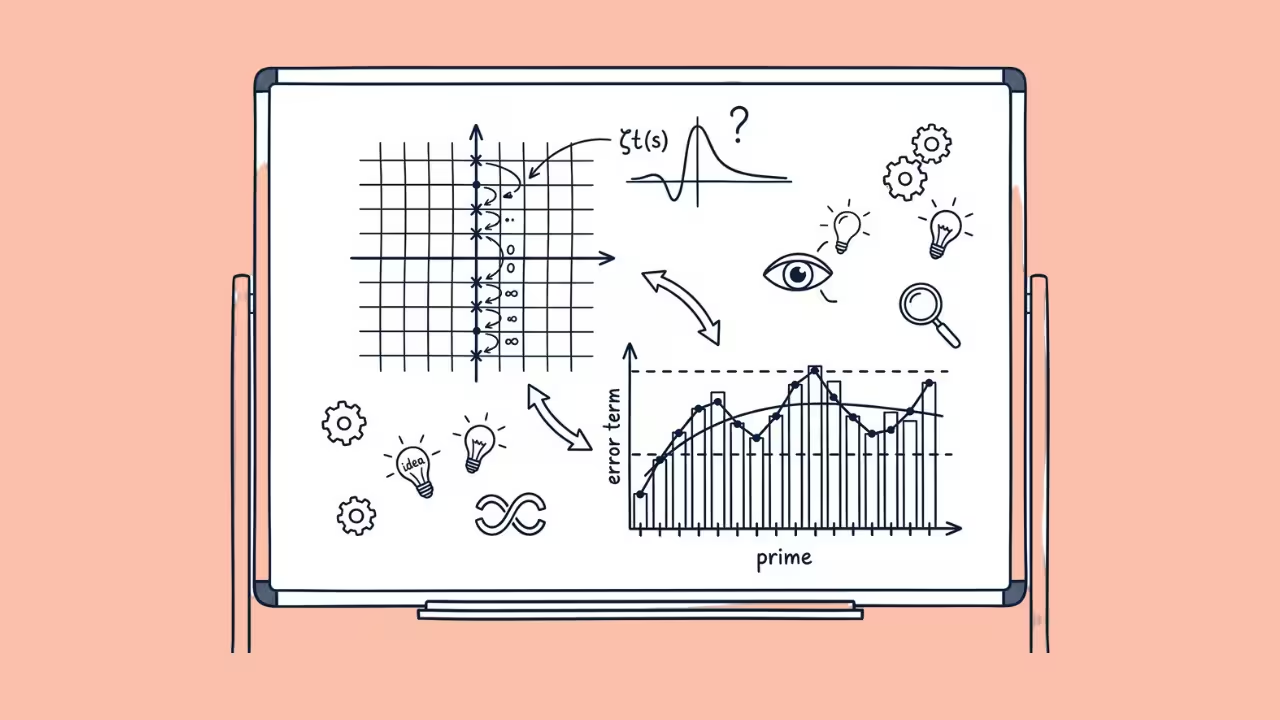

For over a century and a half, one math problem has stumped the smartest minds on Earth. It’s called the Riemann hypothesis.
It deals with how prime numbers are spread out across the number line. Mathematicians have chased a full proof for generations. But nobody has found one yet.
There’s even a $1 million prize waiting for whoever solves it, which is still unclaimed.
But something new just happened. An unreleased Anthropic AI model made progress on this famous puzzle. And the way it happened might be just as surprising as the result itself.

Anthropic’s AI
The model didn’t solve the whole hypothesis, but it pushed the boundary further. It raised the lower bound for which the hypothesis is known to hold. That’s a big deal in math circles.
Anthropic shared the news in a research post on Monday. The company said its model made meaningful headway on one of the hardest open questions in mathematics.
A staff member with no serious math background had given the model a simple prompt. They basically said, “give this a real shot.” Then they stepped back.
The model worked on the problem for about a day and a half, mostly on its own.
The Workflow
The model built a whole team of digital helpers and tested 650 different approaches to the problem.
It coordinated 60 separate subagents, and together, they burned through 31 million output tokens. Each subagent had a different job.
Two of them came up with the actual breakthrough ideas. Thirteen other subagents fed ideas to those two.
Thirty subagents tried to find new angles but came up empty. Another thirteen worked as checkers, testing whether the math held up.
The final two helped write the paper explaining it all. It sounds like a research lab. Except every single “researcher” was the same AI system, split into parts and working together.
Human Oversight
Anthropic didn’t just take the model’s word for it. Two of the company’s in-house mathematicians reviewed the findings by hand.
The result was also verified using Lean, a well-known open-source tool that checks mathematical proofs step by step.
AI models can sometimes sound confident while being wrong. Formal verification tools like Lean catch those mistakes. In this case, the math checked out.
AI and Math
Earlier this year, AI models cracked several Erdos problems, a famous list of open math questions. As models have gotten stronger, their results have gotten more impressive too.
OpenAI recently shared a set of 10 major math results from its internal model, known as Astra.
And in a separate project, Anthropic disproved something called the Jacobian conjecture, another long-standing math puzzle.
AI is starting to touch some of the deepest, oldest problems in the field. And this list of progress isn’t all welcome.
In June, a group of well-known mathematicians signed something called the Leiden Declaration that argued that AI could quietly erode a core value of the field.
Conventionally, a math proof gets credited to a real person. That person takes ownership and stands behind the correctness of their work.
If AI starts producing proofs, who gets the credit? Who takes responsibility if something turns out to be wrong? Those questions don’t have easy answers yet.
Medal Winner
Timothy Gowers, a Fields Medal winner, responded to the Leiden Declaration with a different take.
He wondered if math might simply change in a new direction, and that this change might not be so bad.
He compared it to astronomy. Most stars don’t have names; the vast majority were never named after the people who studied them. Yet astronomy still works, and discoveries are important.
Gowers suggested math could head down a similar path, where the ideas matter more than who gets the byline.
