

The smartest thing Writer did Thursday wasn’t launch a new model. It was publish a research paper proving that the plumbing matters more than the brain.
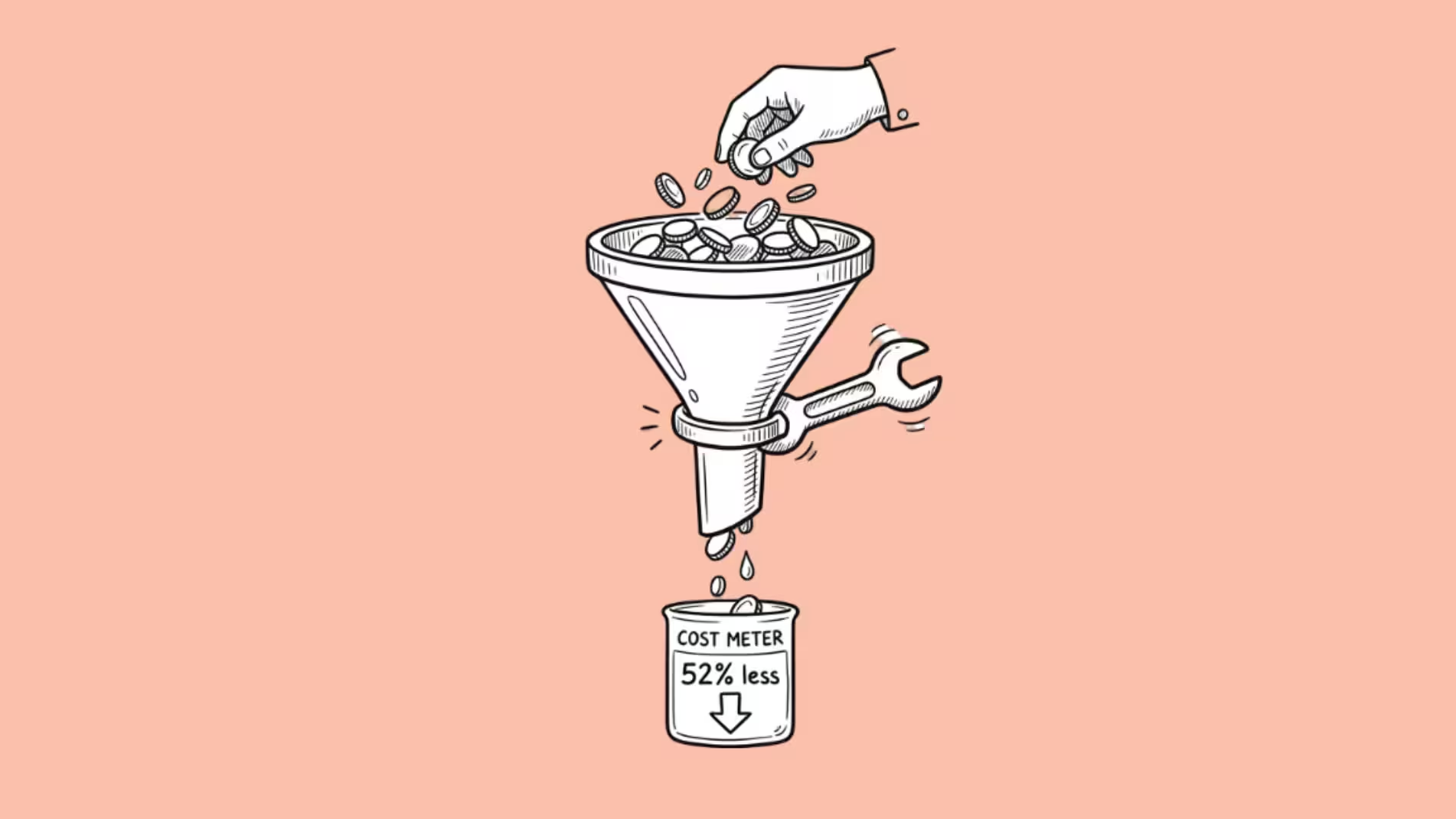
Writer, the enterprise AI platform used by Accenture, Uber, and Vanguard, released its new flagship model Palmyra X6 on Thursday alongside a rebuilt agentic harness that the company says cuts costs by 52%, speeds up tasks by 48%, and improves quality by 10%.
But the headline number hides the more interesting finding.
According to Writer’s own research, published on arXiv last month, changes to the orchestration harness alone cut the blended cost per task by 41% across every model they tested.
Not just Palmyra.
Claude Sonnet 4.6, Gemini 3.1, Gemini Flash 3.5, Qwen 3.6, and GLM 5.1 all got cheaper just by changing how the system assembled context, sequenced turns, and delegated work.
Token consumption per task dropped from 14,200 to 8,800. Cost per task went from 21 cents to 12 cents. Same models. Same tasks. Different plumbing.
“The harness is the one component whose efficiency multiplies across every model an organization runs, present and future,” the researchers wrote.
The Token Spending Problem Nobody Talks About
There’s a pattern Writer calls “token maxing.”
As AI agents get more capable, they use more tokens. Longer reasoning traces. More agent turns. Wider tool payloads. Larger replayed contexts. Per-token prices keep falling, which makes it look like costs are under control.
But total spend rises anyway because the volume of tokens per task grows faster than the price drops.
Enterprise customers are feeling it. “The cost explosion here is just unprecedented for customers,” CEO May Habib told TechCrunch. “And so is the degree to which CIOs are giving up on the labs.”
She didn’t hold back. “I think the enterprise is absolutely sick of chasing the next benchmark. They want flattening cost, and it seems like nobody can deliver that.”
Palmyra X6 Is Built on a Chinese Open-Source Model
Here’s the part that places Writer at the center of an ongoing industry debate.
Palmyra X6 isn’t trained from scratch. It’s a post-training variation of GLM-5.2, the open-weight model from Beijing-based Z.ai (formerly Zhipu AI). Writer discloses this openly and sees it as a strength, not a liability.
The logic: why spend hundreds of millions training a foundation model when you can take a capable open-weight base, post-train it for enterprise use cases, and pair it with a harness that squeezes out waste?
The result is a model that competes with Anthropic and OpenAI on the tasks enterprises actually care about, at a fraction of the deployment cost.
VentureBeat raised the obvious question: if the harness alone delivers most of the savings on any model, why build a model at all?
Writer CTO Waseem AlShikh’s answer was about control. “I cannot control if a lab deprecates their model,” he said.
Owning the model means Writer can guarantee compatibility with its harness optimizations without worrying about upstream changes breaking things.
The Harness Effect Has Limits
The research paper includes a caveat that’s easy to miss.
Sub-agent delegation, one of the harness’s core cost-saving techniques, only works reliably on strong models. In Writer’s testing, only Palmyra X6 (0.86 reliability) and Claude Sonnet 4.6 (0.85) crossed the usable threshold.
Smaller models couldn’t handle the orchestration demands.
The researchers call this “harness leverage.”
The scaffolding only pays off if the model is capable enough to use it. That means the cheapest models on the market won’t benefit from Writer’s approach. You need a certain floor of capability before the plumbing improvements kick in.
Why This Matters Beyond Writer
The broader implication is uncomfortable for the major AI labs. If a rebuilt orchestration layer can cut costs by 40% across any model, then the value proposition of paying premium prices for frontier models gets harder to justify for routine enterprise work.
Writer’s platform remains model-agnostic.
Palmyra X6 sits alongside models from Anthropic, OpenAI, and others imported through Azure or Amazon Bedrock. Customers can pick the best model for each task while the harness keeps costs down regardless.
Habib sees this as the beginning of a shift. The labs have been selling intelligence.
Enterprises are starting to realize they’re paying for waste. “The labs don’t deeply understand right how to help an enterprise get benefit from AI,” she said.
Whether that’s fair or not, the research backs up the core claim. The biggest cost lever in enterprise AI might not be which model you pick. It might be how you run it.
