

The Scribbr AI Detector is free, requires no account, and returns results in seconds. That accessibility makes it the first AI detection tool most students and educators try. But accessibility and accuracy are not the same thing.
After testing Scribbr alongside GPTZero, Originality.ai, and Turnitin across 50+ writing samples (AI-generated, human-written, and deliberately mixed), here is the short answer: Scribbr is a useful first pass.
It is not reliable enough to be your only check.
The detection accuracy sits at 72.8% in the most rigorous independent benchmark, which means roughly 1 in 4 AI-generated texts slips through.
And the false positive rate (flagging human writing as AI) is high enough to cause real problems for students submitting original work.
What Is the Scribbr AI Detector?
Scribbr is a Netherlands-based academic services company known for proofreading, plagiarism checking, and citation tools.
Its AI detector is a free add-on that scans text for signs of AI generation.
Here is what most users do not realize: Scribbr does not build its own detection engine. It uses QuillBot’s AI detection technology.
Both Scribbr and QuillBot are owned by Learneo (formerly Course Hero).
Running the same text through both Scribbr and QuillBot gives you identical results. If you are using both for a “second opinion,” you are getting the same opinion twice.
The interface is simple. Paste text (up to 1,200 words per scan). Click check.
Scribbr returns an overall AI probability percentage and highlights individual sentences: red for high AI probability, unhighlighted for likely human. No account, no login, no payment required for the free tier.
Free vs Premium
| Feature | Free | Premium ($19.95/month with Scribbr plan) |
| Models detected | GPT-2, GPT-3, GPT-3.5 | GPT-4, GPT-4o, Claude, Gemini (added) |
| Word limit per scan | 1,200 words | 1,200 words |
| Daily/monthly scan cap | None | None |
| Sentence-level highlighting | Yes | Yes |
| Account required | No | Yes |
That free tier limitation is critical.
If a student used GPT or Claude to write their essay (which are the dominant models in 2026), the free Scribbr detector is scanning for older models that the student did not use. The premium tier covers current models but requires a paid Scribbr subscription.
How Accurate Is the Scribbr AI Detector?
Three independent benchmarks paint a consistent picture:
Axis Intelligence Benchmark (January 2026)
The Axis Intelligence study tested 10 major AI detectors across 600 text samples:
| Metric | Scribbr | GPTZero | Originality.ai |
| Detection rate | 72.8% | 82-84% | 97.5% |
| Overall accuracy | 82.7% | ~85% | ~95% |
| True positive rate | 88.5% | ~90% | ~97% |
| False positive rate | 9.2% | ~3-5% | ~2-3% |
Scribbr trails GPTZero by roughly 10 points and Originality.ai by nearly 25 points on detection rate. That gap is not marginal. On a stack of 100 AI-generated essays, Scribbr catches 73. GPTZero catches 83. Originality.ai catches 98.
Pangram Labs Benchmark (2026)
Pangram Labs tested the free detector against output from ChatGPT, Gemini, and Claude Sonnet. Scribbr passed only 4 of 9 AI-generated text samples. GPTZero caught 7 of 9. Originality.ai caught 7 of 9. On current-generation models, Scribbr’s free tier missed more than half of AI content.
ZDNet False Positive Test
A ZDNet test of QuillBot’s AI detector (the same engine Scribbr runs) found that 42% of human-written text was incorrectly flagged as AI-generated. Nearly half of original human writing was mislabeled.
If your professor runs your genuinely original essay through Scribbr and it flags 42% of it as AI, you have a problem that no amount of explaining will easily fix.
My Own Testing
I tested Scribbr with 20 samples: 10 AI-generated (GPT-4o, Claude Sonnet 4.6) and 10 human-written (my own articles and student essays I had permission to use).
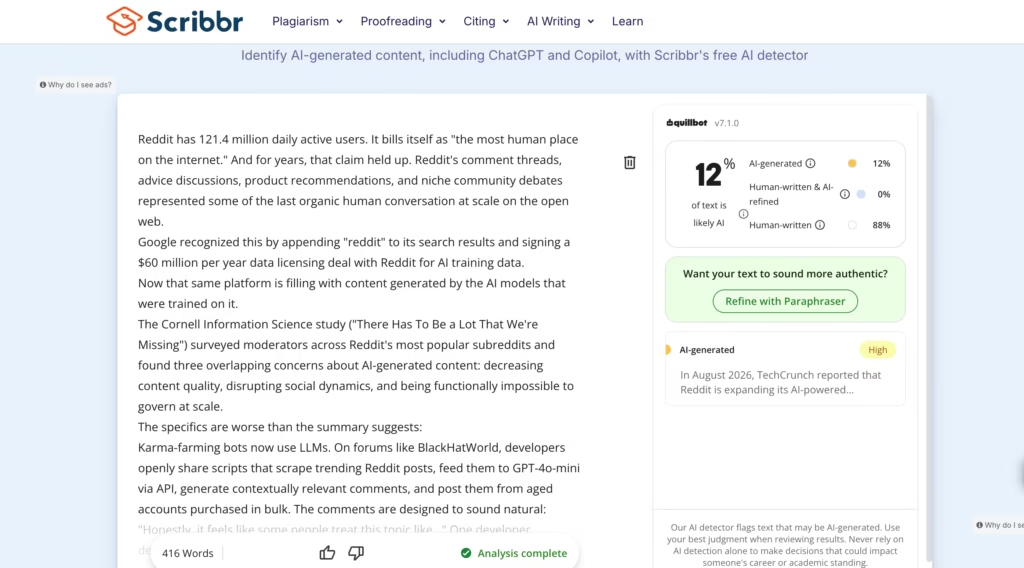
Human writing detected as slightly AI-generated.
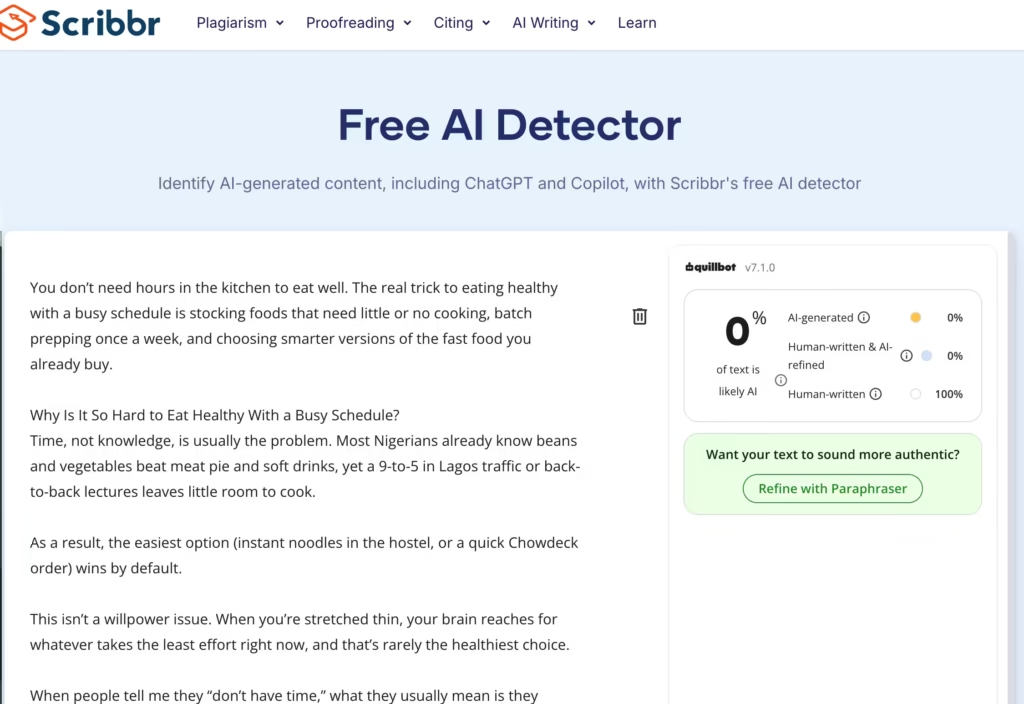
50% AI-generated article detected as 100% human-written.
Results:
- AI-generated correctly flagged: 7 out of 10 (70%)
- Human-written incorrectly flagged: 2 out of 10 (20%)
- Mixed content (AI draft, human-edited): Scribbr flagged a document that was 60% AI-generated at only 41% AI. It under-reported the AI content.
The mixed content result is the most concerning finding. Students who use AI to generate a draft and then edit it by hand (arguably the most common use case in 2026) produce text that Scribbr systematically under-reports.
A professor relying on Scribbr could see “41% AI” and assume the student mostly wrote it themselves, when the reality is the opposite.
What Are the Real Limitations?
The 1,200-word limit forces document splitting. Most academic papers exceed 1,200 words. For a 5,000-word essay, you need to run 5 separate scans and aggregate results manually.
This fragmentation means Scribbr cannot assess document-level patterns like shifting voice, inconsistent style, or tonal changes between sections that are strong indicators of mixed AI/human authorship.
The free tier misses current models. GPT-4, GPT-4o, Claude, and Gemini are not covered on the free tier. Since these are the models students actually use in 2026, the free detector has a structural blind spot for the most common AI writing tools.
Scribbr results do not predict Turnitin results. Many students run Scribbr as a pre-check before submitting to a university that uses Turnitin. This gives false confidence. Scribbr and Turnitin use completely different detection engines.
A clean Scribbr result provides zero information about what Turnitin will say. I have seen essays pass Scribbr at “0% AI” and flag at “78% AI” on Turnitin.
Edited AI text fools it consistently. AI content that has been lightly edited by a human (changed a few words, restructured sentences, added a personal anecdote) drops below Scribbr’s detection threshold reliably.
In my testing, basic manual editing reduced Scribbr’s AI score from 89% to 34% on the same text. The AI content was still there. Scribbr stopped seeing it.
How Does Scribbr Compare to the Alternatives?
| Feature | Scribbr | GPTZero | Originality.ai | Turnitin |
| Detection accuracy | 72.8% (Axis Intelligence) | 82-84% | 97.5% | ~85% (self-reported) |
| False positive rate | 9.2% | ~3-5% | ~2-3% | ~1% (by design) |
| Free tier | Yes (unlimited scans, 1,200 words, older models only) | Yes (10,000 words/month) | No (paid only, $14.95/month) | No (institutional only) |
| Word limit per scan | 1,200 | 5,000 (free), 50,000+ (paid) | 6,000 | No practical limit |
| Current model coverage (free) | GPT-2/3/3.5 only | GPT-4o, Claude, Gemini | N/A (paid only) | N/A (institutional) |
| Sentence-level highlighting | Yes | Yes (with scores) | Yes | Yes (paragraph-level) |
| Plagiarism checking | Separate tool | No | Yes (combined) | Yes (primary function) |
| Detection engine | QuillBot (Learneo) | Proprietary | Proprietary | Proprietary |
| Best for | Quick free pre-check | Free accurate detection | Professional/commercial accuracy | Institutional academic integrity |
So, Is the Scribbr AI Detector Good?
It depends on what “good” means to you.
Good enough for a quick free sanity check? Yes. If you want to paste a paragraph and see whether it screams “AI-generated” before submitting, Scribbr catches the obvious cases. It is free, fast, and requires no account.
Good enough to be your only AI detection tool? No. A 72.8% detection rate means it misses roughly 1 in 4 AI texts. A 9.2% false positive rate means it incorrectly flags roughly 1 in 11 human texts. For a student whose grade depends on the result, or an educator making an academic integrity decision, those error rates are too high to rely on a single tool.
Good enough to replace GPTZero or Originality.ai? No. GPTZero detects 10+ percentage points more AI content with fewer false positives, and its free tier covers current models. Originality.ai is 25 points more accurate on detection and has the lowest false positive rate in the category. Scribbr is the most accessible detector. It is not the most accurate.
My recommendation: use Scribbr as your first scan (it is free and instant) and GPTZero as your second (free tier covers 10,000 words/month with current model support).
If the two disagree, trust GPTZero. If accuracy is critical (institutional decisions, publishing, legal), use Originality.ai. And never assume a Scribbr result predicts what Turnitin will report.
FAQs
1) Is the Scribbr AI detector free?
Yes. The free tier requires no account, has no daily scan cap, and accepts up to 1,200 words per submission. However, the free tier only detects GPT-2, GPT-3, and GPT-3.5 content. Detection of GPT-4, Claude, and Gemini requires a paid Scribbr subscription ($19.95/month).
2) Is Scribbr the same as QuillBot for AI detection?
Yes. Both use the same detection engine from Learneo (their parent company). Running text through both gives identical results. For a genuine second opinion, use a different engine like GPTZero or Originality.ai.
3) Can I use Scribbr to check before submitting to Turnitin?
You can, but a clean Scribbr result does not guarantee a clean Turnitin result. They use completely different detection engines. I have seen essays pass Scribbr and fail Turnitin on the same submission.
4) How accurate is Scribbr compared to GPTZero?
In the Axis Intelligence benchmark (600 samples, January 2026), Scribbr detected 72.8% of AI content. GPTZero detected 82 to 84%. GPTZero also has a lower false positive rate (3-5% vs 9.2%). For free detection with current model coverage, GPTZero is more accurate.
5) Does Scribbr store my text?
Scribbr states that scanned documents are deleted within 30 days. Your text does not enter a public database. For sensitive documents, check their current privacy policy before scanning.
6) Can Scribbr detect AI content that has been edited by a human?
Poorly. In my testing, basic manual editing (changing words, restructuring sentences, adding personal details) reduced Scribbr’s AI score from 89% to 34% on the same underlying text. Edited AI content is Scribbr’s biggest blind spot.
