
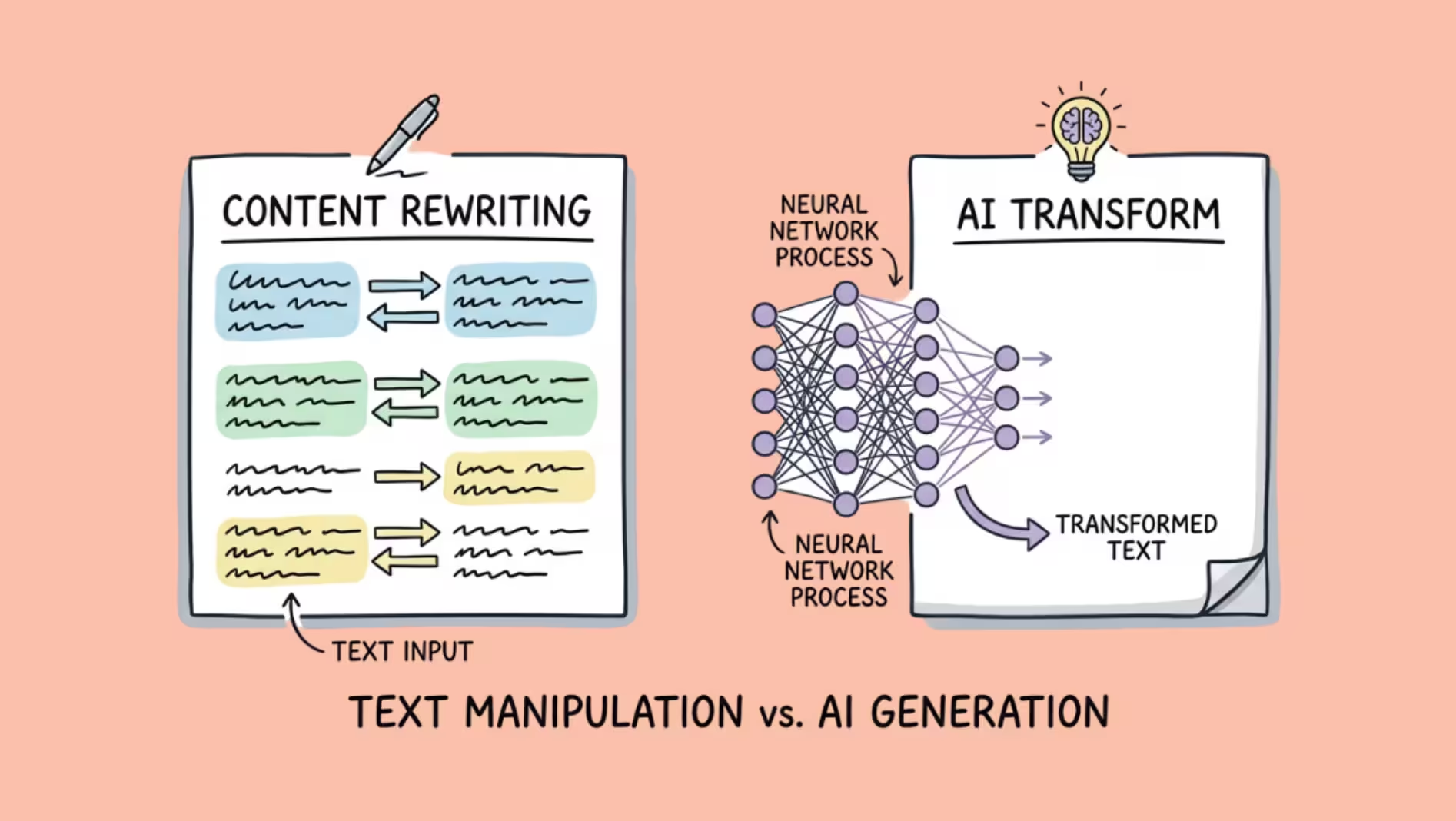

Content spinning swaps words for synonyms to create derivative copies of an existing article.
AI rewriting uses a language model to restate ideas in new sentences, new structure, and often a different voice.
Both start with someone else’s text (or your own draft) and produce a different version of it. But the technical approach, the output quality, and the SEO risk are not the same.
If you are trying to decide which approach fits your workflow – or whether either one belongs in a professional content operation – the distinction is not just semantic.
One of these will get your pages filtered out of search results. The other, used well, is a normal part of how content teams work in 2026.
I run a content operation that publishes multiple articles per week, and I have tested both spinning tools and AI rewriters on the same source material to see what actually comes out the other end.
The difference is not subtle.
How Content Spinning Actually Works
Content spinning is a technique that predates modern AI by a decade.
The original tools used a format called spintax – a markup syntax where you wrap interchangeable words or phrases in curly brackets separated by pipes.
The spinning software picks one option from each set and generates a “unique” version of the article.
Here is what spintax looks like in practice:
{The company|The firm|The organization} {announced|revealed|unveiled} {a new|an innovative|a groundbreaking} {product|solution|platform}.
From that one sentence, a spinner can generate dozens of variations. “The firm revealed an innovative solution.” “The organization unveiled a groundbreaking platform.”
Each version passes a basic plagiarism check because the exact word sequence is different. But the structure, ideas, and information are identical.
Early spinners were crude – they worked from static synonym databases and regularly produced nonsense.
The classic failure case: replacing “Great” in “Great Britain” with “Wonderful Britain” or “Fantastic Britain” because the tool did not understand proper nouns.
Modern spinning tools have gotten better at avoiding those errors, but the fundamental approach has not changed. You are still doing word-level substitution on an existing text.
Some newer spinners advertise “AI-powered” spinning, but in most cases this means they use a lightweight language model to pick better synonyms, not that they actually rewrite the content. The output is still derivative.
The sentence count, paragraph structure, and argument flow of the original article survive intact.
How AI Rewriting Works
AI rewriting uses a large language model – the same type of technology behind ChatGPT, Claude, or Gemini – to read a piece of text and produce a new version. The model does not replace individual words.
It processes the meaning of the input, then generates new sentences that convey the same information in different language.
The technical difference matters. A spinner operates at the word and phrase level: find “announced,” replace with “revealed.”
An AI rewriter operates at the idea level: understand “the company told the public about a new product,” then express that thought in whatever sentence structure the model produces.
The output can have different paragraph breaks, a different opening, a rearranged argument sequence, and sentence structures that look nothing like the original.
This is also what makes AI rewriting harder to detect. Plagiarism checkers compare word sequences.
When an AI rewriter produces entirely new sentences, those checkers find nothing, because the sentences are new.
The ideas are the same, but the language is original in a way that spun content never is.
Tools like Quillbot, Wordtune, Jasper, and dozens of others offer AI rewriting at different quality levels.
The better ones let you control tone, reading level, and how far the output should diverge from the source. The worse ones are functionally just better spinners with a language model bolted on.
The SEO Risk Is Not the Same
Google does not penalize content for being AI-generated.
John Mueller has been direct about this: “I wouldn’t think about it as AI or not, but about the value that the site adds.”
But Google does penalize content that exists to manipulate rankings without adding value – and that distinction is where spinning and rewriting land on opposite sides.
Google’s scaled content abuse policy, updated in March 2024 and enforced aggressively through 2025 and 2026, targets “generating many pages primarily to manipulate search rankings, with little or no value added for users.”
The policy does not care how the content was produced. It cares whether the output is derivative, thin, and published at volume.
Content spinning is almost always derivative by design.
The entire point is to produce multiple versions of the same article. That puts it squarely in the crosshairs of the scaled content abuse policy.
During the March 2026 enforcement wave, sites publishing hundreds of AI-generated or spun pages daily saw traffic losses between 60% and 80%.
AI rewriting occupies a different space. If you take your own draft, rewrite it to improve clarity, adjust the tone for a different audience, or restructure the argument – that is editing.
Every content team does this. The tool you use to do it (a human editor, a language model, or both) does not matter to Google. What matters is whether the output adds value.
But here is the line: if you take someone else’s article, run it through an AI rewriter, and publish the output as your own – that is still content theft.
The rewriter made the plagiarism harder to detect, but the value proposition is identical to spinning. You are publishing someone else’s ideas in rearranged sentences.
What Each Approach Gets You
I ran the same 800-word article through three spinning tools and two AI rewriters to compare outputs directly.
The spinners produced text that was structurally identical to the original. Same number of paragraphs. Same argument order. Same examples, just described with different words.
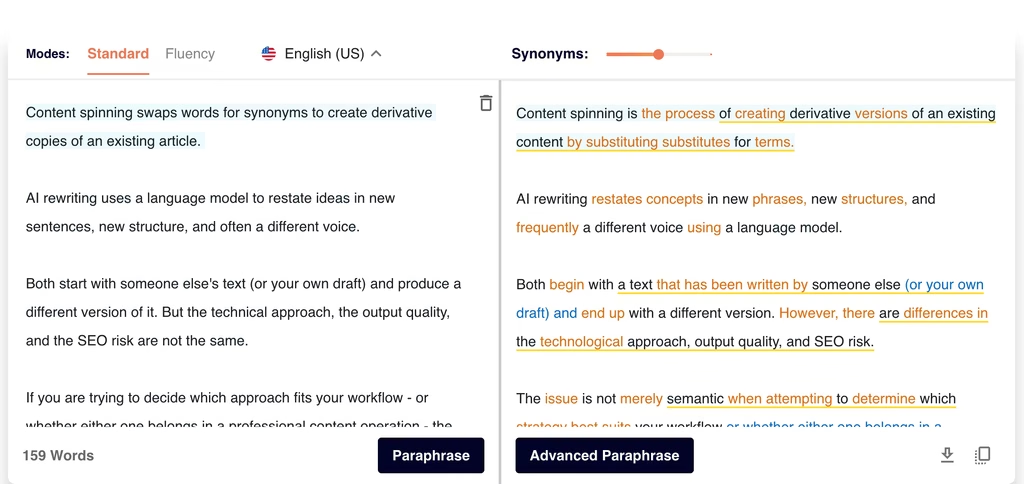
One spinner hit 67% similarity to the source on a Copyscape check. Another managed 41%, which sounds better until you read the output and realize the lower similarity came from garbled phrasing, not genuine rewriting.
The AI rewriters produced text that read like a different article on the same topic. Different opening angles. Rearranged sections.
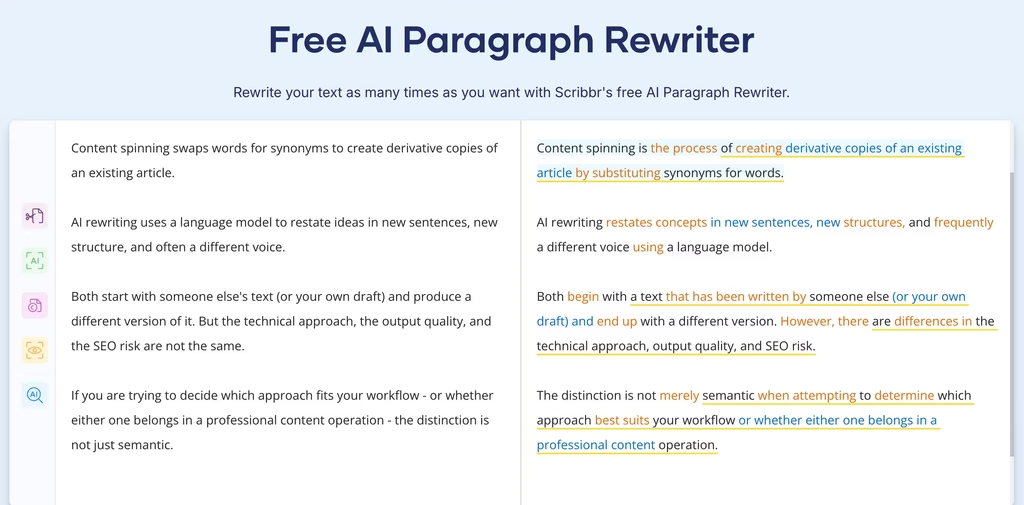
One of them combined two paragraphs from the source into a single, tighter paragraph and split another one in two. The similarity scores came back under 15%.
But the factual claims were the same, because both tools were working from the same source material.
Neither approach creates original reporting, original data, or original analysis. They both transform existing text. The difference is in how deep the transformation goes.
When AI Rewriting Makes Sense (and When It Does Not)
There are legitimate uses for AI rewriting that have nothing to do with gaming search engines:
Repurposing your own content. You wrote a long-form blog post and need a shorter version for a newsletter. You wrote a technical document and need a version for a non-technical audience. AI rewriting handles both of these well.
Improving drafts. A first draft that is structurally sound but wordy or unclear can be tightened by running it through a rewriter with instructions to simplify. I do this regularly with early drafts that have the right information but the wrong rhythm.
Localization. Adjusting content for different regional audiences – not just translating, but adapting references, examples, and tone – is a rewriting task that AI handles faster than a human editor in most cases.
Updating published content. A 2024 article that needs a 2026 refresh can be partially rewritten to incorporate new data and remove outdated sections. The AI rewrites the stale parts while keeping the sections that are still accurate.
Where AI rewriting does not make sense: producing “unique” versions of other people’s articles to rank for their keywords.
That is spinning with extra steps, and Google’s systems are increasingly good at recognizing when a page adds nothing new to a topic regardless of how different the surface-level text looks.
Content Spinning Is Not Coming Back
Some SEO forums still debate whether AI-powered spinning can evade detection. It can, briefly.
A well-tuned language model can produce spun versions that pass plagiarism checkers and AI detectors simultaneously. But detection is only one layer of defense.
Google’s quality classifiers do not just check whether your text matches another page. They evaluate whether your page adds value to the search results.
A spun article that passes every detector still has no original data, no expert perspective, no unique examples, and no reason to exist beyond ranking for a keyword. Quality classifiers catch that pattern whether the text looks “original” or not.
The March 2024 spam policy update was the formal acknowledgment of something that had been happening algorithmically for years: derivative content, however it is produced, gets less visibility over time.
Spinning accelerates the production of derivative content. AI rewriting, used poorly, does the same thing. The tool is not the problem. The intent is.
Research from Ahrefs found that only about 13.5% of top-ranking pages are purely human-written. The rest use AI at some stage – drafting, editing, expanding, or restructuring.
But the pages that rank are the ones where AI assisted a human editorial process, not the ones where AI replaced it.
The Practical Difference in One Sentence
Spinning creates copies. Rewriting creates drafts that still need a human to add the parts that make content worth reading: original data, earned opinions, specific experience, and editorial judgment.
If you are using AI rewriting as a step in your editorial process – between research and publication, with a human adding value before and after – you are using the tool the way it works.
If you are using either spinning or rewriting to skip the editorial process entirely, the output will look like it, and Google will treat it accordingly.
FAQs
Is AI content spinning illegal?
Content spinning is not illegal, but it often violates copyright when used on someone else’s work. Changing words does not create a new copyrighted work – the underlying expression and structure still belong to the original author.
Google also classifies mass-produced spun content as spam under its scaled content abuse policy, which can result in pages being removed from search results entirely.
Can Google detect AI-spun content?
Google does not need to detect spinning specifically. Its quality classifiers evaluate whether a page adds value to the search results. Spun content, by design, adds no new information, perspective, or data. Even if the text passes plagiarism checkers, the lack of original value means spun pages trend toward lower visibility over time, and bulk spinning triggers scaled content abuse enforcement.
Is AI rewriting the same as paraphrasing?
They overlap but are not identical.
Paraphrasing restates a specific passage in different words while keeping close to the original meaning and length. AI rewriting can go further – restructuring arguments, changing the angle, combining or splitting sections, and adjusting tone.
The better AI rewriters operate at the idea level rather than the sentence level, which produces output that reads more like a new draft than a rewording.
What is the best AI rewriting tool?
It depends on what you need. Quillbot is the most widely used for sentence-level paraphrasing. Wordtune is stronger at maintaining natural voice.
Jasper and Claude handle longer-form rewriting where you want structural changes, not just word substitution. For a deeper comparison, see our look at whether AI paraphrasing tools still work.
Should I use AI rewriting for SEO content?
AI rewriting is fine as a step in your process – improving drafts, repurposing your own content, adjusting tone for different audiences. It becomes a problem when you use it to create “unique” versions of other people’s content, which is functionally the same as spinning regardless of the tool quality. Google evaluates whether your page adds value, not whether the text is technically unique.
