
Alan Turing spent his life testing the limits of machines and minds, and he’s famous for his test on artificial intelligence.
But his real claim to fame came earlier. He broke Nazi Germany’s Enigma code during World War II.
Now, more than 80 years later, two brand-new AI models just did something Turing would have found stunning. They cracked Enigma messages that no human had ever solved.
Two Codes
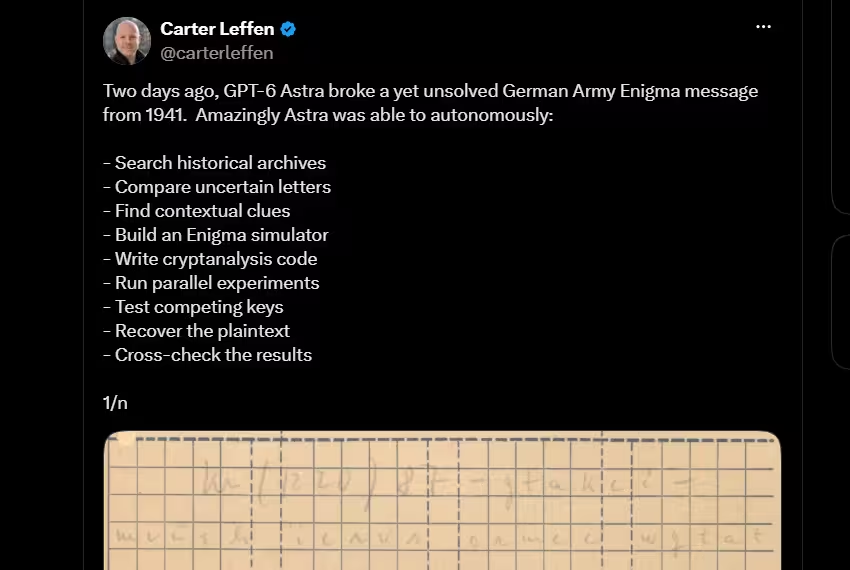
The story starts with a developer named Carter Leffen. He had access to OpenAI’s newest model, Astra. So he gave it a strange task. Find an unsolved Enigma message. Then break it.
Astra dug through archives on its own; It found context clues buried in old records and even built its own working simulator of an Enigma machine.
Then, piece by piece, it cracked a message that had puzzled researchers since 2005.
Leffen also used Astra to build a website. It explains the entire process, start to finish, for anyone curious. Meanwhile, something similar happened on the other side of the AI world.
A cybersecurity expert named Jack Willis used Anthropic’s Claude Opus 5 model to tackle a different unbroken message.
Willis gave Claude more hands-on guidance than Leffen did with Astra. Still, the results were good. Claude used the known signature of a specific officer’s name to unlock the code.
Verification
Frode Weierud, a retired electrical engineer, verified the work of both models. Weierud has spent much of his life fascinated by codes and ciphers.
He runs a website called Crypto Cellar that’s packed with historical records, tools, and a database of Enigma messages, both solved and unsolved.
Last week, Weierud confirmed that Leffen’s solution was correct. He said the achievement left him in awe.
Weierud pointed out something odd in Astra’s research logs. The model referenced a “private collection” of archived messages. These aren’t hosted on Weierud’s site at all.
Nobody knows for sure how Astra found them. Weierud has a few guesses. Maybe another researcher shared them somewhere online.
Or maybe the model tapped into Germany’s public government archives on its own.
Either way, it makes us wonder how far AI will go to solve a problem it’s given. In this case, pretty far.
Weierud compared Astra’s work ethic to that of a skilled human expert. He said the model acted like a professional cryptanalyst and archive researcher.
What it pulled off in just two days, he explained, would normally take a human weeks or even months.
That comparison carries weight. Weierud speaks from experience. He said he personally spent several weeks digging through the same German archive files that Astra referenced.
Mysteries
Weierud says just seven enigma messages remain uncracked. Researchers already know what that message says. But nobody has figured out the actual code used to encrypt it.
Turing cracked Enigma with a room full of brilliant minds and an early computer called the Bombe. It took years of grinding work and constant setbacks.
Today’s AI models did something comparable in a matter of days.
That doesn’t erase what Turing and his team accomplished. Their work changed the course of history. But it does show how far technology has come since then.
The remaining Enigma messages once seemed like permanent mysteries. Now, they look more like a countdown.
