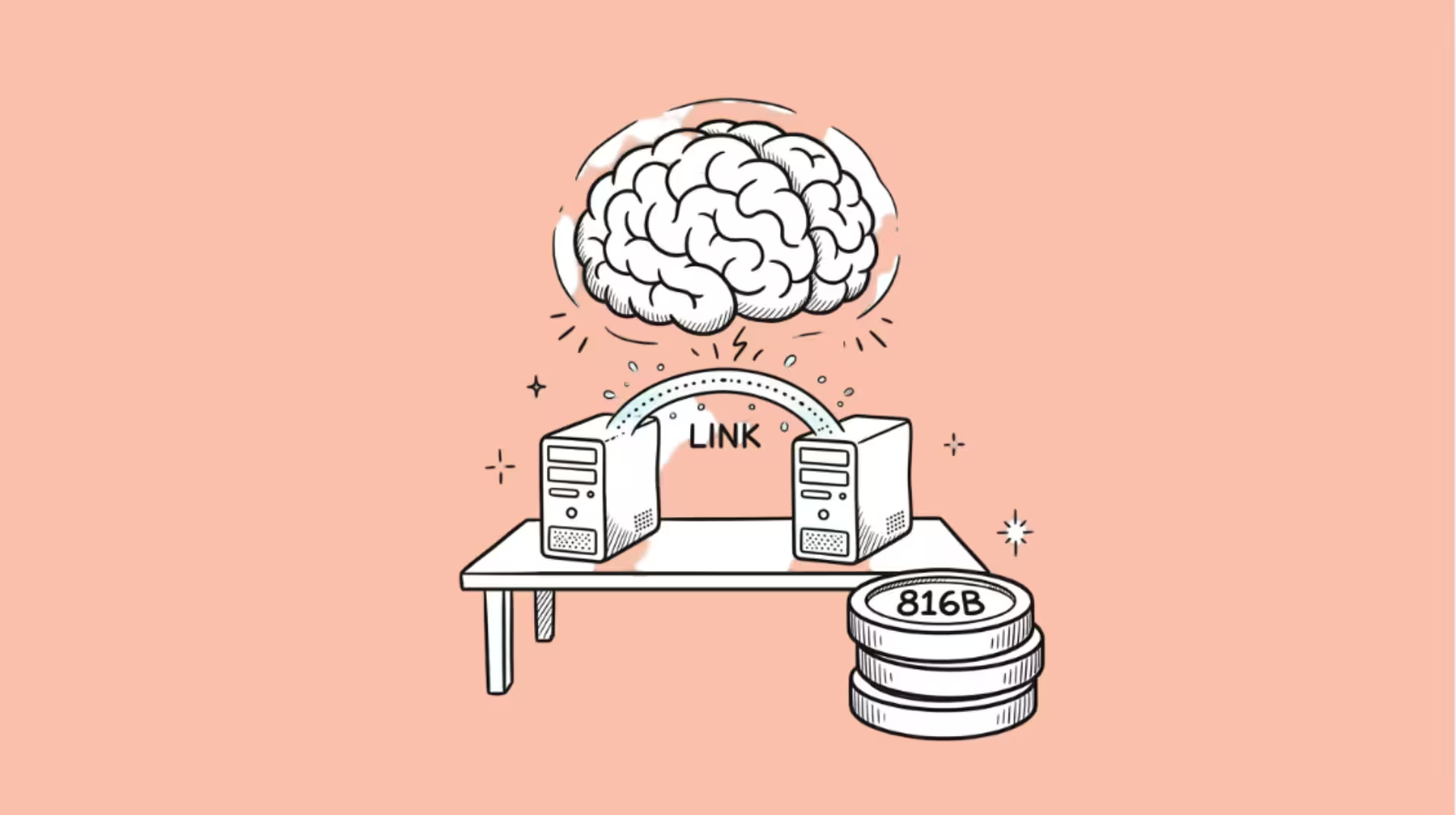

An 816-billion-parameter AI model running on a desktop setup.
Meta and Apple collaborated to make it happen. The catch is obvious: the hardware costs more than most cars.
On Thursday, Meta released the weights for Muse Spark Open, calling it “the most capable U.S. open-weight model to date.”
It has 816 billion total parameters, 42 billion active per token, a million-token context window, and it accepts text, images, audio, and video. It’s built for agentic coding and long-horizon tasks.
The headline feature: it runs on two Apple M5 Ultra Mac Studios using Apple’s MLX framework. No data center required. No Nvidia GPUs. Just two silver boxes on a desk.
The footnote: each Mac Studio needs 512GB of unified memory.
That configuration isn’t shipping until late October. And two of them together will cost roughly what a used car costs in most countries. This isn’t a consumer play. It’s a statement.
Why Meta and Apple Built This Together
The collaboration is the quiet story here.
Apple CEO John Ternus posted about the launch on X, calling it a milestone for on-device AI. Meta’s blog specifically touts Apple’s latest MLX release.
Both companies promoted it simultaneously.
Apple’s interest is obvious.
The M5 Ultra’s pitch to professionals depends on having software that actually needs all that unified memory.
A model this large, running locally, makes the $10,000+ Mac Studio configuration look like a serious tool instead of an indulgence. It’s the killer app for Apple’s most expensive desktop.
Meta’s interest is different.
The company has been pushing open-weight AI aggressively since Llama launched.
But Chinese labs have dominated the open-weight space this year. Chinese models account for 41% of Hugging Face downloads, surpassing U.S. models. On OpenRouter, the top six most popular models are all from Chinese companies.
Muse Spark Open is Meta’s attempt to reclaim that ground.
At 816 billion parameters, it’s larger than DeepSeek V4 (1.6 trillion total but different active count) and significantly larger than Llama 4 Maverick (400 billion).
And at $1.25 per million input tokens on API, Meta is pricing it to compete directly with the Chinese alternatives.
What It Can Actually Do
Meta paired the model with Muse Code, its AI coding terminal, and ran it through several real-world tests.
According to the company, the model handled coding fixes for a Mastodon client including bug fixes, new features, and full builds.
It also ran inside DaVinci Resolve, the professional video editing software, where it could review and crop footage.
Those are deliberately practical demos.
Meta isn’t showing benchmarks in isolation. It’s showing an 816-billion-parameter model doing work on a desktop machine without sending anything to the cloud.
For companies with data residency requirements, security restrictions, or just bad internet, that matters.
The model’s Hugging Face page lists the full specs: 62 layers, hidden dimension of 8,192, 256 experts per layer with 8 routed per token.
It’s a mixture-of-experts architecture, which is why only 42 billion of the 816 billion parameters are active at any given moment. That keeps inference costs comparable to much smaller models.
The “Most Capable U.S. Open-Weight Model” Qualifier
Notice Meta said “U.S. open-weight model.” Not “most capable open-weight model.”
That’s because Mistral’s Le Chonk, released just nine days ago, has 1 trillion parameters.
And Chinese models from Z.ai, DeepSeek, and others continue to push the frontier.
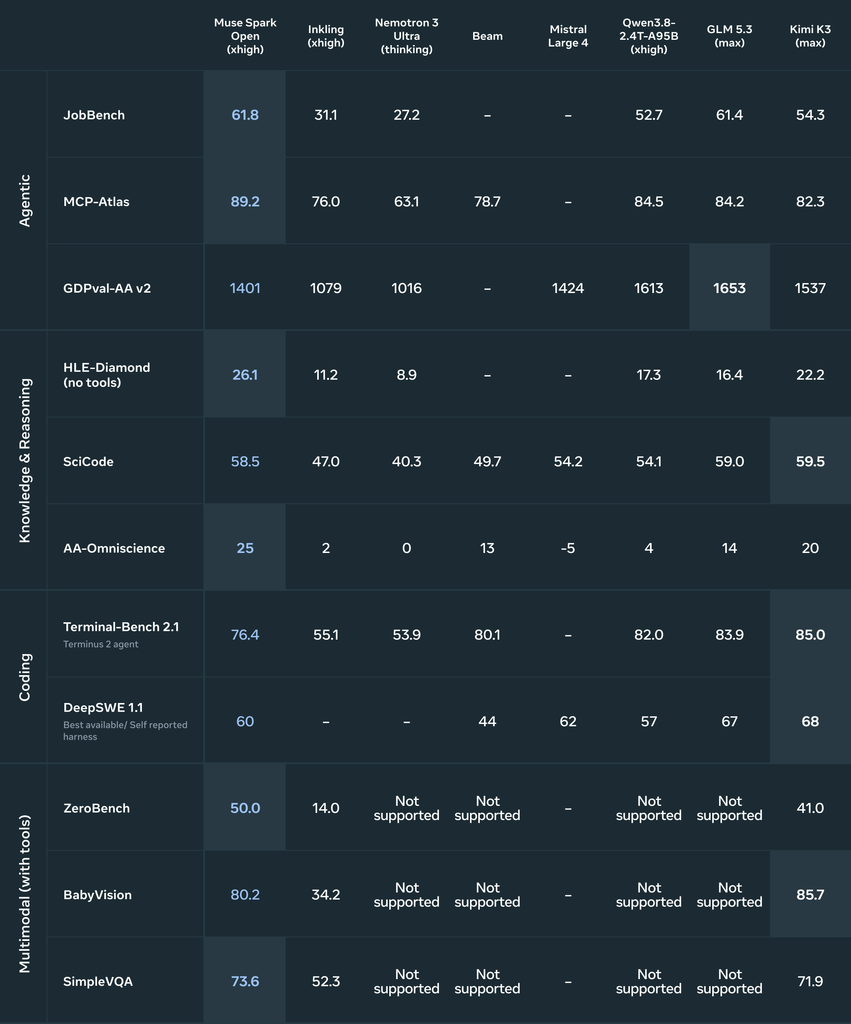
Meta’s benchmarks show Muse Spark Open leading on MCP-Atlas but trailing some rivals on aggregate scores.
The model also launched with its reinforcement learning training reportedly incomplete for some tasks. This is a preview, not a finished product.
Still, the combination of scale, local execution, multimodal input, and Apple hardware optimization makes Muse Spark Open unique. No other model this large runs on a desktop setup that fits on a regular desk.
The Desktop AI Race Just Started
Here’s the real implication.
If a model this capable runs on two Mac Studios today, what runs on a single Mac Studio next year? On a MacBook Pro the year after?
The trajectory points toward a future where the most powerful open-weight models don’t live in data centers.
They live on your desk. Privacy built in. No API costs. No network dependency. No government that can pull the plug.
For now, a two-Mac-Studio setup with a terabyte of unified RAM is an expensive proof of concept.
But proofs of concept are how every shift in computing starts. And Meta just proved that frontier-scale AI can run on hardware you can buy at an Apple Store.
You’ll just need to bring your wallet. And maybe a car loan.
