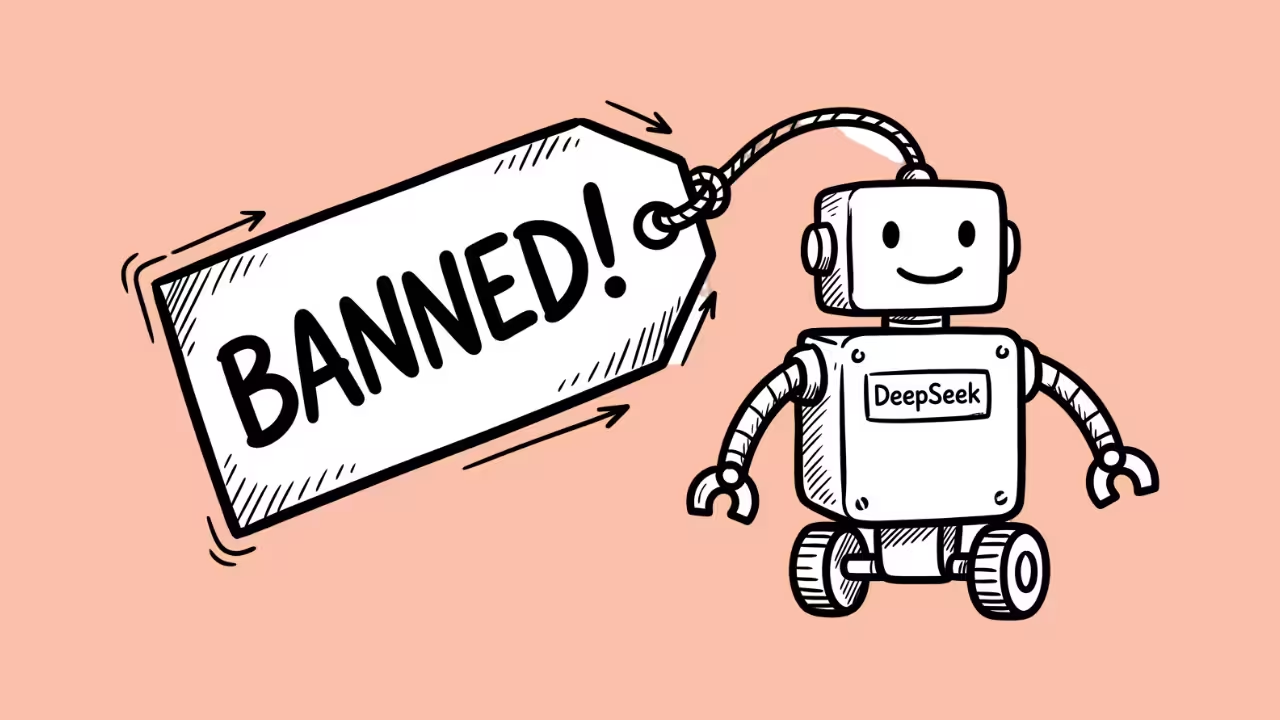

On Tuesday, October 20, 2026, the Department of Homeland Security (DHS) ordered federal civilian agencies to stop buying products and services from DeepSeek, the Chinese AI startup.
Agencies must also remove any DeepSeek tools already running on government computer systems.
The reason for this is national security worries tied to the company’s operations in China.
The Order
The order doesn’t just target DeepSeek’s own chatbot or apps. It also covers third-party products and services built on DeepSeek technology.
Many software companies build their tools on top of existing AI models. So if a vendor quietly used DeepSeek under the hood, that product now falls under the ban too.
However, agencies can ask for exceptions if they have a strong reason.
User Data
Data is at the center of this development. According to the order, DHS fears that sensitive information from U.S. government users could end up in the hands of Chinese authorities.
Under Chinese law, companies based in China may be required to share data with the government.
For instance, a federal worker types a question into an AI tool. That question might include details about a project, a policy, or a person.
If that data travels to servers tied to China, U.S. officials worry it could be accessed by Beijing.
For security officials, that’s simply too big a risk to take.
China
Speaking at a briefing on Tuesday, Chinese Foreign Ministry spokesperson Mao Ning said China opposes what it sees as the U.S. stretching the idea of national security too far.
She also accused Washington of turning technology and trade issues into political fights.
She added that China “will resolutely safeguard the legitimate rights and interests of Chinese enterprises.”
China has put out similar response patterns whenever the U.S. has restricted Chinese tech firms in the past.
DeepSeek
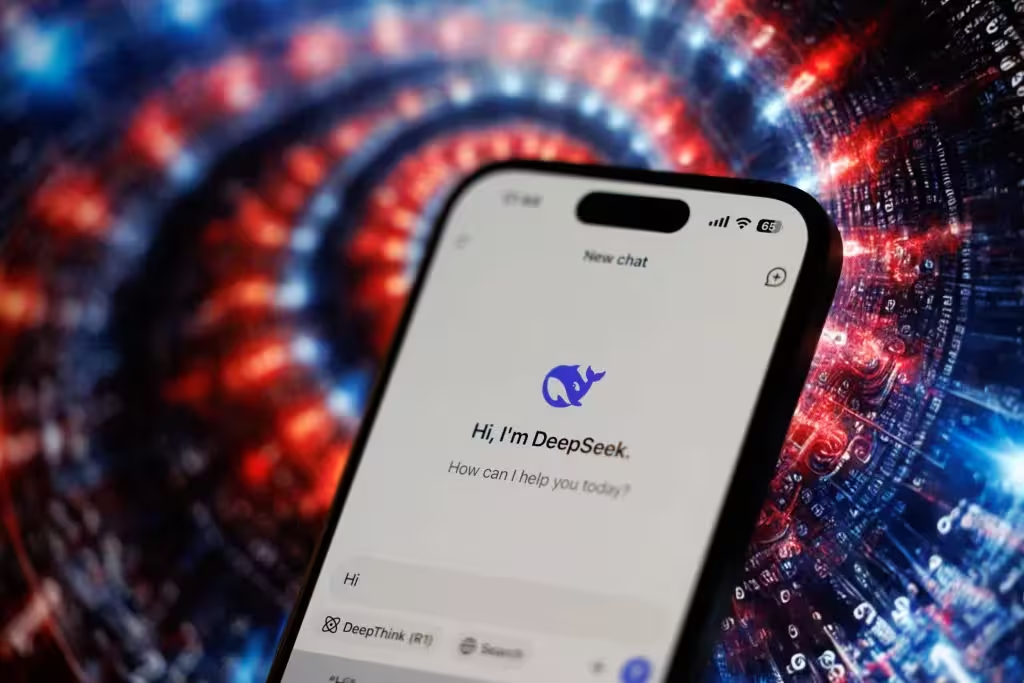
Actually, this order builds on earlier steps. Back in December 2025, Congress passed a law that targeted DeepSeek’s use in national security systems within the intelligence community.
Now, the latest order widens those limits to cover federal civilian agencies as well. Many other government bodies have acted on their own long before this.
In January 2025, Texas became the first state to outlaw DeepSeek when Governor Greg Abbott ordered state agencies to block websites connected to the People’s Republic of China.
The Navy also barred service members from using DeepSeek in any form, citing security and ethical concerns.
In February 2025, Australia’s Department of Home Affairs also adopted an order blocking DeepSeek products and applications on government systems and mobile devices.
Canada also restricted the chatbot on some federal mobile devices, citing serious privacy concerns.
DeepSeek’s Disruption
To understand why governments care so much, you have to go back to January 2025, when DeepSeek released its R1 reasoning model.
It sent shockwaves through the tech industry almost overnight. That’s because the model showed that a Chinese lab could compete with top U.S. players at a fraction of the cost.
Investors panicked. Nvidia, the chipmaker at the center of the AI boom, saw its shares drop sharply in a major sell-off.
Since then, DeepSeek has kept challenging American rivals like OpenAI and Meta. Its big selling point is low-cost, open-weight models.
“Open-weight” simply means developers can download the model and run or tweak it themselves. That makes it cheap and flexible, and it’s a big reason the tool spread so quickly.
DeepSeek is based in Hangzhou, China, and its CEO also created High Flyer, a hedge fund reported to be the startup’s sole funder.
Distillation
There’s another layer to this story. In a September report, the U.S. accused DeepSeek and five other Chinese AI companies of using large-scale “model distillation” to pull information from American AI systems.
Alibaba and Moonshot AI were among the companies named.
Distillation is a shortcut. One AI model learns by studying the answers another model gives.
Instead of building knowledge from scratch, the newer model copies the behavior of a more advanced one. Two major U.S. AI companies have raised alarms about this separately.
OpenAI told U.S. lawmakers earlier this year that it had spotted suspected attempts by DeepSeek to distill its models.
Anthropic said it had found unauthorized attempts by DeepSeek and other Chinese AI labs to collect outputs from its Claude models.
If those claims hold up, critics argue that some of DeepSeek’s low-cost success came from borrowing work done by American firms.
China’s Restrictions
Last week, Bloomberg reported that China is weighing export restrictions on 23 AI-related technologies.
The list reportedly includes chip designs and certain advanced AI models to address security and misuse risks.
So while Washington moves to keep Chinese AI out of its systems, Beijing may soon limit which of its own AI tools can leave the country.
