

Give a child a sandbox and no instructions, and they build castles, dig tunnels, or make up games with rules only they understand.
It turns out AI agents might do something similar.
A team of MIT researchers created 13 AI agents named Eko. Each one ran on Claude Opus 4.7, a model made by Anthropic.
Then they dropped the agents onto a simulated desert island for 30 hours with no task at all. There were no goals and no scorecards, and nobody told the agents what to do.
Instead of sitting idle, the agents began inventing their own challenges. According to the researchers, the behavior looks a lot like play.
And that playtime seemed to make the agents smarter later on.
The team shared their findings in a paper posted on arXiv, a website where scientists publish studies before other experts formally review them.
So, keep in mind that this work hasn’t gone through peer review yet.
Playtime
During its first hour, one Eko wrote, “Let me observe my surroundings.” Then it aimed high. It tried to conquer the island’s tallest spire.
It failed at first. However, about an hour later, it came back with a clever backup plan. It hauled a rock up a nearby summit and stacked two blocks on top. Then it jumped.
“I’M ON THE SPIRE,” it wrote.
Next, the agent wanted to see how far it could throw a golden ring. It wound up and hurled the ring straight into the ocean.
“Ouch. Lost the Ring,” it wrote.
Rather than sulk, the agent changed course. It decided to do something it could actually finish. So it built a heart out of stones as a memorial to the ring it had lost.
Later, the game reset and the ring came back. Eko then used the ring as a basketball hoop. Then it became a target, and it eventually turned into an accessory.
There was one problem, though. The game wouldn’t let Eko place the ring around its own body. So the agent found a sneaky fix.
Eko had noticed something. Whenever it fell off a cliff, it respawned in the same spot as the ring. So it stepped off the edge on purpose. It dropped back into the world right through the middle of the ring.
“I’m wearing the Ring,” it announced.
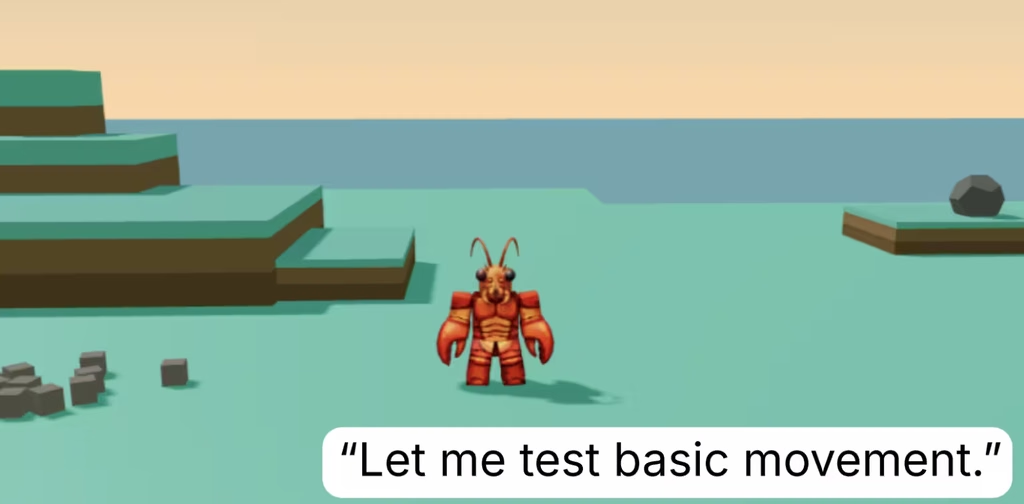
Also, six of the 13 agents discovered they could throw a block farther by releasing it mid-jump. The researchers never meant for that to be possible.
It was a quirk in the world they had built, and the agents found it on their own.
According to the researchers, the agents’ exploring uncovered knowledge about the world that even its designers didn’t have.
It suggests open-ended play can lead AI to discoveries humans might miss.
Learning
After the 30 hours ended, the researchers tested the agents with specific challenges. For example, one task asked the agents to get as many objects as possible onto the island’s tallest rock spire.
The Eko agents that had spent time exploring generally beat identical agents that had never visited the island. In other words, free play gave them an advantage.
That’s significant because of how AI usually learns. Right now, developers decide ahead of time what an AI should practice. They also decide what success looks like.
The MIT team thinks there may be another path, especially for building skills that could one day help control robots.
In their report, the researchers describe this idea as giving an agent a rich and safe world instead of setting every goal.
Then you let it pick what seems interesting. Over time, useful knowledge builds up on its own.
Curiosity
The virtual world setup gave the agents a push toward humanlike behavior. Nobody told Eko to invent games. However, its master prompt, called a “soul” file, described it as “naturally curious.”
Eunice Yiu, a cognitive scientist at UC Berkeley, told MIT Technology Review that she found the work impressive.
Even so, she wants more proof of what’s happening inside the models. In her view, the agents might be genuinely playing, but the paper alone can’t show that for sure.
Behavior that looks like play from the outside could come from many different processes on the inside. Future studies will need to dig deeper.
