
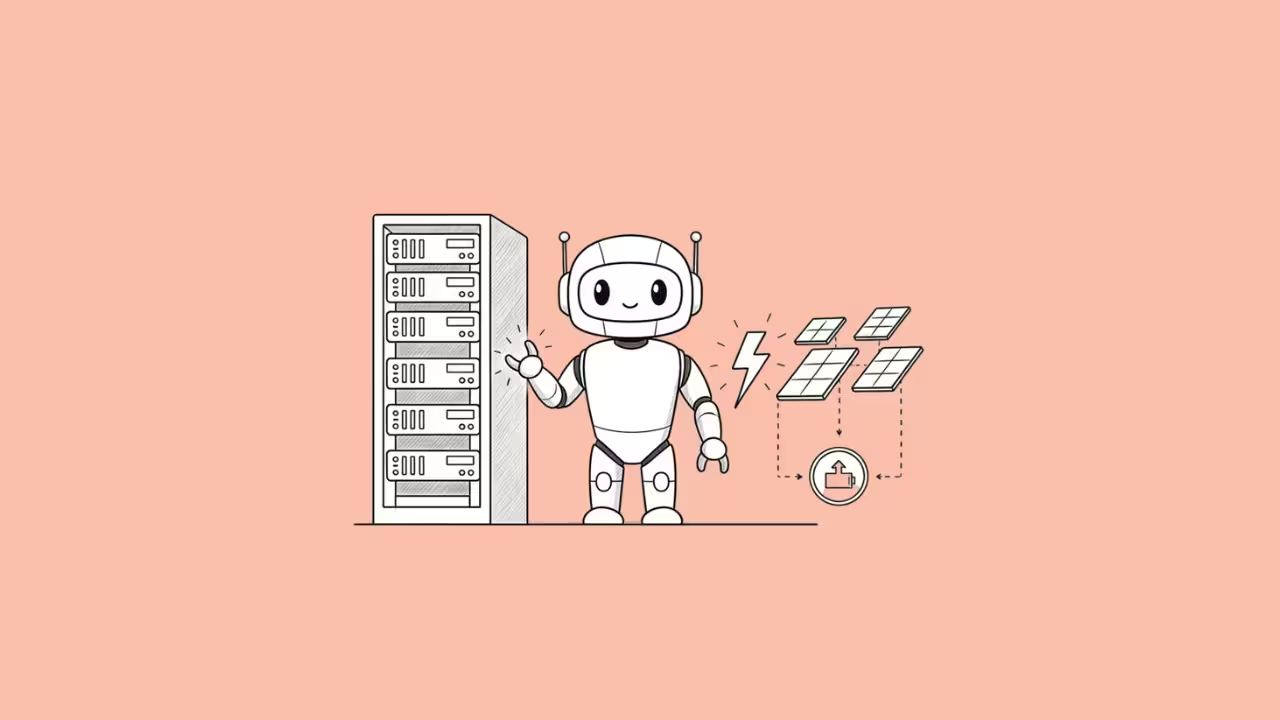

So there’s something most people don’t realize.
Every time you use AI, somewhere in the world, a massive data center is burning through enough electricity to power a small town.
For instance, studies have shown that answering just one question on ChatGPT consumes approximately 3wh of electricity.
I’m not trying to scare you off from using AI.
Trust me, I love the technology as much as you do.
But we need to talk about the elephant in the room, or should I say, the power-guzzling beast in the server farm?
Why Does AI Eat So Much Power?
1. The Training Phase
Training an A.I. model is pretty much akin to teaching a toddler how to talk, except this toddler has to read every book in the Library of Congress about 50 times over.
During training, AI systems process massive amounts of data using thousands upon thousands of powerful processors running in parallel.
GPT-3, for example, consumed about an estimated 1,287 megawatt-hours of electricity in training alone, according to research from Google and UC Berkeley.
That’s enough energy to power an average American home for about 120 years. Please feel free to read that again, and let it sink in for a second.
2. The Inference Phase
Even after training, every time you ask an AI a question, you’re triggering what’s called “inference” – the process where the AI uses its training to generate a response.
One query might not use much power, but multiply that by millions of users making billions of requests daily, and it adds up fast.
Here’s a comparison:
| Activity | Estimated Power Consumption |
| One Google search | 0.3 watt-hours |
| One ChatGPT query | 2.9 watt-hours |
| Streaming one hour of Netflix | 0.8 kilowatt-hours |
| Training GPT-3 (one time) | 1,287,000 kilowatt-hours |
Can you see how a single AI query uses almost 10 times more power than a Google search?
Now imagine how many ChatGPT queries happen every single day.
The Effects of AI and Power Use on the Real World
What does AI and power consumption actually mean for our planet?
Data centers already account for about 1-2% of global electricity use. If you think that doesn’t sound like much, it might help to know that’s roughly equivalent to the entire country of Spain’s annual energy consumption.
And with AI exploding in popularity, the International Energy Agency projects this could reach just under 3% by 2030.
The Water Problem
AI doesn’t just need electricity. It needs water. Lots of it.
Those massive data centers running AI models generate incredible amounts of heat. To keep the servers from literally melting, companies use water-based cooling systems.
Microsoft’s data centers alone consumed about 1.7 billion gallons of water in 2021, enough to fill over 2,500 Olympic-sized swimming pools.
In places like Arizona and Nevada, states already dealing with water shortages, new data centers are creating serious tension between tech companies and local communities.
Can you blame people for being upset?
Who Are the Biggest Energy Hogs?
With power consumption, different AI consume energy at different rates. Some applications are way worse than others.
The Heavy Hitters:
- Large Language Models (LLMs): GPT-5, Claude, Gemini, these conversational AIs are power houses
- Image Generation:Midjourney, Stable Diffusion need some serious computing power
- Video Processing AI: Deepfakes and video enhancement tools are incredibly energy-intensive
- Autonomous Vehicles: These employ powerful onboard processing to process sensor data that is constantly generated by self-driving cars.
The More Efficient Players:
- Recommendation Algorithms: Netflix and Spotify use AI, but it’s relatively lightweight
- Spam Filters: Your email’s AI guardian doesn’t need much juice
- Voice Assistants: Siri and Alexa use power, but they’re optimized for efficiency
- Basic Image Recognition: Face unlock on your phone is surprisingly efficient
What’s Being Done About This Energy Crisis?
Good thing people are actually working on this problem.
And some of the solutions are pretty clever.
1. Smarter Chips
Tech companies are developing specialized AI chips that do more work with less energy.
Google’s Tensor Processing Units (TPUs) and Apple’s Neural Engine are designed specifically to run AI tasks efficiently.
2. Renewable Energy
Major AI companies are investing heavily in renewable energy.
Microsoft, Google, and Amazon have all committed to running their data centers on 100% renewable energy.
But here’s the catch: “committed to” and “actually doing it” are two very different things. Most are still years away from hitting those targets.
3. Edge Computing
Instead of sending every request to a massive data center thousands of miles away, edge computing processes AI tasks locally, on your phone, your laptop, or nearby servers.
This cuts down on transmission power and makes things faster. Win win.
What Can You Do?
I know what you’re thinking: “I’m just one person. What difference can I make?”
Actually, quite a bit.
1. Make Smart Power Choices
We can’t dictate how A.I. companies govern their data centers, but we can control our own personal energy consumption. Try having backup power enabled that’s powered by renewable resources when working with AI tools.
For instance, a good solar generator or dependable power station can keep your devices running during power outages while reducing your carbon footprint.
It’s just a small step, yes, but when millions of people take small steps they become giant leaps.
2. Choose Efficient AI Tools
Not all AI tools are equally power-hungry. Before you fire up an image generator for fun, ask yourself if you really need it.
Sometimes a good old-fashioned stock photo works just fine. No really, think about it.
3. Support Companies Doing It Right
Vote with your wallet. Support companies that are transparent about their energy use and actually investing in renewable energy, not just talking about it.
What Does The Future of AI and Power Consumption Look Like?
Look, I’m not going to sugarcoat this.
If we keep scaling AI at the current rate without addressing power consumption, we’re heading toward a serious problem.
Some researchers estimate that training a single large AI model could eventually produce as much carbon as five cars over their entire lifetimes.
But here’s why I’m cautiously optimistic:
Reasons for Hope:
- AI is becoming more energy efficient: More recent models can do more with less power
- Renewable energy is more affordable than ever: Solar and wind are now cost-competitive with fossil fuels
- Regulation is coming: Governments are starting to pay attention to AI’s environmental impact
- Innovation is speeding up: Quantum computing and other technologies could revolutionize efficiency
Remaining Challenges:
- AI adoption is advancing faster than we’re making AI more efficient: We’re creating new AI applications quicker than we can optimize them
- Global inequality: Not everyone has access to clean energy infrastructure
- No standardized measurement: Companies use different methods to measure the energy consumed by AI, so comparing them is a hard slog
- The rebound effect: More efficient AI often leads to more AI use, potentially offsetting any savings
The Bottom Line
Ten years ago, hardly anyone talked about AI’s energy footprint.
Today, it’s a major topic at tech conferences, in boardrooms, and increasingly in government hearings. So yeah, I guess we’re on the right path.
Sure, AI is amazing but we all have to be constantly thinking how we can use it responsibly.
Every query you make, every image you generate, every AI assistant interaction has a real energy cost. That doesn’t mean you should stop using AI.
It means you should be mindful about it. Use it when it adds real value. Skip it when it’s just for kicks.
And maybe, just maybe, consider offsetting your digital carbon footprint with some clean energy solutions in your own life.
Because at the end of the day, technology should make our lives better, not our planet worse.
