
Job seekers are drowning in job boards, portals, and repetitive forms. So when a tool promises to apply for you while you sleep, it’s easy to see the appeal. AI application tools like AIApply pitch themselves as a shortcut through that grind.
But speed and success are not the same thing. Before you hand your job search to an algorithm, it helps to understand what the research actually shows, what recruiters see on their end, and what real users say about AIApply specifically.
Does Applying With AI Actually Work?
The short answer is: it depends on what you mean by “work.”
AI tools are excellent at output. They can write a cover letter in seconds and submit dozens of applications in an hour. Volume goes up fast. But volume and quality tend to move in opposite directions once automation takes over. Because most AI application tools optimize for speed, the resulting applications are often broad rather than tailored to the specific role. Recruiters can tell.
A Robert Half survey from March 2026 found that 67% of U.S. HR leaders say reviewing AI applications has slowed down their hiring process, and one in five report delays of more than two weeks.
At the same time, 84% of those same teams say their workloads have gotten noticeably heavier. That is not a coincidence. When every applicant can generate a polished resume in minutes, application volume for any single job posting explodes, but the average quality of that pool does not improve.
Some single job postings now receive over 1,200 AI-generated applications within days, which overwhelms recruiting teams almost instantly. That flood does not translate into more offers for candidates. It usually means the opposite.
One job seeker who tracked her own experiment found this out directly. She used three separate AI agents to auto-apply to 819 jobs over one month, spending roughly $50 and two days setting everything up.
The payoff was five interviews. That is a real result, but it also shows how thin the conversion rate becomes once volume is the main strategy. Out of 819 submissions, fewer than 1% turned into a conversation.
This is the main issue researchers keep circling back to: AI made applying easier, but it did not make matching better. A generic, mass-produced application can pass an initial upload, but it rarely survives closer review, whether that review is done by a human or by a screening algorithm trained to catch copy-paste patterns.
The Recruiter’s Side
It helps to picture the other side of the screen. Recruiters are not sitting back while candidates automate their way through the market. They are automating too, and the flood cuts both ways.
Ninety-three percent of recruiters plan to increase their use of AI in 2026, and 59% say AI is already surfacing candidates they would not have otherwise found. Adoption has jumped fast: 39% of organizations had already adopted AI somewhere in HR by December 2025.
Recruiters lean on this technology largely because they have no choice. Teams that used to sift through roughly 80 applications per opening are now looking at closer to 400. That flood has a side effect to job seekers: fraudulent or AI-assisted candidates now rank as the number one anticipated hiring challenge for 2026, ahead of the long-running complaint about a shortage of qualified talent.
Recruiters are actively watching for signs of mass-produced, low-effort submissions. Generic AI outputs are one of the easiest patterns to spot. A resume that reads like it was written for no job in particular, rather than this job, tends to get filtered out before a human ever opens it.
Harvard Business Review has framed this as a race. Employers and candidates are both automating, so the quality bar does not vanish. It simply moves. Candidates now have to look relevant to a screening system and credible to the human who reads what survives. Tools that only chase volume make the second half of that equation harder, not easier.
What Is AIApply?
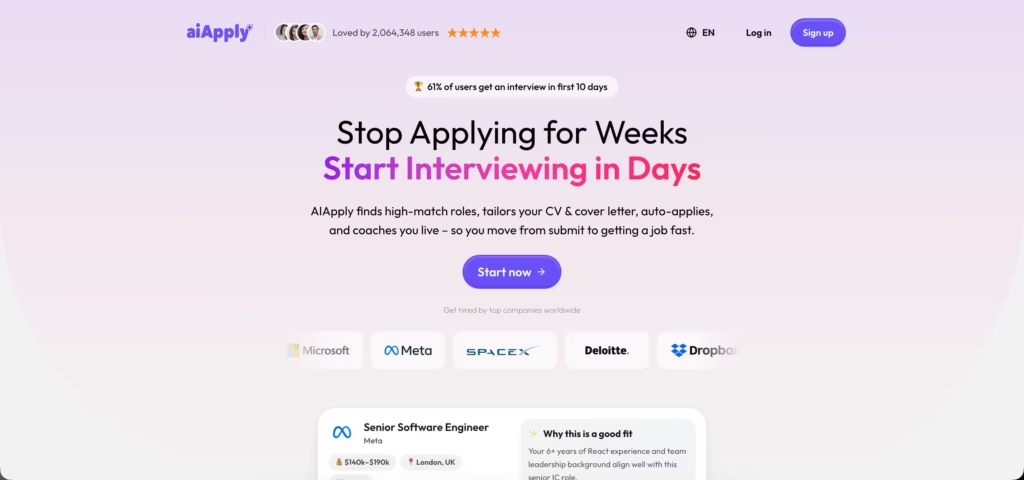
AIApply is one of the most visible platforms in this category. It positions itself as a job application AI, claiming to be “loved by” over 1.1 million users, with Auto Apply presented as a feature that can submit applications to hundreds of matched positions daily.
The platform features an AI resume builder, cover letter generator, auto apply, interview practice, a resume scanner and optimizer, a resume translator, and a job search board into one dashboard.
Key Features
1. Auto Apply: Users enter professional details and job preferences, such as experience level, salary expectations, industry, and location, which the platform uses to decide which jobs to submit applications to automatically.
2. Resume and cover letter tools: AI-generated documents built around a candidate’s profile and a specific job description.
3. Interview Buddy: A live coaching tool alongside AI mock interviews meant to help candidates prepare once an application converts into a conversation.
4. Resume scanner and application tracker: Tools to check ATS compatibility and monitor submissions in one place.
Pricing
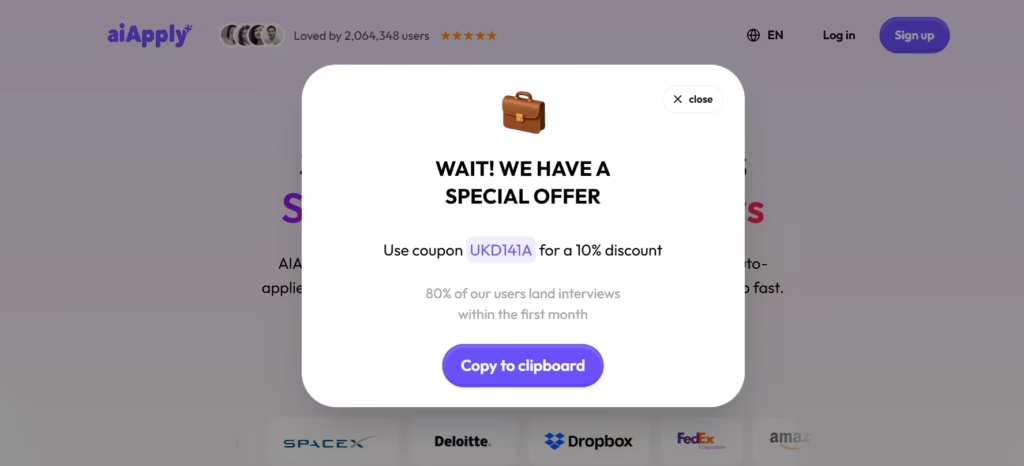
Pricing is one of the more confusing parts of AIApply. The platform itself doesn’t reveal its pricing straight up. When I signed up, I went through a series of questions about the use case and the job I wanted before I got to the pricing page. I can’t therefore ascertain that the pricing is the same for everyone.
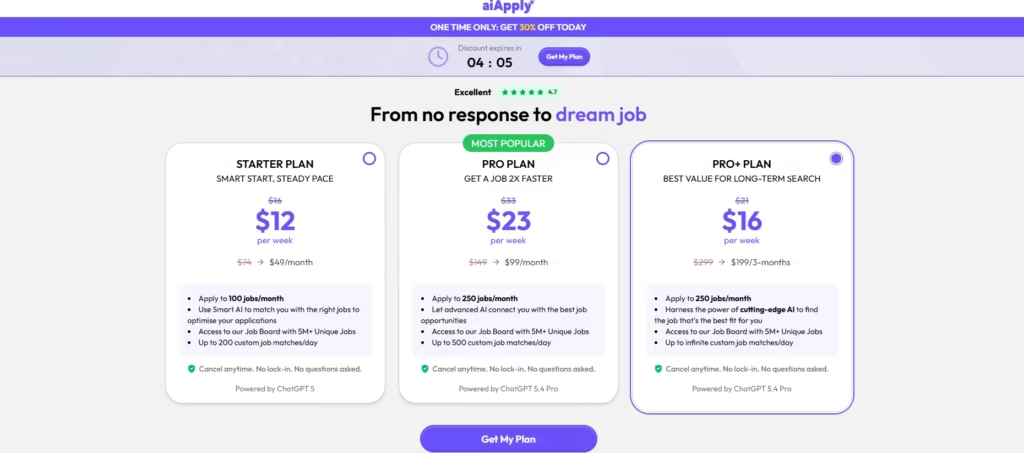
To allay my doubts, I signed up for the tool again. I selected answers that would probably draw the pricing in a different direction (if it was answer-dependent, that is). The pricing did, in fact, turn out to be use case and job type-dependent. And it’s certainly not free as the page suggested.
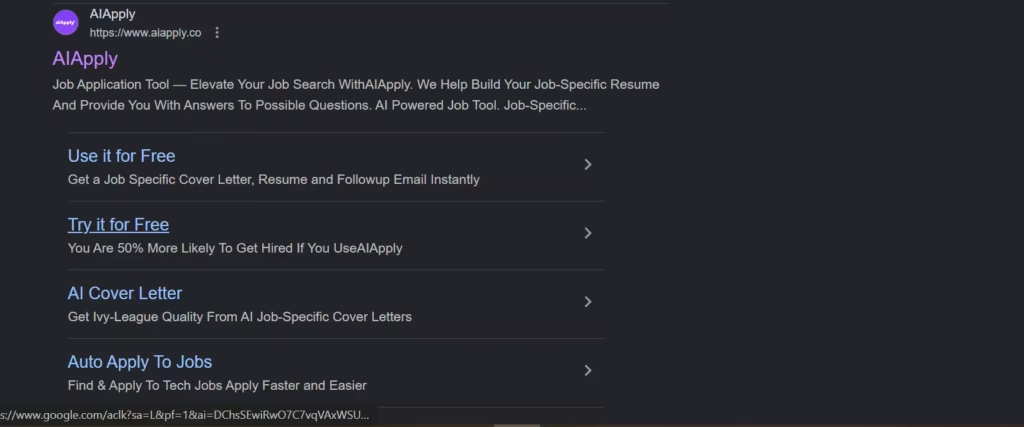
This pricing page, spun from the AI resume builder bundled up with Cover Letter maker and Auto apply, resulted in an application Kit Pro plan. It was priced at $29/month, whereas the previous pricing operated a weekly billing cycle starting from $12 (which is $48/month).
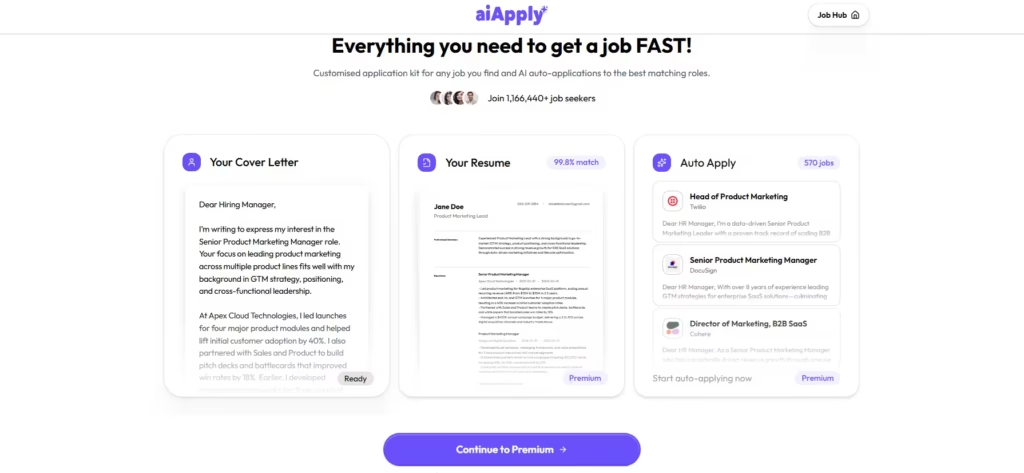
Other third-party reviewers also report pricing that echoes my experience. One review reports weekly pricing starting around $12 and rising to $23 depending on application limits, with no free trial available for auto apply. Others report a monthly structure instead.
One in-depth test found a base Pro Toolkit subscription of $29 a month that does not include auto apply at all, with auto apply sold separately through credit packs. On the 100-credit pack, that works out to roughly $0.39 per application.
The takeaway here is to verify current pricing directly on AIApply’s site before subscribing, since the toolkit and the auto-apply engine are often billed separately.
Benefits of AIApply
AIApply’s strongest reviews consistently point to the same two features: the cover letter generator and Interview Buddy. Candidates who struggle with blank-page writing get a head start, and the interview prep layer helps once a real conversation happens. It is also useful for candidates with a clearly defined target role, since narrower filters produce more relevant matches.
Drawbacks
The trade-off is targeting accuracy. Multiple Trustpilot reviewers report the same thing: the AI applies broadly rather than strategically, prioritizing volume over relevance. One specific limitation is that when I reviewed the auto-apply settings, I noticed there’s no way to exclude specific companies or fine-tune industry filters beyond broad categories.
That explains why users report getting matched to roles that don’t fit. Pricing transparency is another recurring complaint, since the separation between the subscription and auto-apply credits is easy to miss during signup.
What Do Trustpilot Reviews Say About AIApply?
AIApply’s Trustpilot profile is large and mixed. Of roughly 1,454 total reviews, about 65% are five-star, 18% are four-star, and 12% are one-star. That’s a polarized split typical of tools where results vary widely by how carefully the user configures them.
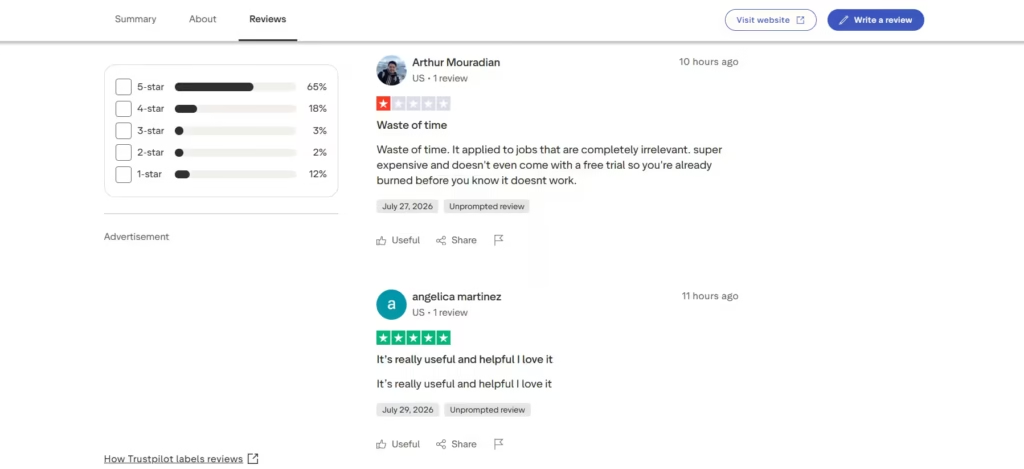
Positive reviewers frequently describe time saved and appreciate how the platform auto-adjusts a resume for each application. That removes the pain of manually filling out individual company forms.
More critical reviewers describe cancellation friction and applications that felt disconnected from their actual goals, with one reviewer specifically warning about an “obscene” cancellation flow with roughly a dozen screens of discount offers before the subscription actually ends.
Notably, Trustpilot has flagged AIApply’s profile with a notice that the company may be using unsupported methods to collect reviews, which affects how reliable the star rating is on its own.
So, Does AIApply Work?
Here’s my take: AIApply is worth using if you’re targeting high-volume, standardized roles, like entry-level or early-career positions. There, speed matters more than precision, and a slightly generic application still clears the bar.
But I wouldn’t rely on auto-apply alone for mid-level, senior, or specialized roles, where relevance is everything, and recruiters can spot a mismatched application instantly. The cover letter generator and Interview Buddy are the two features worth paying for regardless of experience level. The auto-apply engine is the part that needs the most hand-holding and the most skepticism.
The research backs this up on both sides of the hiring table. More applications do not equal more offers once volume outpaces relevance, and recruiters are actively filtering for exactly the kind of untargeted submissions that unmonitored auto-apply tends to produce.
The candidates who get the most out of AIApply are the ones who still narrow their targets, review what the AI generates before it goes out, and treat automation as a time-saver rather than a replacement for judgment.
