

Every machine learning model starts with data, and the quality of that data sets a ceiling on what the model can achieve. Teams building computer vision, language, and recommendation systems need huge volumes of accurately labeled examples, and they need them fast.
Data annotation is the process of adding labels to raw data such as text, images, video, and audio, and it serves as a core component of AI applications because it helps machine learning algorithms understand the data they learn from. Yet manual labeling is slow and costly, while pure automation is quick but error-prone. AI-assisted labeling offers a middle path, where models generate first-pass labels, and people verify them.
The balance between machine speed and human quality control determines whether a training set is useful or quietly harmful.
What Are AI Assisted Labeling Services?
AI assisted labeling services use a trained model to propose labels, which human reviewers confirm, correct, or reject. A model might draw bounding boxes around cars, suggest sentiment tags for reviews, or highlight regions in a scan, so annotators work from suggestions instead of a blank screen. Pre-labeling is the core mechanism: the model assigns tentative labels with confidence scores, high-confidence items move quickly, and uncertain ones receive closer attention. These services sit between data collection and model training, and the quality of that handoff shapes every later stage. Many providers also offer tooling for project management, reviewer training, and quality reporting.
Why Fully Automated Data Labeling Falls Short
Automation looks attractive on paper. A model never tires and processes thousands of items in minutes. Yet it has clear limits.
- Model bias. A labeling model inherits the gaps and skews of its own training data. If certain object types, dialects, or demographics were underrepresented, the model will mislabel them consistently.
- Edge cases. Rare situations, such as unusual lighting, partial occlusion, or slang, fall outside what the model has seen. These are often the very cases that matter most for safety and performance.
- Error propagation. When a model labels data that is later used to train a new model, mistakes compound. The new model learns the old errors as if they were facts, and the problem becomes harder to trace.
- Ambiguous data. Some items have no single correct answer. Is a sarcastic review positive or negative? Is a faint shadow on an X-ray a finding or an artifact? Resolving such questions requires context, domain knowledge, and judgment that automated systems lack.
How Human-in-the-Loop Labeling Improves Accuracy
Human-in-the-loop labeling places trained people at the points where machine output is least reliable. Annotators review suggested labels, fix mistakes, and handle the complex cases that models flag as uncertain. This is where human data annotation adds the most value, because a person can weigh context, read intent, and apply detailed guidelines that a model cannot interpret.
The role goes beyond simple correction. Experienced reviewers spot patterns in model errors, such as a class that is repeatedly confused with another, and report them back to the project team. Those observations lead to clearer guidelines and better instructions.
Feedback loops make the system stronger over time. Corrected labels are fed back into the model, which is retrained on the improved data. Each cycle reduces the number of obvious errors, so reviewers can spend more time on subtle problems. The result is a workflow in which accuracy rises while the volume of manual effort per item gradually falls.
Core Components of a Hybrid Annotation Workflow
A hybrid annotation workflow joins machine efficiency with human oversight in a repeatable process. Two stages carry most of the weight. The first stage uses a model to label data at speed, and the second relies on people to check that output against clear guidelines. Each stage covers the weak points of the other, since models struggle with nuance and people struggle with volume. Defining who handles what, and when an item moves from one stage to the next, keeps the process predictable and the results consistent.
Automated Pre-Labeling and Active Learning
The workflow begins with a model that applies initial labels to incoming data. Active learning then decides which items deserve human attention first. Instead of reviewing data in random order, the system ranks items by model uncertainty and sends the most informative ones to annotators.
This approach focuses effort where it improves the model most. Clear, easy examples are accepted with light checks, while borderline cases receive full review. Over successive rounds, the model learns from the hardest examples and needs fewer interventions on routine ones.
Human Review and Multi-Layer Quality Assurance
Human review forms the second stage. A first-level annotator verifies or corrects each label. A second-level reviewer then checks a sample or all of the work, depending on project risk. Complex or disputed items escalate to subject matter experts.
Layering review in this way catches different error types at different points. Guideline misunderstandings surface early, while subtle domain errors reach specialists. Clear documentation, regular calibration sessions, and shared examples keep every reviewer aligned with the same standard.
Data Annotation Quality Control Methods That Work
Quality control turns a labeling process into a dependable one. Several proven methods are commonly combined:
- Inter-annotator agreement: Multiple annotators label the same items, and their level of agreement shows how clear the guidelines are and how consistent the team is.
- Gold standard datasets: A set of items with verified answers is mixed into regular work. Comparing annotator output against these answers reveals accuracy without guesswork.
- Consensus scoring: When several people label one item, the final label reflects majority agreement, with disagreements sent to a senior reviewer.
- Spot audits: Reviewers pull random samples from completed batches to confirm that quality holds steady across the project.
Quality metrics tie these methods together. Precision, recall, and agreement scores can be tracked per annotator, per label class, and per batch. Patterns in these figures point to unclear instructions, weak spots in the model, or reviewers who need additional training. Reporting these results openly allows teams to correct problems before they reach the training set.
Key Benefits of Combining Automation with Human Oversight
Each approach has strengths, and a hybrid model keeps the best of both.
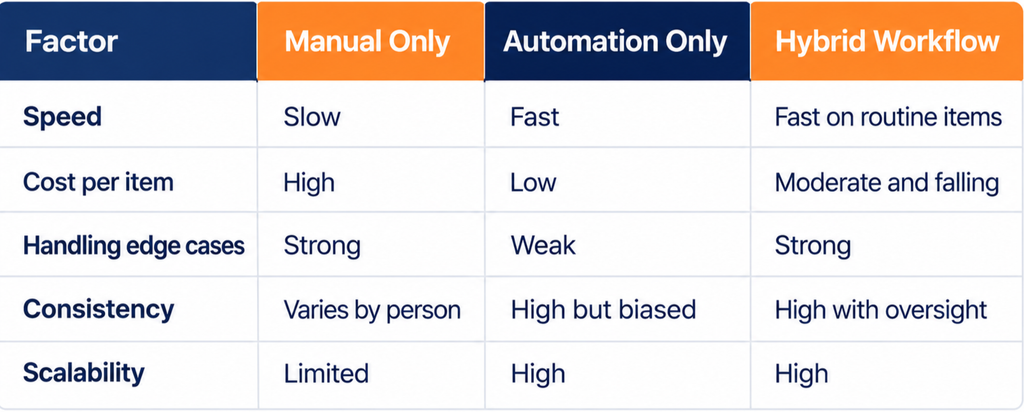
Speed improves because models handle repetitive work. Cost efficiency follows, since human time goes to review rather than creation from scratch. Scalability comes from the ability to add data volume without a matching rise in headcount.
Consistency benefits from shared guidelines and automated checks, while reduced rework may be the most practical gain. Catching errors early prevents the expensive cycle of training a model, finding poor results, and relabeling large portions of a dataset.
Common Use Cases Across Industries
Hybrid labeling supports a wide range of applications.
Autonomous vehicles. Computer vision models need accurately marked pedestrians, vehicles, lane lines, and signs. Pre-labeling speeds up the work on thousands of frames, while human reviewers verify difficult scenes such as night driving or heavy rain.
Medical imaging. Models can outline structures in scans, and clinically trained reviewers confirm or adjust them. Domain expertise is vital here, as small errors carry real consequences.
Natural language processing. Sentiment analysis, intent detection, and entity recognition all depend on nuanced text labels. Humans resolve sarcasm, slang, and cultural references that models often misread.
E-commerce. Product tagging, category assignment, and attribute extraction benefit from automation at scale, with people correcting unusual or poorly described items.
How to Choose the Right AI Assisted Labeling Partner
Selecting a provider affects data quality, project timelines, and long-term costs. Several criteria deserve close attention:
- QA process transparency: Ask how quality is measured, reported, and improved, and request sample reports.
- Domain expertise: Confirm that reviewers understand your field, especially for medical, legal, or technical data.
- Tooling: Look for flexible annotation interfaces, model integration, and clear audit trails.
- Security and compliance: Verify data handling practices, access controls, and alignment with relevant regulations.
- Scalability: Check that the team can grow with your project without a drop in quality.
- Pricing model: Compare per-item, hourly, and project-based structures against your expected volume.
A short pilot project is a practical way to test these points before committing to a larger contract.
Conclusion: Building Better AI With Smarter Labeling
Reliable AI starts with reliable data. Automation delivers speed and scale, yet it cannot replace human judgment on ambiguous, rare, or high-stakes examples. The strongest results come from workflows that let models handle routine work, direct human attention to uncertain items, and verify output through structured quality control.
Teams that adopt this approach gain faster turnaround, lower costs, and training data they can trust. The steps are clear: define precise guidelines, apply layered review, measure quality continuously, and choose a partner with transparent processes. Start with a pilot, evaluate the results against your own accuracy targets, and expand once the workflow proves itself. Better labels lead to better models, and that advantage compounds with every training cycle.
