
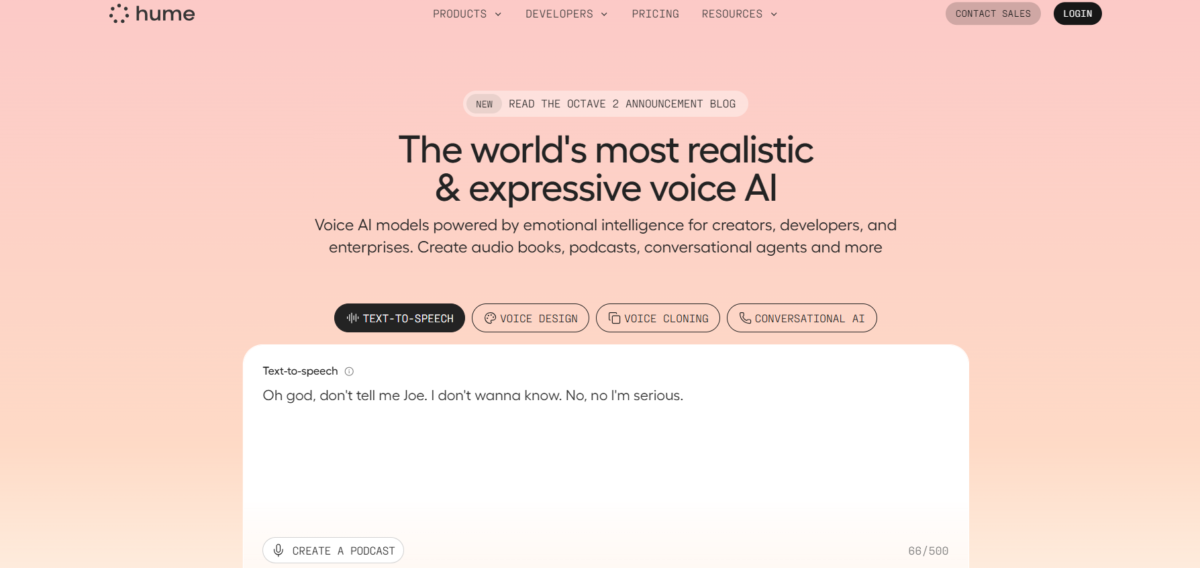


Hume AI is a generation tool that uses advanced AI to produce emotionally heavy voices with undertones that convey an adequate depth of expression.
Key Features
1. Text-to-Speech
Hume has a text-to-speech feature that’s powered by Octave, a speech-language model. Octave understands both language and meaning and can grasp context, emotion, and instructions.
Therefore, voices sound more natural and expressive, complete with an emotional nuance. Understanding emotional nuance enables adjustments of parameters (pitch, emphasis, rhythm, and tone) that remain consistent across long-form content.
Note: The speech language model exists as Octave 1 and Octave 2.
To use this functionality, I pasted a script for a TikTok fashion video. I set the voice to TikTok fashion influencer and hit play.

This feature did not meet my expectations. The voice did sound similar to a TikToker’s in typical uptalk, but there was that unmistakable robotic undertone that ran through every sentence. It seemed to me that the cadence of the speech was calculated and almost too exact to be human-like, much less a hip youngster.
While I didn’t expect AI to come up with a truly human voice, I did expect a high degree of similarity.
2. Voice Design
This involves curating custom synthetic voices via text prompts that specify tone, personality, emotion, accent, cadence, vocal identity, and style. Octave is responsible for effectively interpreting those descriptions into text. Generated voices can be saved and reused multiple times.
I used a prompt for a female, high school principal with a good balance of authority and empathy. Viola Davis as Annalize Keating from How to Get Away with Murder was who I had in mind.
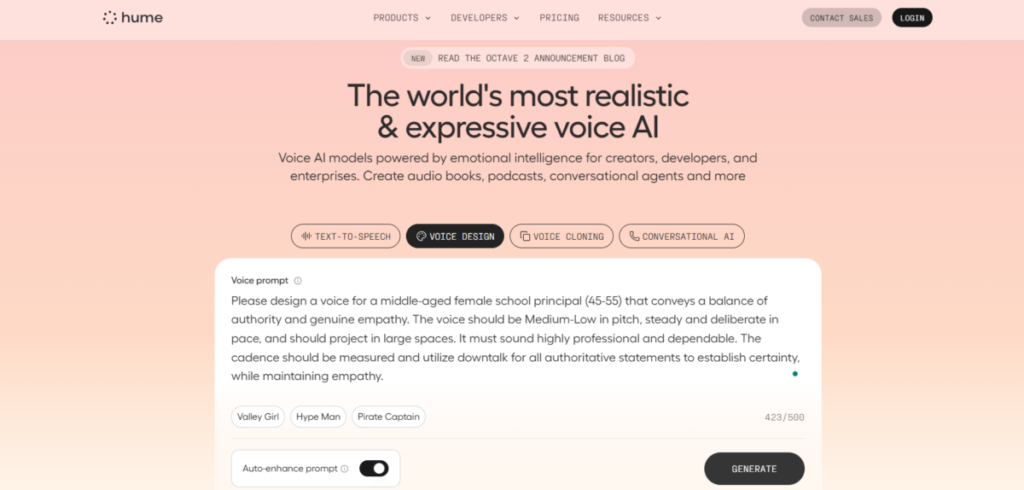
Hume generated three different voice options. Voice 3 sounded the most like what I wanted. It delivered a good blend of a female voice that bore authority and feeling. The first voice sounded too scripted and stiff. The second sounded more domineering and overly crisp.
I ran this function again using a prompt that gave free rein to feeling. The prompt described a teen girl expressing disgust at a fashion choice. All three of the voices carried the required expression. However, voice 3 did stand out as the most natural-sounding. I could feel the tone of irritation strongly.
In general, Hume did a good job of producing realistic, natural-sounding voices. The voices weren’t monotonous, and they added the right emotion where needed. There were only a few points that exposed their artificial origin.
3. Voice Cloning
Hume effectively duplicates voices down to the details – speech patterns and tone. The synthetic version, generated by providing a recorded speech sample, can be used in text-to-speech and Empathetic Voice Interface systems.
Cloned voices can be previewed and used within the Hume platform or via API. In the case of voices belonging to others, users must obtain legal rights.
4. Conversational AI
This is a live, emotionally aware voice interaction system that listens to how the user speaks. It notes the tone, rhythm, and emotional cues to understand both obvious and implied meanings. Then, it provides responses that match the expression and cadence.
Humen AI also handles back-and-forth dialogues smoothly and can make adequate adjustments. It detects when a user stops talking, stops when the user interrupts, and modulates its tone based on the user’s emotional cues.
I had a fun conversation with the AI podcast host about art and the paradigm shift into realistic art during the Renaissance.
The Bottom Line
Hume AI is a technically and emotionally intelligent tool that produces voices for a variety of uses. It can also make a good conversation partner, much like a sounding board to work through ideas, thoughts, and concepts.