

An AI so powerful it can’t be released to the public. A lawsuit against the Pentagon. And a company that’s still talking to the very government it’s suing.
That’s the strange, fascinating situation Anthropic finds itself in right now.
Jack Clark, one of Anthropic’s co-founders and its Head of Public Benefit, confirmed this week that the company briefed the Trump administration about Mythos, its most capable and controversial AI model to date.
What’s Mythos?
Anthropic announced Mythos last week, but don’t expect to try it out anytime soon. The company has decided not to release Mythos to the public.
The reason is that it’s simply too capable, particularly in cybersecurity. Mythos reportedly has powerful abilities that could pose serious risks if they ended up in the wrong hands.
Anthropic made the rare call to keep it locked away, even as the AI space gets increasingly competitive.
That kind of restraint is unusual in a field that often moves fast and fixes things later.
Pentagon Lawsuit
Here’s where things get complicated. Back in March, Anthropic filed a lawsuit against Trump’s Department of Defense.
The Pentagon had labeled Anthropic a “supply-chain risk,” a label that sparked a very public clash.
The military had wanted unrestricted access to Anthropic’s AI systems. That included potential use cases like mass surveillance of Americans and fully autonomous weapons.
Anthropic declined access, and the DoD eventually gave the contract to OpenAI instead.
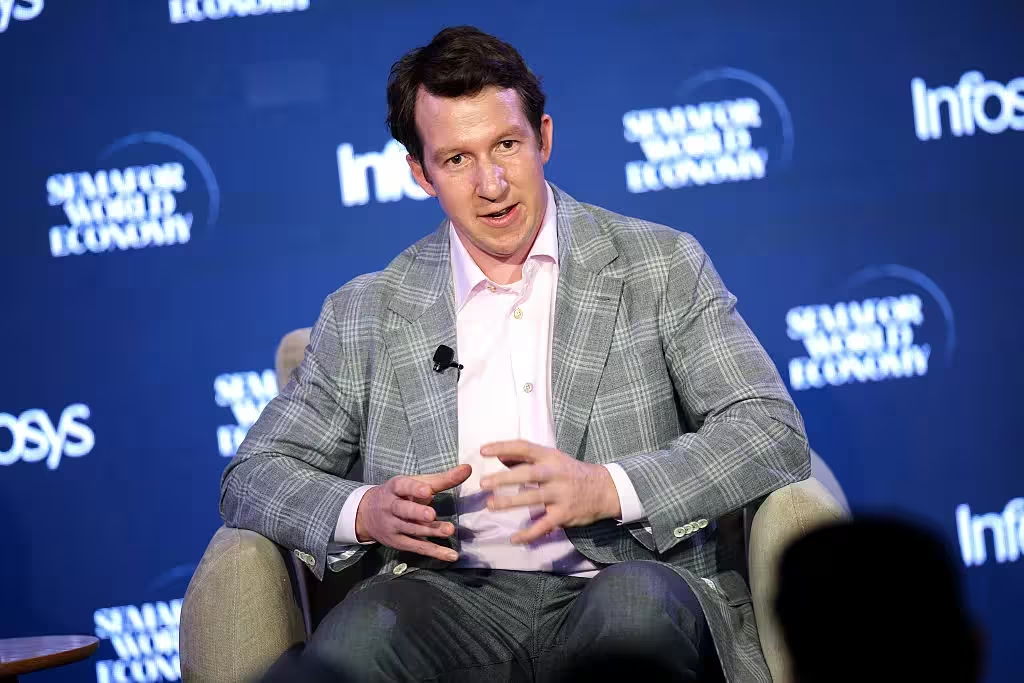
So why is Anthropic still talking to the people it’s suing? Clark addressed that head-on at the Semafor World Economy Summit this week.
He described the lawsuit as a “narrow contracting dispute,” not a sign that Anthropic was pulling away from national security conversations.
“Our position is the government has to know about this stuff,” Clark said.
He argued that the private sector and the government need to find new ways to work together on technology that affects national security.
That’s why the Mythos briefing happened, and why more briefings are coming. “We talked to them about Mythos, and we’ll talk to them about the next models as well,” Clark confirmed.
Early Testing
While the public waits on the sidelines, some of the world’s largest financial institutions may be getting a look.
Reports emerged last week that Trump administration officials were actively encouraging major banks to test Mythos.
The list reportedly includes JPMorgan Chase, Goldman Sachs, Citigroup, Bank of America, and Morgan Stanley.
That suggests the administration sees Mythos as something worth integrating into key sectors, even as the general public remains locked out.
Unemployment Crisis
The conversation at Semafor didn’t stop at Mythos. Clark also tackled one of the biggest fears around AI: job loss.
Anthropic’s CEO, Dario Amodei, has previously warned that AI could push unemployment to levels not seen since the Great Depression. That’s a stark and sobering prediction.
Clark, who leads an economics team at Anthropic, takes a slightly softer view.
He explained that Amodei’s projections come from a belief that AI will become far more powerful than most people expect, and faster than they expect.
The unemployment warnings flow from that premise. Right now, though, Clark says the data tells a more measured story.
Anthropic is seeing only “some potential weakness in early graduate employment” in select industries.
Still, Clark was clear: Anthropic is paying close attention and preparing for the possibility that things could shift quickly.
Staying Relevant
If there’s one question parents and students are asking right now, it’s this: which degrees will still matter when AI can do so much?
Clark wouldn’t point fingers at specific majors to avoid. Instead, he offered a broad insight that’s worth paying attention to.
The most valuable education, he said, involves “synthesis across a whole variety of subjects and analytical thinking.” In other words, being able to connect dots across different fields.
His reasoning makes a lot of sense. AI can give you access to enormous amounts of specialized knowledge.
What it can’t replace is the human ability to ask the right questions, spot unexpected connections, and think creatively across disciplines.
“The really important thing is knowing the right questions to ask and having intuitions about what would be interesting if you collided different insights from many different disciplines,” Clark said.
That’s a different kind of intelligence than memorizing facts. And it might be exactly what’s most valuable in a world where AI handles so much of the heavy lifting.
