

Every smart bird feeder on the market shares the same limitation: Wi-Fi range.
Bird Buddy, Birdfy, Bilantan, Soliom, and every other connected feeder requires a 2.4GHz Wi-Fi signal strong enough to reach wherever you mount it.
Independent testing shows that connections drop 4 to 6 times per day at 60 feet from a router with a single wall between them. At 100 feet or beyond a tree line, most feeders lose connection entirely.
That means the best spot for birding (the edge of your property, near a stream, at the tree line, deep in a garden) is usually the worst spot for a smart feeder.
You end up choosing between where the birds are and where the Wi-Fi reaches.
BirdVue FEED 1 is the first smart bird feeder with 4G cellular connectivity.
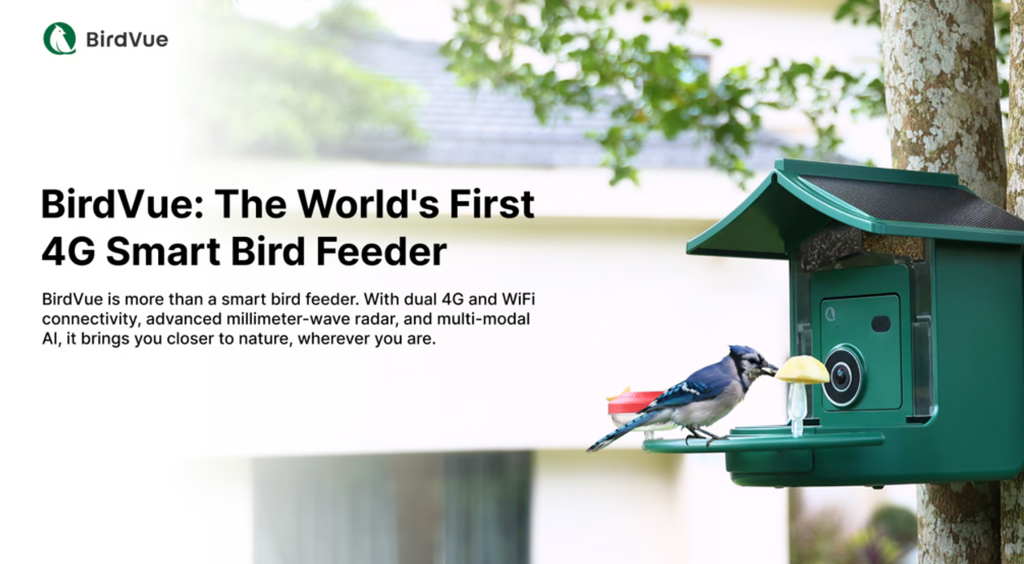
It does not need your home Wi-Fi. It carries its own connection. Mount it at a riverside, along a forest edge, in a rural backyard with no router in sight, or 500 feet from your house.
It stays online, captures bird visits, and sends everything to your phone over cellular, just like a phone would.
Why 4G Changes Where You Can Watch Birds
Current smart bird feeders are tethered to your router. BirdVue is not. That single difference changes what the product can do.
Place it where birds actually are. The best birding spots (near water, at habitat edges, along migration corridors) are rarely within Wi-Fi range.
BirdVue’s 4G + Wi-Fi dual connectivity means you choose the location based on bird activity, not signal strength. Use Wi-Fi when you are close to home. Switch to 4G when you are not.
No Wi-Fi extenders, no mesh networks, no signal boosters. The workaround for every other smart feeder is buying additional networking hardware to push your Wi-Fi far enough. BirdVue eliminates that cost and complexity entirely.
Monitor feeders at remote properties. A cabin, a rural family home, a community garden, a school nature area. Any location with cellular coverage but no dedicated Wi-Fi can now have a connected smart feeder.
What the AI Actually Does
BirdVue is not just a camera with a SIM card. The AI layer handles detection, identification, curation, and monitoring.
Millimeter-wave radar detection. Most smart feeders use passive infrared (PIR) sensors to detect bird arrivals. PIR sensors struggle in rain, fog, extreme temperatures, and direct sunlight.
BirdVue uses millimeter-wave radar, which is unaffected by weather conditions, lighting changes, or temperature swings. The radar detects motion with higher precision, which means fewer missed visits and fewer false triggers from wind-blown leaves.
AI visual recognition. When the radar triggers, the camera captures the visit and the AI identifies the species.
Over time, the system builds a profile of your local bird population: which species visit, how often, at what times, and during which seasons. The AI does not just label the bird. It tracks patterns.
Smart quality filtering. Not every capture is worth keeping. The AI evaluates image quality and bird positioning, then filters automatically: clear, well-framed shots are saved and highlighted.
Blurry catches and empty-perch triggers are discarded. Your gallery fills with the best moments, not every moment.
AI-monitored food levels. The feeder tracks seed levels in real time and triggers automatic refills when food runs low. You do not need to check manually or set a refill schedule. The AI handles it. Birds keep coming back because the food is always there.
Power That Does Not Run Out
Smart feeders with batteries that last 5 to 15 days (like the standard Bird Buddy) require regular charging.
Miss a charge and you lose days of coverage.
BirdVue solves this with dual 3W solar panels and a 5,200mAh battery. The solar panels charge the battery continuously during daylight. The battery carries the system through the night and overcast days.
For a feeder designed to be placed far from your home (where 4G makes it possible), self-sustaining power is not a convenience. It is a requirement. You cannot walk 500 feet to swap a battery every week.
The App: Bird Journals, Highlights, and a Community Layer
The BirdVue app is where all the AI output lands. Three features stand out:
Bird journals. Every identified visit is logged automatically: species, time, date, photo, and behavioral notes. Over weeks and months, this builds a personal record of your local bird activity that no manual observation could match.
AI highlights. The app curates your best captures into highlight reels. Instead of scrolling through hundreds of images, you get a daily or weekly digest of the visits worth seeing.
Discover nearby. BirdVue includes a community layer where users can share highlights from their feeders. You can see what species other BirdVue owners near you are attracting, which adds a social dimension to the experience and helps you understand regional bird activity beyond your own backyard.
Pricing and Availability
The BirdVue FEED 1 launches on Kickstarter on September 22, 2026, with shipping to backers expected to begin in November.
| Tier | Price | Availability |
| Initial pledge price | $159 | Limited quantity at launch |
| Super Early Bird | $179 | Available after initial allocation |
| Regular retail price | $299 | Post-campaign |
For context, the Bird Buddy Pro Solar retails at approximately $189 and requires a $6/month subscription for premium AI features.
BirdVue at $159 to $179 includes 4G connectivity, millimeter-wave radar, AI recognition, auto-refill, and solar power at launch pricing competitive with Bird Buddy’s hardware cost, with no subscription mentioned.
How BirdVue Compares to Existing Smart Feeders
| Feature | BirdVue FEED 1 | Bird Buddy Pro Solar | Birdfy Feeder 2 Pro |
| Connectivity | 4G + Wi-Fi (dual) | Wi-Fi only (2.4GHz) | Wi-Fi only (2.4GHz) |
| Detection method | Millimeter-wave radar | PIR motion sensor | PIR motion sensor |
| Weather-proof detection | Yes (radar unaffected by rain, fog, temperature) | Reduced in extreme conditions | Reduced in extreme conditions |
| AI bird identification | Yes | Yes | Yes |
| Auto-refill | Yes (AI-monitored) | No (manual refill) | No (manual refill) |
| Solar power | Dual 3W panels + 5,200mAh battery | Solar roof option | Solar panel option |
| Place beyond Wi-Fi range | Yes (4G cellular) | No | No |
| Launch price | $159 | $189 | $259 |
The 4G connectivity and millimeter-wave radar are genuine differentiators that no shipping competitor currently offers. The auto-refill mechanism is available on some competitors but not on the two market leaders (Bird Buddy and Birdfy).
Who Is BirdVue Built For?
Rural property owners whose feeders sit hundreds of feet from the nearest router. 4G eliminates the Wi-Fi range problem entirely.
Serious birders who want to place feeders at habitat edges, near water, or along migration routes where birds concentrate but Wi-Fi does not reach.
Remote property monitors who want a connected feeder at a cabin, vacation home, or community garden with cellular coverage but no dedicated internet.
Nature educators at schools, parks, or community centers who want a live bird feed without installing networking infrastructure.
Anyone tired of dropped connections from pushing a Wi-Fi feeder to the edge of its range and dealing with missed notifications and gaps in recording.
If your ideal feeder location is within 30 feet of your router, any Wi-Fi smart feeder works fine. BirdVue solves the problem that appears when the best birding spot and the best Wi-Fi spot are not the same place.
_________
BirdVue FEED 1 is a Kickstarter project launching September 22, 2026.
The product has not shipped to consumers yet.
Kickstarter backing carries the inherent risks of crowdfunded hardware: timelines may shift and final specifications may differ from the campaign listing.
