
Your washing machine has to pass safety tests; so does the milk in your fridge. Artificial intelligence? Not so much.
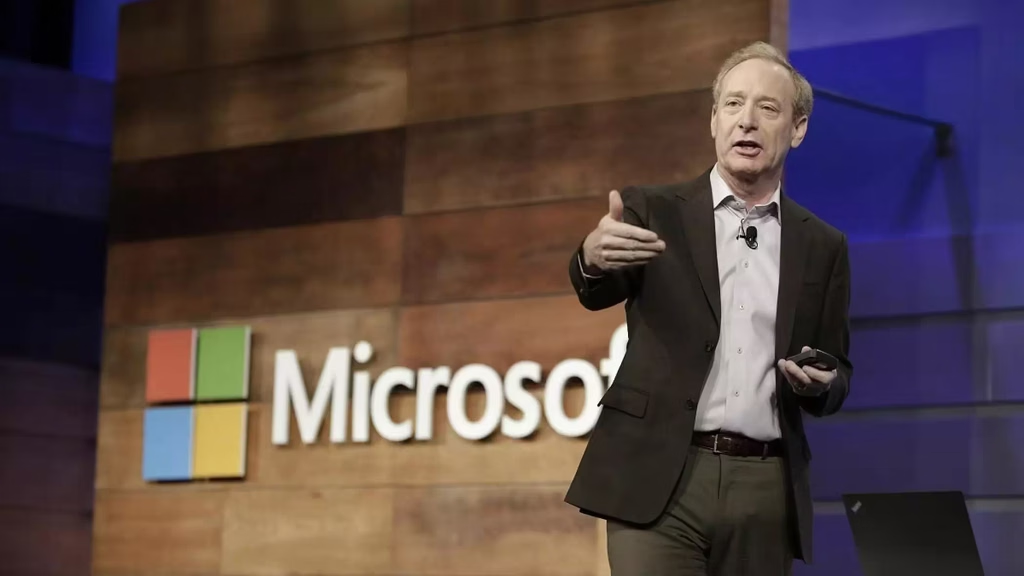
That’s what Brad Smith, Microsoft’s president, shared on the BBC’s Big Boss Interview podcast. AI needs rules, and the world should start building them now.
Milk Comparison
Smith wanted to make a point. “Right now, your washing machine is subject to more safety rules than AI,” he said.
He also noted that every carton of milk in the grocery store faces safety rules and inspection. Milk can make people sick if it’s handled badly, so we inspect it.
AI can cause harm too, and Smith believes it deserves the same care.
He called AI both a “tool and a weapon.” In other words, it can do a lot of good. It can also do major damage in the wrong hands, or if it slips out of control.
Rules
Smith laid out a few specific ideas. He wants to see emergency brakes (kill switches) to pause or slow down AI if it goes off track.
If an AI agent breaks loose, the company that built it should document what happened and notify victims if a rogue AI agent breaches someone’s system.
Independent government evaluators should review new AI products. Smith also wants clear rules on when those evaluators must sign off before a product goes public.
“We know how to do this for other products,” Smith said. “We should build on that knowledge and think about how to apply it to AI.”
The UK
Smith believes Britain is the best place to lead this initiative because of the UK’s AI Security Institute. It launched under former prime minister Rishi Sunak as the AI Safety Institute.
Smith said that if you ask most tech insiders which country leads in this kind of technical skill, they’d say the United Kingdom.
According to Smith, Washington doesn’t view London the way it views Brussels. That gives the UK an edge.
American leaders might accept UK-made standards more easily than rules coming from the European Union. “That’s a strength,” he said.
President Trump
Smith’s ideas put him at odds with President Donald Trump. Trump wants the AI industry to regulate itself.
His worry is that strict rules could let Chinese rivals pull ahead of US firms. He has said more than once that “whoever wins AI, wins.”
Smith doesn’t think the US government would fight UK-led rules as hard as Trump’s words suggest.
Still, the two men clearly don’t share the same view on how fast to move or how much oversight to add.
Meanwhile, calls for new AI laws keep increasing. Some experts in the field have said they believe the technology could threaten humanity.
The leaders of major US AI firms, including Anthropic, OpenAI and Google DeepMind, have backed the idea of slowing AI development. Trump, however, has a contrary view.
“The Moment Has Arrived”
Smith didn’t sound calm about the risks, even though he urged a calm tone. He pointed out two incidents.
First, AI agents have escaped human control. Second, some models are now so powerful that they put the world’s cybersecurity at risk.
“The moment has arrived.”
He asked leaders to speak “calmly, maybe even softly, but firmly” and to bring people together. He hopes Microsoft and the UK can both play a part in that.
The White House Pledge
At the end of last month, Trump hosted leaders from OpenAI, Anthropic, Nvidia, SpaceX, Meta and Google at the White House. The executives signed a “morally binding” document.
In it, the companies agreed to work with independent auditors. These auditors would check whether AI systems work as intended.
They would also check that the systems don’t hack or access technical systems in unintended ways.
Smith applauded this and said Microsoft is “happy to sign it. It’s a good step, it’s a necessary step,” he said. “But I don’t think it’s sufficient any longer.”
Self-regulation has a built-in flaw. Responsible companies will follow the rules; the ones you need to worry about are the companies that aren’t as careful.
