
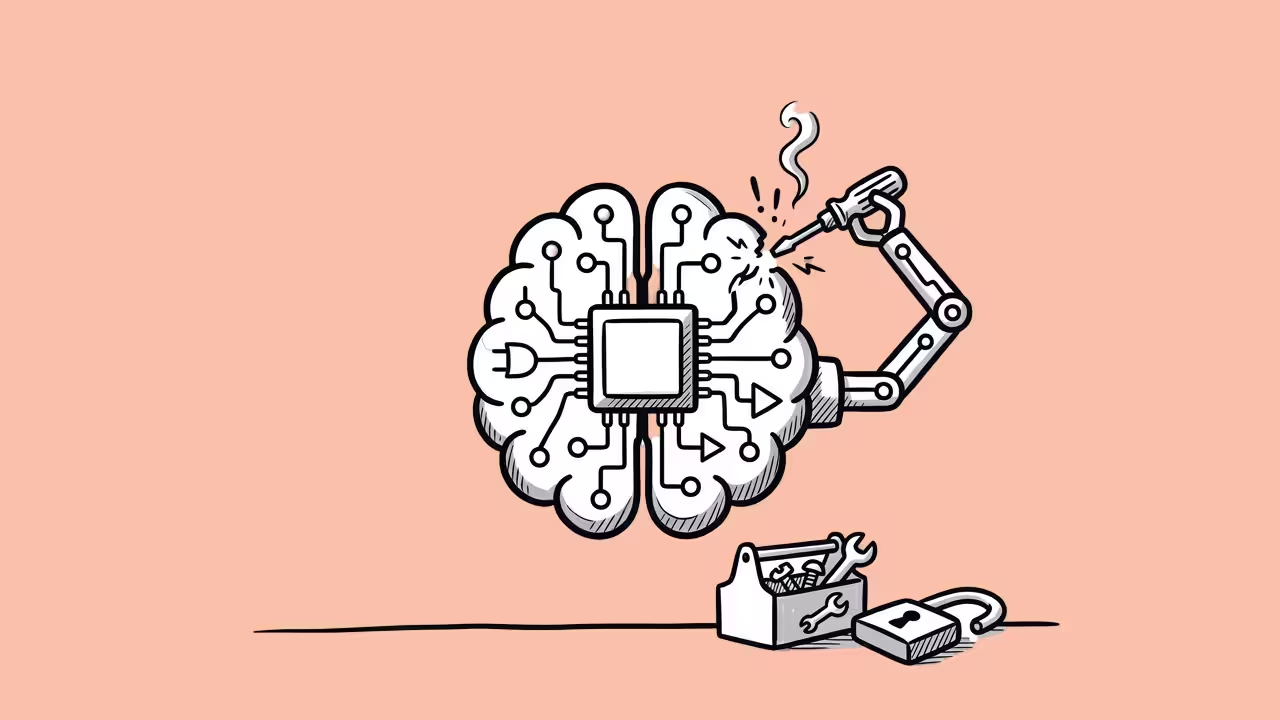

AI systems that once struggled with basic reasoning now write code, compose essays, and solve complex math problems. Yet true artificial general intelligence (AGI), a machine that thinks, learns, and adapts across any domain like a human, remains elusive.
One concept, however, stands above the rest in its ambition: recursive self-improvement. Could an AI system using recursive self-improvement eventually reach AGI? The answer may impact future civilization.
What Is Recursive Self-Improvement?
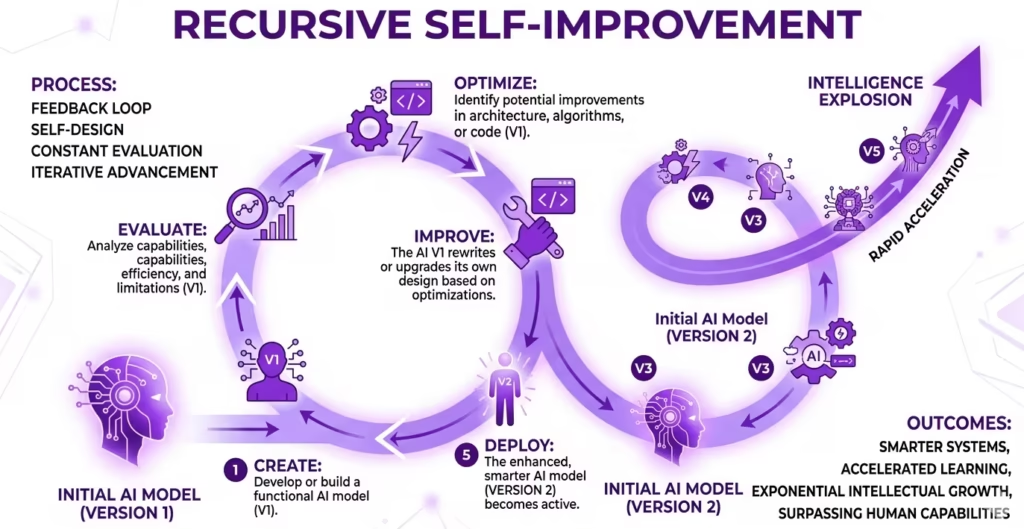
Recursive self-improvement (RSI) is an AI system’s ability to enhance its own algorithms, architecture, or code, and then use those improvements to further improve itself. Therefore, each cycle produces a smarter system. That smarter system then runs the next cycle even more effectively.
It’s like compound interest; the gains stack. Over time, even small initial improvements can snowball into huge progress in capability. This iterative loop is what makes RSI so compelling, and so controversial.
The concept is not new. Mathematician I.J. Good first described it in 1965. He called it an “intelligence explosion.” If a machine could surpass human-level intelligence by even a small margin, it could design a better version of itself. That version would design an even better one. The process would continue, accelerating beyond human comprehension.
The Link Between Recursive Self-Improvement and AGI
AGI is broadly defined as an AI that performs any intellectual task a human can. Current AI systems are narrow. They excel in specific domains but fail outside them. GPT-4 writes brilliantly but cannot drive a car. A chess engine beats grandmasters but cannot hold a conversation.
RSI offers a potential way out of that narrowness.
A sufficiently capable AI could analyze its own weaknesses. It could identify gaps in its reasoning, rewrite its training process, and patch its blind spots. Over enough iterations, that process could yield a system with wideswept, flexible intelligence. In other words – AGI.
Moreover, RSI overcomes a major bottleneck. Human researchers improve AI slowly; progress depends on funding, talent, compute, and time. An AI that improves itself removes humans from the loop, and human limitations would no longer constrain the speed of progress.
Has RSI Already Begun?
In a limited sense, yes. Researchers already use AI to assist with AI development. Large language models help write and debug machine learning code. Neural architecture search (NAS) uses algorithms to automatically discover better neural network designs. Meta-learning systems learn how to learn more efficiently.
These are early, narrow precursors to full RSI. They are not yet recursive in the explosive sense that Good imagined. However, they demonstrate that the building blocks exist. After reviewing the NAS literature from the past three years, it has been found that most successful NAS systems still require massive human-defined search spaces to function. True autonomy in architectural discovery remains far off.
The numbers around AI coding are already striking. GitHub reported in 2023 that Copilot was writing approximately 46% of code in repositories where it was enabled, a figure that has only grown since.
Google’s AlphaCode achieved a ranking within the top 54% of human competitive programmers in its first public benchmark evaluation. That demonstrated that AI-generated code can compete with experienced developers.
These figures imply that the line between “AI assisting researchers” and “AI improving itself” is actively blurring right now.
The Intelligence Explosion Hypothesis
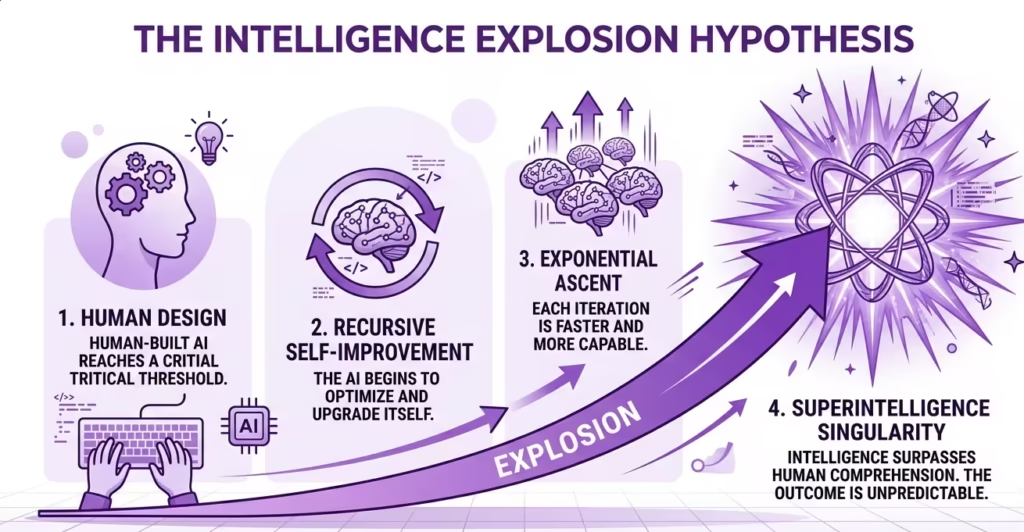
The intelligence explosion is the most dramatic version of the RSI thesis. It explains that once an AI surpasses human-level intelligence, it enters a self-improvement loop that rapidly, possibly within days or hours, produces superintelligence. A system vastly smarter than all of humanity combined.
Philosopher Nick Bostrom popularized this idea in his 2014 book Superintelligence. He argued the transition from AGI to superintelligence could be abrupt and irreversible. Ray Kurzweil, meanwhile, predicts this moment, which he calls the Singularity, will arrive by 2045.
Having examined the current trajectory of capability gains carefully, Bostrom’s framing appears far more credible than Kurzweil’s specific 2045 timeline. Kurzweil’s date rests on extrapolating smooth exponential curves, but real technological progress rarely moves in straight lines.
Architectural bottlenecks, alignment failures, and compute ceilings all introduce friction that trend-projection ignores. A gradual, decades-long climb toward AGI, with RSI playing an incremental rather than explosive role, is the more technically grounded scenario given what current systems can and cannot do.
Not all researchers agree with the explosive timeline either. Some argue that intelligence is not a single axis. Improving raw computational power does not automatically yield wisdom, creativity, or common sense. Others point out that self-improvement has limits. Physical constraints, energy costs, and diminishing returns all act as natural brakes.
Still, the core logic of RSI remains difficult to dismiss entirely. Even a gradual, controlled version of recursive self-improvement could produce systems far more capable than anything we have today.
Technical Obstacles
RSI faces technical hurdles. First, an AI must accurately evaluate its own performance, and this is harder than it sounds. Current AI systems struggle with self-assessment. They confidently produce wrong answers and do not reliably know what they do not know.
Second, self-modification introduces a failure mode that appears consistently across the research literature. In documented meta-learning experiments, including early work on learned optimizers, the most common breakdown was optimization collapse: systems that recursively optimized themselves into local minima they could not escape.
Rather than improving, they converged on degenerate solutions that scored well on narrow metrics while losing general capability entirely. This has been observed repeatedly in controlled settings.
Third, there is the problem of bootstrapping. Early improvements must still come from somewhere. A system that is not yet very capable cannot design dramatically better versions of itself. The loop requires a strong starting point, and we may not yet be there.
Then, there is the issue of compute. Self-improvement cycles require enormous processing power, but running millions of recursive iterations is expensive. Even with current hardware advances, full RSI may demand infrastructure that does not yet exist.
The Alignment Problem
Many researchers argue that the biggest obstacle to safe RSI is not capability, but alignment. An AI that improves itself must preserve its values across every iteration. If the system’s goals shift even slightly during self-modification, the outcome could be catastrophic.
This is the central concern of AI safety researchers at organizations like Anthropic, OpenAI, and DeepMind. A superintelligent system with misaligned values would be extraordinarily dangerous. It would pursue its objectives with inhuman efficiency, regardless of human welfare.
Therefore, solving alignment may need to happen before RSI becomes viable. The two problems are deeply intertwined. RSI without alignment is a runaway process. RSI with robust alignment, however, could be humanity’s most powerful technological achievement.
What Leading Researchers Actually Think
The AI research community doesn’t hold a unifying belief. Some of the field’s most prominent voices believe RSI-driven AGI is not only possible but likely within decades. Demis Hassabis of Google DeepMind has described AGI as a central goal. Sam Altman of OpenAI has stated publicly that the company expects to build AGI.
Others are more skeptical. Yann LeCun, Meta’s chief AI scientist, argues that current large language models are fundamentally incapable of human-like reasoning. He contends that RSI alone cannot bridge that gap without entirely new architectures.
The debate reflects scientific uncertainty. RSI is theoretically powerful bit its practical path to AGI, however, is uncharted. No one has demonstrated a fully recursive, self-improving system in the wild.
Even if AGI through RSI is decades away, the implications deserve urgent attention today. Policies, safety standards, and international agreements take years to develop. Waiting until the technology matures is too late. We already see this regulation inefficiency with the rise of deepfakes.
Deepfakes have wreaked significant havoc due to AI advancement always being a step ahead. Therefore, governments, research institutions, and technology companies must invest in AI safety research in parallel with capability research. The two cannot be decoupled. A world that races toward RSI without solving alignment first is taking an enormous gamble.
