
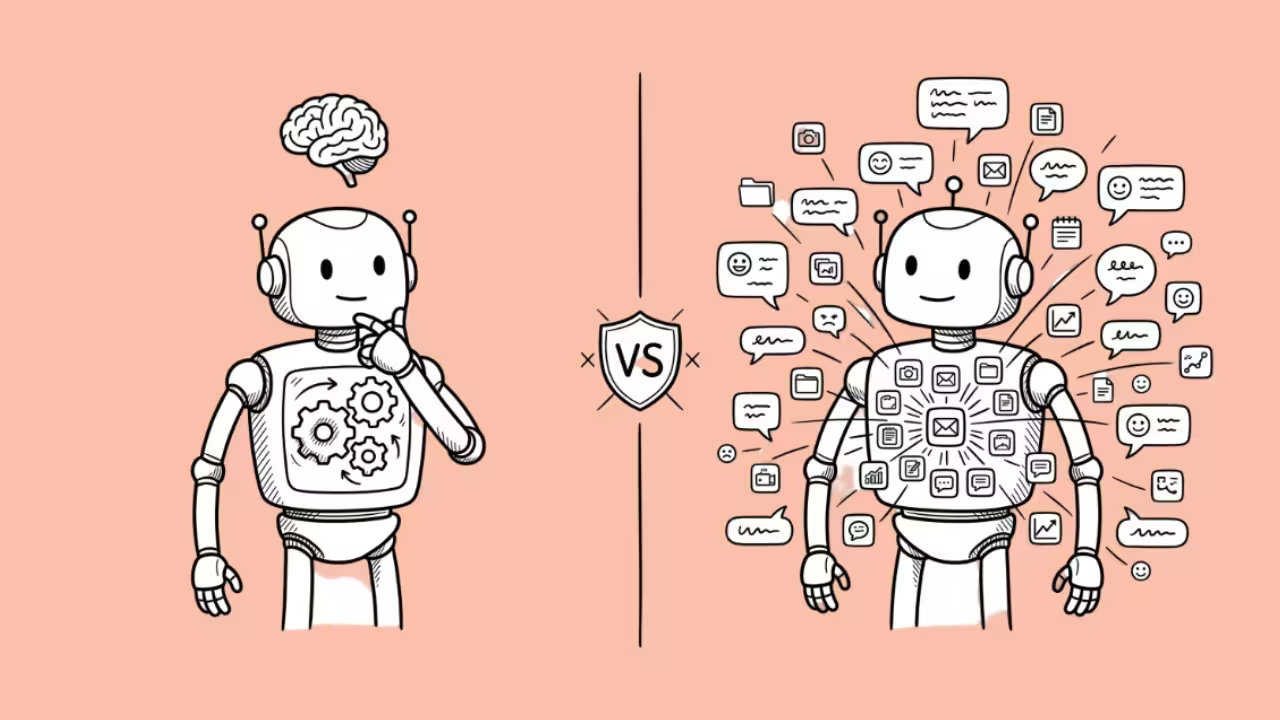

AI is moving from prompt-based interaction to systems that can plan, use tools, and complete workflows. For founders and builders, that changes what software is expected to do.
Chatbots changed how people interact with software. AI agents may change how work actually gets done.
For the past few years, most people have experienced AI through a simple pattern: type a prompt, get a response, refine the prompt, get a better response. That interface is powerful, but it is still reactive. The user drives the process. The AI waits.
Agents are different.
Instead of only responding to instructions, an AI agent can work toward a goal. It can break that goal into steps, choose tools, interact with systems, evaluate progress, and keep going until the task is complete or needs human input.
That is not just a better chatbot. It is a different way of thinking about software.
Ido Fishman approaches this shift as an advisor, founder and hands-on builder, not only as an observer of the market. He has been using AI coding tools, including Claude Code, to build internal systems for his own businesses, including CRM workflows and marketing management tools. That practical experience gives him a direct view into how AI is moving from chat-based assistance to real workflow execution.
As he puts it:
“Most people still interact with AI at the interface level, but the real transformation is happening at the system level, where AI is no longer responding to prompts but initiating, planning, and executing.”
That distinction is the key to understanding where AI is heading next.
From Chat Interface to Execution Layer
The first wave of mainstream AI tools was built around conversation.
You ask. The model answers.
You ask again. It improves the answer.
That pattern made AI accessible, but it also kept AI inside the interface. The human still had to manage the workflow, decide what came next, copy information between tools, check for errors, and turn the output into action.
Agents move AI closer to the execution layer.
An agent does not simply generate text about a task. It can help complete the task. A research agent can gather sources, compare information, summarize findings, and prepare a brief. A sales agent can identify leads, draft outreach, update a CRM, and flag responses. A support agent can classify tickets, draft replies, detect repeated issues, and escalate sensitive cases.
The shift is simple but important:
Chatbots help users think. Agents help users act.
That does not mean agents are magic or fully autonomous workers. In many cases, they still need guardrails, review, and careful setup. But the product expectation is changing. Users no longer want AI only to produce an answer. They increasingly expect AI to move a workflow forward.
How AI Agents Actually Work
Most useful agents follow a similar loop:
Goal → Plan → Execute → Evaluate → Iterate
The user gives the system a goal. The agent turns that goal into smaller tasks. It selects the tools or data sources it needs. It takes action. It checks whether the action worked. Then it adjusts.
That loop is what separates an agent from a basic prompt-response tool.
A chatbot might answer, “Here is a suggested email campaign.”
An agent might research the audience, generate the campaign, create the assets, schedule the emails, monitor performance, and recommend the next experiment.
The difference is not only the output quality. It is continuity.
A useful agent needs memory, tool access, context, permissions, and feedback loops. Without those pieces, it may look impressive in a demo but fail inside a real business process.
This is where many agent projects get stuck. They focus too much on what the model can say and not enough on what the system can reliably do.
Why Builders Should Think in Workflows, Not Prompts
For founders, operators, and technical builders, the agent shift changes the starting point.
The wrong question is: “What can I ask AI to do?”
The better question is: “Which workflow should AI help complete?”
That difference matters because many business processes are not single-step tasks. They involve context, judgment, approvals, tool switching, and follow-up actions.
Take CRM management as an example.
A prompt can help write a follow-up email. An agentic workflow can do much more. It can review recent calls, summarize the buyer’s pain points, draft the follow-up, update the opportunity notes, suggest the next step, and remind the right person if there is no reply.
That is where AI starts to feel less like a writing assistant and more like operational software.
The same pattern applies to marketing management. A simple AI tool can generate campaign ideas. A more agentic system can analyze campaign performance, identify weak segments, suggest new messaging, prepare creative variations, and queue tasks for review.
This is why hands-on building matters. Once you try to connect AI to real business systems, the hard problems become obvious: messy data, unclear workflows, permission boundaries, weak integrations, inconsistent outputs, and the need for human approval at the right moments.
That is also where the opportunity is.
Where Agents Create Real Value
AI agents are most useful when the task is repeated often, depends on context, and involves multiple steps.
They are less useful when the process is vague, high-risk, or poorly understood.
The strongest early use cases tend to fall into a few categories.
Research and Knowledge Work
Agents can gather information, compare sources, summarize findings, and turn research into usable outputs. This is useful for market research, competitive analysis, legal preparation, product planning, and investment research.
The value is not just speed. It is the ability to keep a research process moving without forcing a human to restart from scratch at every step.
Sales and CRM Operations
Sales teams spend a lot of time on repetitive coordination: lead research, call summaries, follow-ups, CRM updates, and pipeline notes.
Agents can help reduce that manual work. But the best version is not simply “AI writes emails.” The better version is a system that understands the sales process, knows what data matters, and helps maintain momentum across the pipeline.
Marketing Execution
Marketing teams already work across many tools: analytics, email platforms, ad accounts, spreadsheets, project management systems, and content calendars.
An agentic system can help connect those tools. It can monitor campaign performance, identify patterns, suggest changes, and prepare tasks for human review.
That turns AI from a content generator into a campaign operations layer.
Customer Support and Internal Operations
Support agents can classify tickets, suggest responses, detect recurring problems, and escalate sensitive issues. Internal operations agents can route requests, update records, and trigger workflows across different systems.
These use cases work because they are structured enough for automation but still benefit from AI’s ability to interpret language and context.
Where Agents Still Break
The excitement around agents is real, but so are the limitations.
Agents fail when they are given too much autonomy without enough structure. They also fail when they lack reliable data, stable tool access, clear permissions, or a way to recover from mistakes.
Common failure points include:
- Weak memory that loses important context
- Tool integrations that break or behave unpredictably
- Agents taking actions without the right approval
- Hallucinated steps inside a workflow
- Poor error handling when something goes wrong
- Loops where the agent keeps trying instead of escalating
- Outputs that look correct but are based on incomplete information
This is why agents need more than powerful models. They need infrastructure.
They need defined workflows, audit trails, permission systems, human checkpoints, and feedback loops. The more important the workflow, the more important the guardrails.
Autonomy without control is not a product advantage. It is a risk.
The Real Bottleneck Is Infrastructure
The future of agents will not be decided only by which model is smartest.
Models matter, but agentic systems depend on everything around the model: data pipelines, APIs, memory, orchestration, permissions, monitoring, and user experience.
This is why the most important agent products may not look like flashy standalone apps. Many will operate quietly inside existing systems. They will connect tools, coordinate steps, and help teams move faster without forcing them into a completely new workflow.
That is also why builders should avoid thinking about agents as isolated features. A useful agent is part of a system.
As Fishman explains:
“The difference is subtle but profound: a chatbot gives you answers, but an agent gets things done.”
That sentence captures the shift. The value is not in making AI sound more intelligent. The value is in making AI useful enough to complete work reliably.
What This Means for Founders and Builders
For anyone building with AI, the lesson is clear: do not start with autonomy for its own sake.
Start with a workflow.
Find a process that is repetitive, valuable, and painful enough that users already want help. Map the steps. Identify the tools involved. Decide where AI should act, where it should suggest, and where a human must approve.
Then build the smallest agentic loop that improves that process.
That could be as simple as:
- Research → summarize → draft → human approval
- Ticket intake → classify → suggest response → escalate
- Lead research → draft outreach → update CRM → remind salesperson
- Campaign data → analyze → recommend change → create task
The best early agents will not replace entire teams. They will remove friction from workflows that already exist.
That is how AI moves from novelty to utility.
Final Takeaway
The move from chatbots to autonomous agents is not just a UX upgrade. It is a shift in what software is expected to do.
Chatbots wait for instructions. Agents pursue outcomes.
That does not mean every process should become fully autonomous. The best agentic systems will know when to act, when to ask, and when to stop.
For builders, the opportunity is not to create AI that simply sounds smarter. It is to create systems that can plan, use tools, learn from feedback, and move real work forward.
The next generation of AI will not be judged only by how well it answers questions.
It will be judged by how reliably it gets things done.
