

Drones get all the headlines.
But on the ground in Ukraine, a fleet of American autonomous vehicles has been quietly running resupply missions, hauling ammo, and evacuating wounded soldiers since last October.
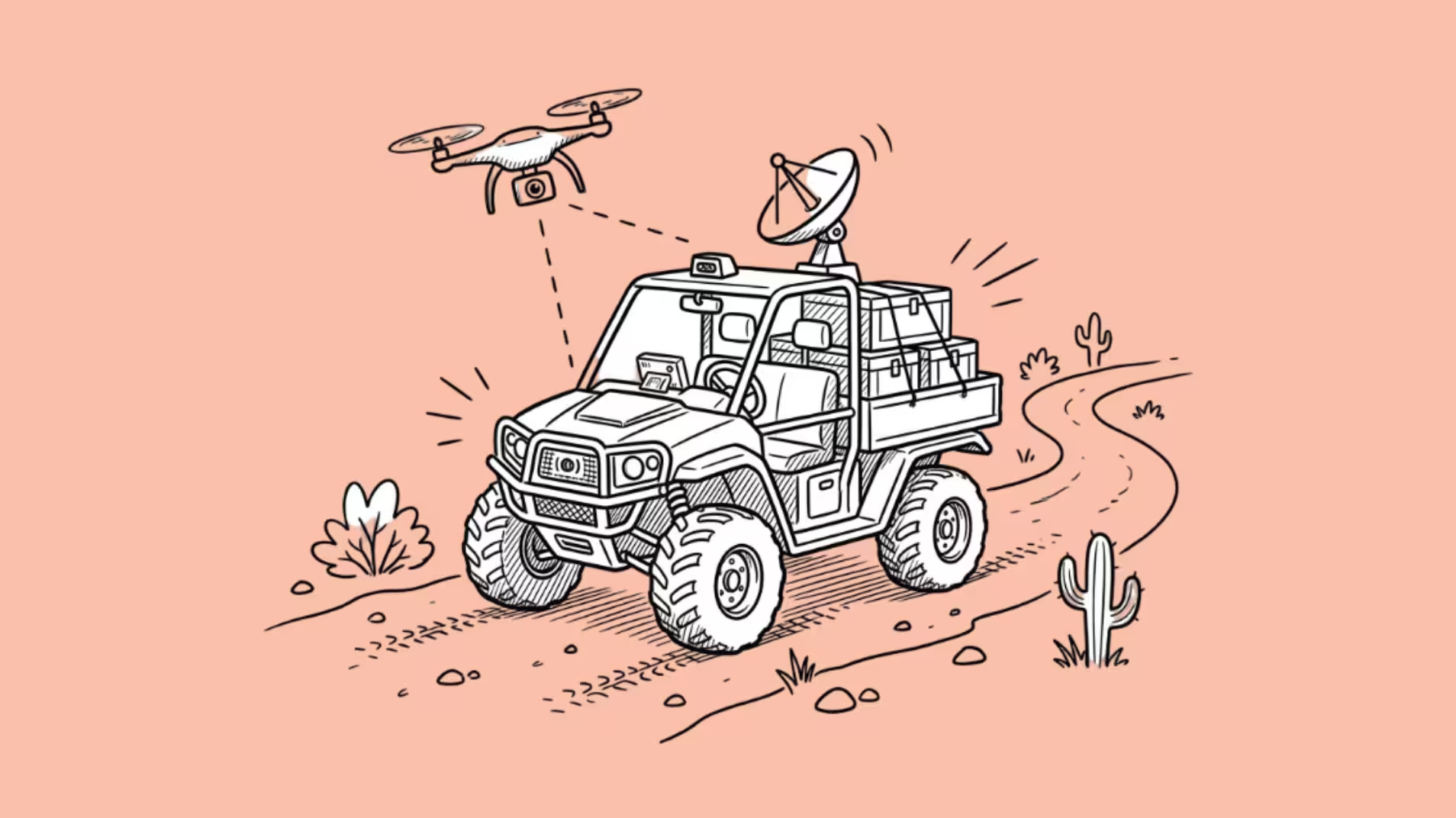
Forterra, a Maryland-based defense tech company, revealed to TechCrunch today that more than 100 of its self-driving Lancer ATVs have been deployed in active conflict zones across Ukraine.
The company calls it the largest deployment of autonomous ground vehicles in combat by any U.S. defense tech firm. Funded by American defense dollars, the program has been running for nine months without any public disclosure.
The numbers: 2,500+ miles driven. More than 1,100 missions. 777,440 pounds of cargo hauled. Fifty-two casualty evacuations. Some vehicles have been lost to Russian attacks, particularly when they got stuck in deep mud and became sitting targets.
Why Ground Robots When Drones Rule the Sky
Everyone knows aerial drones have transformed this war.
What’s less obvious is the problem they’ve created. Drone surveillance has turned huge areas into kill zones. Anything that moves gets spotted. Anything that gets spotted gets hit.
“There’s nowhere to hide,” said Sergeant Major Corey Wilkens, who leads a U.S. Army program developing autonomous vehicle tactics.
“You become very, very vulnerable to be attacked by FPV drones, other sorts of drones dropping munitions, artillery, mortar, the full range of things that they have.”
Ukraine already builds its own unmanned ground vehicles for resupply and medevac.
But those are typically battery-powered and can only carry about 250 kilograms. Forterra’s Lancers are gas-powered, built on Polaris ATVs, and can haul 750 kilograms. That’s three times the cargo capacity.
For soldiers trying to resupply a defensive position under constant surveillance, that difference matters.
The Ukrainians Weren’t Impressed at First
It wasn’t love at first sight.
Ukrainian forces have had mixed experiences with Western defense contractors showing up with shiny new tech that doesn’t survive contact with reality.
Forterra’s initial offerings felt too tailored for the well-resourced U.S. Army, not for the conditions actually faced on the front lines.
What changed? Adaptations.
The biggest one was strapping a Starlink satellite antenna to the vehicles, giving them reliable connectivity even in remote, contested areas. That single modification turned skepticism into enthusiasm.
Scott Philips, Forterra’s chief innovation officer, visited a Ukrainian unit’s operations center to see the vehicles firsthand. He was in range of Russian attacks.
That earned respect from a military that’s had its fill of executives who only see the war from conference rooms.
They’re Not Actually Driving Themselves. Not Yet.
Here’s the honest part of the story. Despite the “autonomous” label, Ukrainian soldiers have mostly been teleoperating the vehicles in combat zones.
They’re too valuable to trust fully to software. And the autonomy isn’t ready for what war actually demands.
The vehicles can navigate diverse terrain on their own. They can follow routes and avoid obstacles. But they can’t identify an unexpected enemy patrol and react the way a human driver would. “
We actually need to be able to respond to the enemy threats, live, while it’s in front of the enemy, which the autonomy doesn’t know how to do yet,” the Ukrainian soldier explained.
Forterra has been working on combining classical robotics algorithms with newer generative AI that allows machines to react to their surroundings in less predictable ways. The challenge is data.
You can’t train a model on situations humans don’t encounter, like navigating a minefield or operating a weapon system, using open-source datasets. That kind of training data has to be built from scratch.
“You need to be able to turn the dials,” said Scott Sanders, Forterra’s chief growth officer and a former U.S. Marine officer. “Some things need more of a classical robotics approach, and then you leverage AI where you need to.”
A $500 Million Bet on Ground Autonomy
Forterra has been building autonomous vehicles for 20 years.
The company has raised more than $500 million in venture funding from investors including XYZ Venture Capital and Moore Strategic Partners. It was named one of Fast Company’s Most Innovative Companies of 2026.
The Ukraine deployment gives Forterra something its competitors don’t have: real combat data. Nine months of missions in an active war zone, with all the mud, electronic warfare, software failures, and hard lessons that come with it.
That data is gold for winning future U.S. military contracts.
The competition is growing fast.
Scout AI raised $100 million earlier this year to build foundation models for military autonomous platforms.
Overland AI has raised $142 million and partnered with Anduril on autonomous vehicle demonstrations. Field AI is also trialing UGVs with the U.S. military.
Ukraine alone is expected to acquire 30,000 unmanned ground vehicles in 2026, up from roughly 2,000 in 2024. The market is exploding.
One Request From the Front Lines: Make It Cheaper
The Ukrainians gave Forterra a clear challenge. Bring the cost down.
The Lancers aren’t expensive for their category, partly because they’re built on Polaris’ commercial supply chain rather than custom military hardware.
But they’re still too valuable to throw around the way Ukraine deploys cheap FPV drones by the thousands.
Drones work because they’re expendable.
When a $500 FPV drone gets shot down, nobody blinks.
When a Lancer gets stuck in mud and Russian forces zero in on it, that’s a real loss. Until the cost drops, commanders will keep holding them back from the riskiest missions.
“Ground autonomy is achievable now and we’ve seen it,” Wilkens said. The question is whether it can be made cheap enough and smart enough to change how wars are fought, not just how supplies are moved.
For Forterra, the nine months in Ukraine are proof of concept. For the soldiers using the vehicles every day, it’s simpler than that. They need more of them. And they need them to cost less.
