


Google is adding a new way for users to create automated workflows using AI agents, Opal.
It will build mini-apps that can plan and execute tasks using simple text prompts. At the same time, it removes much of the complexity linked to software development.
New AI Agent
Gemini 3 Flash powers this update and helps the system handle both planning and execution.
Users can describe what they want in plain language. The agent then creates a structured plan, determines the next steps, and executes tasks automatically.
Importantly, the system selects the tools it needs on its own. Users do not have to configure integrations manually.
For example, the agent can use Google Sheets to store and manage data. It can also maintain memory across sessions.
This makes it suitable for use cases like tracking a shopping list in an e-commerce app.
As a result, users can build apps that are not only functional but also persistent over time.
Also read: Google Removes AI Health Summaries Due to Medical Risk
Adaptive Agents
These agents are interactive and are designed to respond dynamically during task execution.
If additional input is required, the agent will ask users for clarification and present options to guide decisions. Then, it will adjust the workflow based on responses.
This ensures that tasks remain accurate and relevant. It also reduces the need for constant manual input.
Complex Workflows
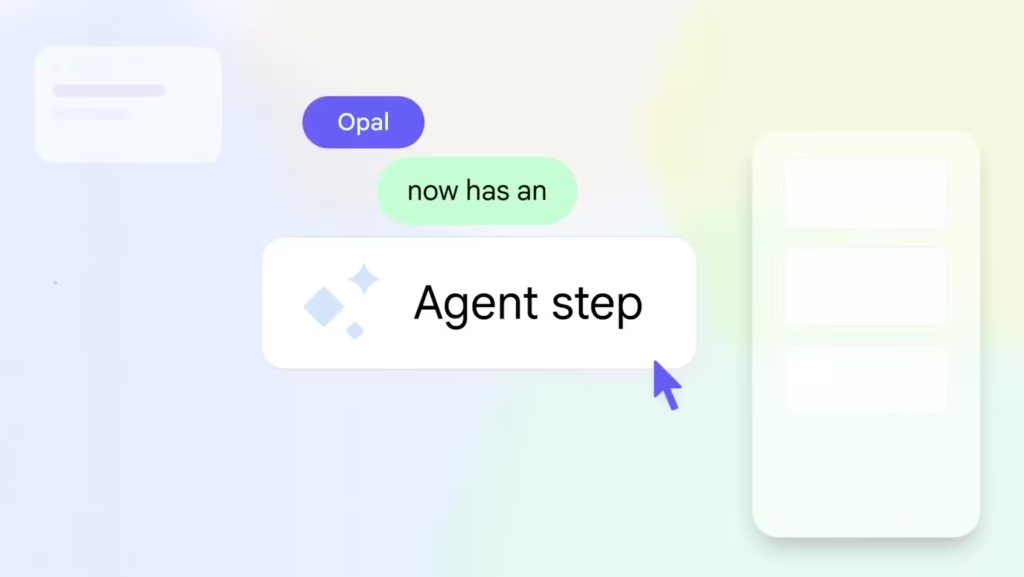
Google states that this feature allows users without technical knowledge to build complex workflows.
They create mini web apps, automate multi-step processes, and build tools tailored to specific needs.
For instance, a small business owner can create a simple order tracker. A marketer can build a campaign workflow, and a student can design a task planner.
All of this can be done using natural language instead of code.
Opal’s Growth
Opal has expanded quickly since its initial launch in July 2025. In October 2025, it expanded to 15 countries, including Canada, India, Japan, South Korea, Vietnam, Indonesia, Brazil, and Singapore.
November 2025 saw Opal become available in over 160 countries. And then in December 2025, it became integrated into the Gemini web app with a visual editor for building apps without code.
This expansion reflects growing global interest in no-code and AI-driven development tools.
AI App Builders
Replit, Lovable, Wabi, Emergent, and Rocket.new along with Google, are building platforms that help users to create apps using natural language.
The entire point is to reduce barriers to entry while competing to make app creation faster and more intuitive.
