

Hume AI is no ordinary voice tool. It reads emotions and responds with feeling. And it does all of this through a surprisingly affordable pricing structure. But before you sign up, you need to know exactly what each plan costs, and what they actually provide.
After spending a week testing Hume’s EVI feature with conversational prompts, I noticed it catches vocal hesitation and adjusts tone faster than any TTS tool I’ve used before. That responsiveness comes at a range of price points.
This guide breaks down every Hume AI pricing tier, explains the usage-based costs, and helps you pick the right plan for your needs.
What Is Hume AI?
Hume AI is an emotionally intelligent voice platform built for developers, creators, and enterprises. It offers two flagship products: Octave, a context-aware text-to-speech (TTS) engine, and EVI (Empathic Voice Interface), a real-time speech-to-speech model that detects emotional cues and responds naturally.
Hume doesn’t just convert words into audio. It interprets tone, rhythm, and sentiment. That makes it uniquely valuable, but it also means pricing involves two separate usage models you need to understand before committing.
Also read: Hume AI Honest Review [2026 ]
Hume AI Pricing Plans
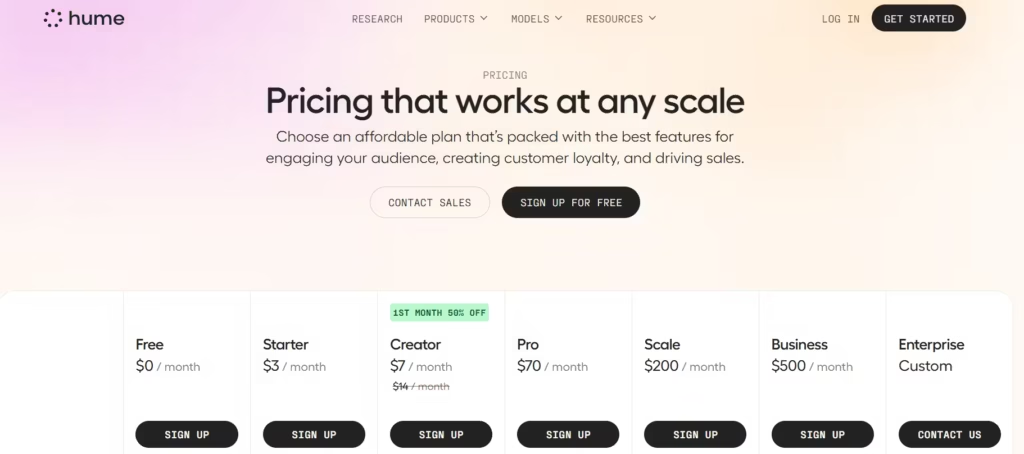
Hume AI’s plans are tiered by character limits, EVI minutes, and features. Here is every plan, pulled directly from the official pricing page.
1. Free Plan ($0/month)
The Free plan is a genuine entry point, not just a trial. You get 10,000 characters per month (roughly 10 minutes of audio) and 5 minutes of EVI usage. You also get unlimited voice cloning, which, honestly, surprised me. Being able to create and save as many custom voices as you like at zero cost is a feature most tools lock behind paid tiers.
That said, there are limitations. There is no commercial license, so you cannot use your output for monetised content. Overage is not available either; once you hit the cap, you stop completely. When I tested the Free plan, I hit the 10,000-character limit within two days of casual experimentation. This cap is genuinely restrictive if you’re doing more than light tinkering. Still, it is the cleanest way to test Hume’s technology before spending a dollar.
2. Starter Plan ($3/month)
At $3 a month, the Starter plan triples your character allowance to 30,000 characters (~30 minutes of audio). EVI usage jumps to 40 minutes per month, with additional minutes billed at $0.07 each. You also unlock 20 projects and 5 concurrent connections, enough headroom for small personal builds.
Here is the catch: the Starter plan still does not include a commercial license. That is the single biggest limitation at this tier. If you plan to use Hume’s voices in any public-facing or monetised product, the Starter plan will not cover you. You need to step up to Creator.
3. Creator Plan [$14/month (First Month 50% Off)]
This is where commercial use begins, and for most independent builders, it is the right starting point. At $14 per month, you unlock a commercial license plus 140,000 characters (~140 minutes), 200 EVI minutes, 1,000 projects, and 75 requests per minute.
Do not even consider the Starter plan if you are monetising content. I have seen too many creators hit the character cap mid-project and lose momentum. Go straight to Creator. Overage characters cost $0.15 per 1,000, and Hume currently offers a 50% discount on your first month, dropping the price to just $7 to start. For podcasters, audiobook producers, and app developers, this tier delivers real commercial value at a low entry cost.
4. Pro Plan ($70/month)
The Pro plan is where the numbers shift meaningfully. You receive 1,000,000 characters per month (~1,000 minutes of audio) and 1,200 EVI minutes, with additional EVI usage at $0.06 per minute. Overage characters drop to $0.12 per 1,000, so your per-unit cost falls as volume rises.
Concurrent connections increase to 10, and the project cap rises to 3,000. This tier suits growing startups, SaaS companies, and content studios producing audio at scale, teams that have outgrown Creator but are not yet pushing enterprise volumes.
5. Scale Plan ($200/month)
The Scale plan delivers 3,300,000 characters (~3,300 minutes) and 5,000 EVI minutes. Overage falls to $0.10 per 1,000 characters, and extra EVI usage drops to $0.05 per minute. You also get 3 team seats, 20 concurrent connections, and 10,000 projects.
This tier is built for high-volume operations: customer service platforms, large content agencies, or development teams building voice applications used by thousands of users daily. The inclusion of team seats here is notable; it signals that Scale is designed for collaborative, production-grade environments.
6. Business Plan ($500/month)
Hume’s highest self-serve tier includes 10,000,000 characters (~10,000 minutes) and 12,500 EVI minutes. Overage drops to just $0.05 per 1,000 characters, the lowest rate available outside Enterprise. You also get 5 team seats, 30 concurrent connections, and 20,000 projects.
At this level, the cost per minute of generated audio is hard to beat. ElevenLabs’ standard Multilingual API charges $0.12 per 1,000 characters; Hume’s Business plan overage rate is $0.05 per 1,000, a 58% lower rate for comparable output at scale, as of early 2026.
7. Enterprise Plan (Custom Pricing)
The Enterprise plan is fully custom. Hume tailors pricing based on your volume, use case, and compliance requirements. You get unlimited team seats, custom RPM limits, dedicated Slack support, and full compliance coverage: SOC 2 Type II, GDPR, and HIPAA.
If your organisation handles sensitive data, healthcare, finance, or legal, this is the only tier that meets those standards. Contact Hume’s sales team directly to negotiate terms.
Expression Measurement API Pricing
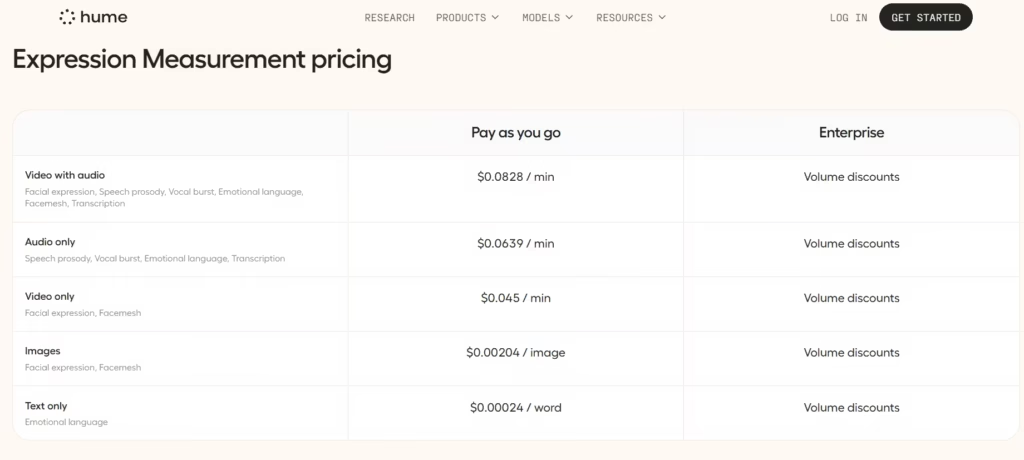
Separate from the subscription plans, Hume also has an Expression Measurement API. This tool analyses human emotion from audio, video, images, and text. It runs on a pure pay-as-you-go model with no subscription required.
Current rates:
- Video with audio (facial expression, prosody, transcription): $0.0828/minute
- Audio only (prosody, vocal bursts, emotional language): $0.0639/minute
- Video only (facial expression, facemesh): $0.045/minute
- Images (facial analysis): $0.00204/image
- Text only (emotional language): $0.00024/word
Note: Enterprise users can negotiate volume discounts across all categories. This API is especially relevant for research teams, UX analysts, and companies building empathy-aware applications that need to measure, not just generate, emotional data.
What Does a Commercial License Actually Cover?
This is a common point of confusion. Hume’s commercial license starts at the Creator plan and covers using Hume-generated voice content in monetised products, paid apps, client-facing projects, sponsored podcasts, sold audiobooks, and YouTube channels.
Without it, on the Free or Starter plans, your output is limited to personal, non-commercial use. So if you are building anything intended to reach a paying audience, budget at least $14/month. It is a low bar for the rights it unlocks.
Hume AI Pricing vs Competitors
ElevenLabs offers a larger voice library and ultra-low latency of around 75ms, compared to Hume’s sub-200ms. However, ElevenLabs charges more per character at comparable tiers, $0.12 per 1,000 characters on its standard Multilingual API versus Hume’s $0.05 at the Business tier, and lacks Hume’s native emotional intelligence model. It reads words well; Hume understands feelings.
In my view, Hume’s emotional intelligence makes it worth the slight latency trade-off for use cases like therapy bots or customer service, where empathy matters more than raw speed. A 125ms difference is imperceptible to most users; an emotionally tone-deaf response is not.
Murf AI provides 200+ voices and strong video editing integration. However, it does not offer LLM-based emotional context awareness or EVI-style real-time conversation capability.
Hume’s October 2025 launch of Octave 2 also delivered a 50% cost reduction versus the previous generation, making Hume the only voice platform combining built-in emotional intelligence with a pricing structure that undercuts rivals at high volume.
Which Hume AI Plan Should You Choose?
The right plan depends entirely on what you are building, and the decision is more nuanced than a bullet list suggests.
If you are testing or learning, start with the Free plan. No credit card, no commitment, just a real look at the technology. Be aware, though: two days of active experimentation can exhaust the 10,000-character cap. Treat it as a sampler, not a workspace.
If you are running non-commercial personal projects, the Starter plan at $3/month gives you enough room to experiment meaningfully. Just do not launch anything public on it.
If you are monetising content or building an app, do not consider anything below Creator. The $14/month commercial license is the minimum for legitimate commercial use, and the 50% first-month discount makes it a low-risk start.
If you are running a SaaS product or growing platform, move to Pro at $70/month. The lower overage rate and higher character ceiling pay for themselves quickly at moderate volume.
For high-volume operations, Scale ($200/month) or Business ($500/month) reduces your per-character cost in ways that compound at scale. Run the numbers on your monthly character usage; if overage charges on a lower tier are approaching the next plan’s base price, upgrade immediately.
And if your organisation operates in healthcare, finance, or any regulated industry, the Enterprise plan is non-negotiable. SOC 2 Type II, GDPR, and HIPAA compliance are only available at that tier.
Note: Hume regularly offers a 50% first-month discount on the Creator plan, bringing it to $7. Check the pricing page before subscribing.
Is Hume AI Worth the Price?
Hume AI pricing is well-calibrated for what the platform delivers. No other voice AI combines emotion recognition, LLM-based contextual speech, and real-time conversational capability at these price points.
The Free and Starter plans give anyone a real look at the technology. The Creator plan unlocks commercial use for $14/month. The upper tiers reward volume with progressively lower per-unit costs that outpace rivals like ElevenLabs at scale.
If emotional authenticity matters to your product, Hume AI delivers significant value that many other tools cannot replicate.
