
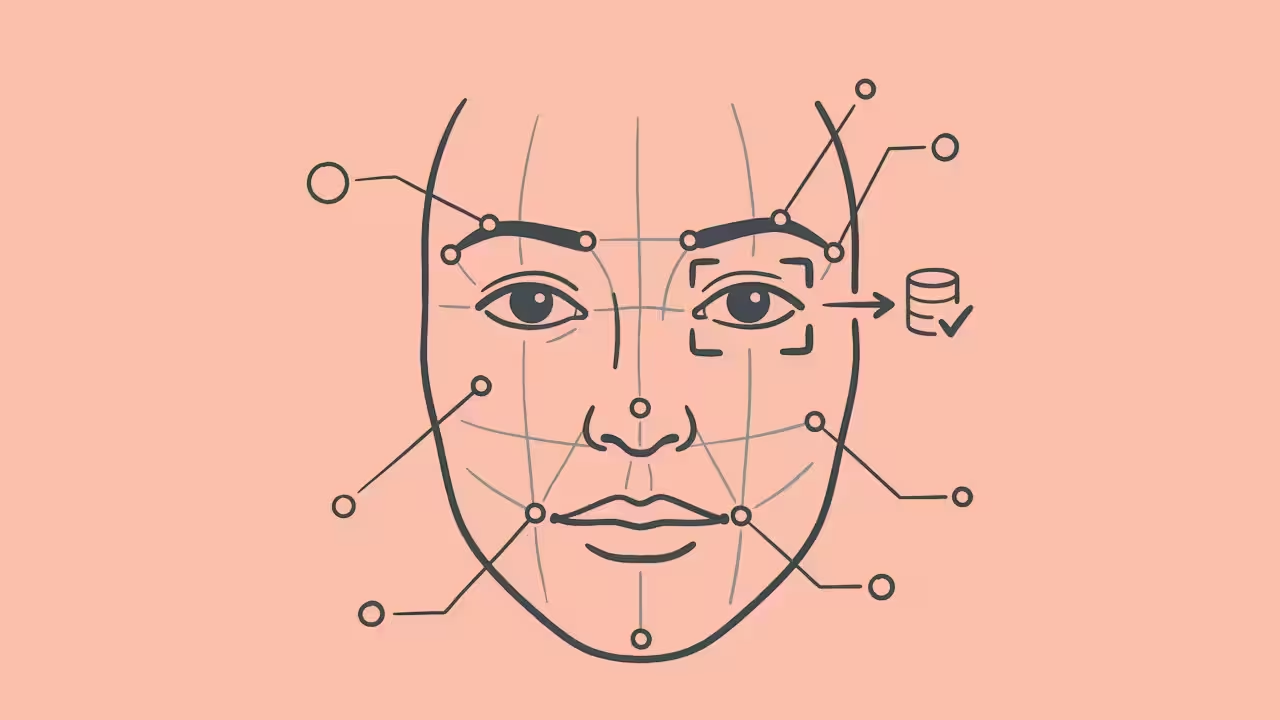

Clearview AI dominates conversations about facial recognition technology. Law enforcement agencies love its speed, while privacy-conscious people have some reservations about its methods. So, which side is right? The truth sits somewhere in between.
Clearview AI has strong technical performance, but it also has serious legal and ethical issues. This article breaks down the evidence so you can judge for yourself.
What Is Clearview AI?
Clearview AI is a facial recognition company that matches uploaded photos against a massive database of scraped images. Photo uploads are met with matching images found online. Consequently, police departments, federal agencies, and even the U.S. military now rely on it to identify unknown faces quickly.
Where Clearview AI Gets Its Data
Clearview AI built its database by scraping publicly available photos from websites and social media platforms. The company claimed to have scraped more than 10 billion images as of October 2021. Since then, growth has accelerated dramatically.
By late 2023, Clearview’s reference database had surpassed 70 billion images, doubling its volume within just 20 months. By mid-2024, the company’s database had reached 50 billion images, while law enforcement searches doubled to roughly 2 million annually.
This scraping fuels most of the controversy surrounding the tool. Clearview never asked platforms like Facebook or Instagram for permission. It never asked individuals either. As a result, nearly anyone who has ever posted a public photo online could be in the database. That includes children, activists, and crime victims alongside actual suspects.
The Facial Recognition Algorithm
Clearview’s algorithm converts each face into a numeric vector, sometimes called an embedding. Neural networks generate this vector, then the system compares it against billions of other vectors to find likely matches.
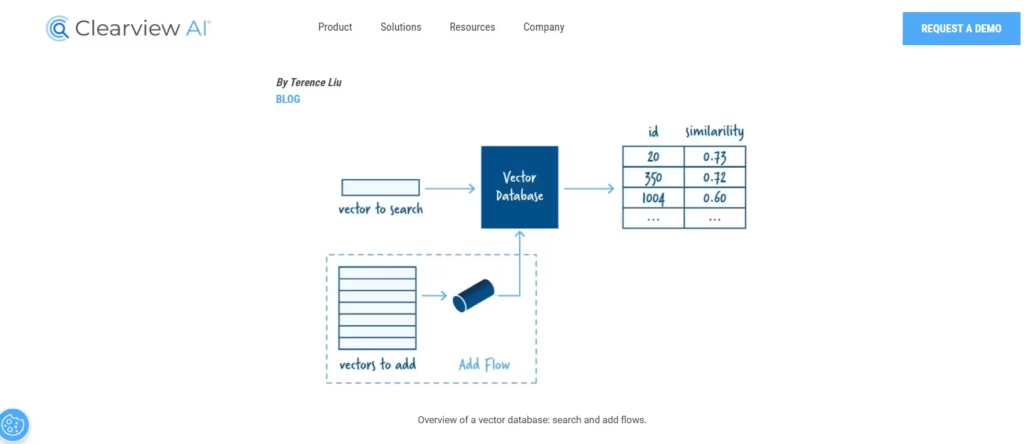
Because the database operates at such a massive scale, Clearview built custom infrastructure to keep searches fast. The company grew its search system from handling a few million face images to searching roughly 30 billion, developing new techniques to manage that scale efficiently.
Speed is another quality Clearview possesses. A search that once took minutes now returns results in a fraction of a second, even across tens of billions of records.
Benchmark Standards Clearview AI Has Hit
The National Institute of Standards and Technology (NIST) runs the industry’s most respected accuracy benchmark: the Face Recognition Vendor Test (FRVT). Clearview has submitted algorithms to this test multiple times, and the results look impressive on paper.
In October 2021, Clearview’s first algorithm submission ranked No. 1 in the U.S. for matching visa photos (99.81%), mugshot photos (99.76%), visa-border photos (99.7%), and border photos (99.42%), placing in the top five worldwide out of 650 algorithms tested.
The following month, a second test focused on one-to-many matching, the mode most relevant to criminal investigations. Clearview’s algorithm ranked No. 1 in the U.S. and placed in the top 10 worldwide across every category, out of 328 algorithms evaluated.
NIST tests dozens of vendors, and several competitors post comparably strong numbers. For instance, SenseTime scored the top overall result on a recent FRVT identification leaderboard, while Clearview finished as the top U.S.-based provider. So, Clearview performs excellently among American vendors, but it doesn’t automatically outrank every global competitor.
How Clearview AI Has Helped Law Enforcement
Police departments credit Clearview with solving cases that conventional methods couldn’t crack. Officers upload a still image from surveillance footage, and the tool often returns a name within seconds. Investigators then use that lead to build a case, locate a suspect, or clear an innocent person.
International use cases have also increased. During the war in Ukraine, Ukrainian government agencies used Clearview’s technology across 18 agencies, helping identify more than 230,000 Russian soldiers. Domestically, federal use has also increased. Immigration and Customs Enforcement, Customs and Border Protection, and even Army Special Forces units now hold active contracts, according to recent procurement records.
Still, the tool isn’t infallible. Wrongful arrests tied to facial recognition mismatches have surfaced repeatedly. In one case, a Florida man was wrongfully arrested in August 2024 after a facial recognition match, combined with an unreliable photo lineup, led police to the wrong suspect.
He is far from alone; watchdog groups have documented multiple similar wrongful-arrest cases nationwide. These incidents highlight a core risk: facial recognition can generate leads, but it cannot replace solid investigative corroboration.
Privacy Violations
Clearview’s rapid rise came with equally rapid backlash. Regulators worldwide have criticized its data practices. In the Netherlands, the Dutch Data Protection Authority fined Clearview roughly €30.5 million (about $34 million) for violating the EU’s General Data Protection Regulation.
Italy issued a separate GDPR penalty, and France, Greece, and the United Kingdom launched their own investigations. The UK’s fine was later overturned on jurisdictional grounds, but the underlying privacy concerns are unaddressed.
Domestically, the American Civil Liberties Union sued Clearview in Illinois in 2020, arguing the company violated the state’s Biometric Information Privacy Act. The case settled in 2022. Under that agreement, Clearview was permanently banned nationwide from making its faceprint database available to most private companies and individuals, with sales restricted primarily to government agencies.
Individual concerns are left out of the equation. Individuals, more than organizations and agencies, are concerned about privacy. A Reddit thread I examined was filled with post after post of people detailing their discomfort with their pictures being part of a company’s database without consent.
Ethical issues like that and others probably triggered a nationwide class action lawsuit. After years of litigation, Clearview and class counsel reached a settlement in June 2024, granting the class a 23% equity stake in the company, valued at approximately $51.75 million based on a January 2024 valuation.
Notably, 22 state attorneys general objected, arguing the deal failed to provide adequate monetary relief. A federal judge approved the settlement anyway in March 2025.
What Reputable Organizations Say
NIST’s testing data supports Clearview’s accuracy claims, at least among top-performing algorithms. The agency’s benchmarks show minimal demographic accuracy gaps among leading vendors, which Clearview cites as evidence against bias claims.
Civil liberties groups tell a different story. The ACLU has repeatedly argued that Clearview’s technology threatens vulnerable populations, including domestic violence survivors and undocumented immigrants, who depend on anonymity for safety.
Privacy regulators across Europe have similarly labeled Clearview’s data collection practices unlawful under GDPR standards. Meanwhile, some U.S. senators have publicly shared concerns about the company’s unchecked access to biometric data.
So, Is Clearview AI the Best Facial Recognition Tool?
Technically, Clearview AI ranks among the most accurate facial recognition platforms available today, particularly for U.S.-based law enforcement use cases. Its NIST scores back that up. However, “best” depends heavily on what you’re measuring. Other popular competitors like FacecheckID are also good options.
| Clearview AI | FaceCheck ID | SenseTime | |
|---|---|---|---|
| Public access | No — law enforcement, government, and vetted enterprise only | Yes — open to any paying member of the public | No — enterprise and government deployments only |
| Database size | ~50–70 billion images (scraped from public web/social media) | Public web images, exact size undisclosed | Not a public search database — computer vision platform |
| NIST accuracy | 99.81% (visa photos), 99.76% (mugshots) | Not independently NIST-benchmarked | Not directly comparable — different use case |
| Primary use case | Criminal investigation, government ID matching | Public reverse-image/identity search | Enterprise/government computer vision infrastructure |
| Pricing model | Not public — contract/quote-based | Subscription, public pricing tiers | Not public — enterprise contract |
| Known controversies | Illinois BIPA settlement, €30.5M Dutch fine, UK/Australia scraping rulings | Ongoing privacy criticism, less regulatory action to date | Human rights criticism over surveillance deployments in China |
If raw matching accuracy and database scale matter most, Clearview leads the pack. If ethical data sourcing, regulatory compliance, and public trust matter more, the picture looks far less favorable.
No tool exists in a vacuum. Clearview’s power comes directly from the same scraping practices that triggered lawsuits, fines, and bans across multiple countries. Anyone evaluating this technology should weigh both sides carefully before deciding whether performance justifies the privacy trade-offs involved.
FAQ
1) Is Clearview AI banned in the U.S.?
No, Clearview AI is not banned nationwide, but its use is restricted in several places.
A handful of U.S. cities and states have banned or limited government use of facial recognition technology by law enforcement, and Clearview separately settled a class-action lawsuit under Illinois’ Biometric Information Privacy Act (BIPA), agreeing to limit sales to private companies and individuals in that state.
2) Is Clearview AI available to the public?
No. Clearview AI restricts its platform to law enforcement, government agencies, and select enterprise/security customers it does not offer a consumer-facing product.
Members of the public can’t create an account or run searches themselves, which is one of the key differences from tools like FaceCheck ID or PimEyes.
3) What alternatives exist to Clearview AI?
The closest comparisons are FaceCheck ID, which is open to the general public and searches a broader set of public web images; PimEyes, another public-access reverse image/facial search tool; and SenseTime, which focuses more on enterprise and government-scale computer vision infrastructure in Asia rather than a searchable public database.
4) Does Clearview AI have access to private data?
Clearview’s core controversy is exactly this question.
The company built its database by scraping publicly posted images from social media and other websites without the consent of the people pictured or the platforms themselves — not from private or hacked sources.
