

Six months ago, Manus was Meta’s $2 billion prize. Beijing killed the deal.
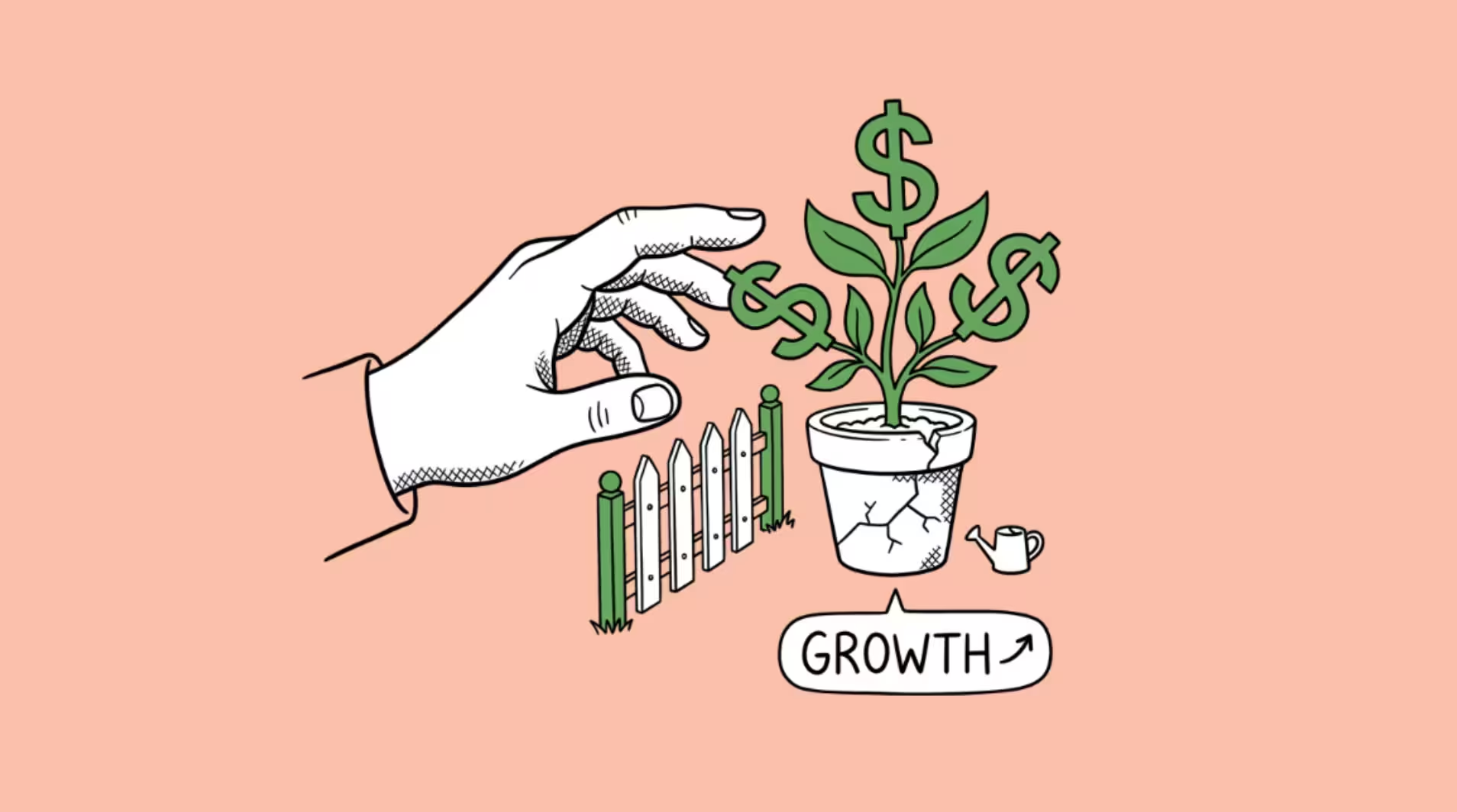
Today the company raised $500 million on its own, revenue has quintupled, and it’s reportedly heading for a Hong Kong IPO. The breakup was the best thing that ever happened to it.
Butterfly Effect, the parent company of AI agent startup Manus, announced Thursday via WeChat that it has raised more than $500 million. B
oyu Capital and IDG Capital co-led the round. Existing investors Tencent, HSG (formerly Sequoia China), and ZhenFund also participated. Manus didn’t disclose its valuation, but was reportedly in talks last month at a $4 billion number.
If that’s accurate, Manus is now worth twice what Meta agreed to pay for it in December.
The Deal That Wasn’t
The timeline is worth walking through because it explains why this funding round matters more than a typical $500 million raise.
Manus went viral in early 2025 with a demo of its AI agent.
It was scrappy, imperfect, but showed something real: a general-purpose AI agent that could actually do things.
The company relocated its team from China to Singapore in mid-2025.
By December, Meta came calling with a $2 billion acquisition offer.
At the time, Manus had roughly $100 million in annual recurring revenue.
Then Beijing stepped in.
In April, Chinese authorities ordered Manus to unwind the Meta deal amid growing concerns about Chinese AI talent and technology flowing to Western companies. Meta officially cut ties in June.
Manus resumed independent operations in August and had to delete some user data as part of the split.
Revenue Went From $100M to $500M During the Chaos
Here’s the number that investors noticed.
The Information reported in June that Manus’ annualized revenue had surged to about $500 million, up from $100 million when the Meta deal was signed.
Five times the revenue in roughly six months, while the company was simultaneously being torn apart by regulators, deleting user data, and rebuilding as an independent entity.
That kind of growth during that kind of disruption is why Boyu and IDG wrote the check. Dan Wang, China director at Eurasia Group, told CNBC: “The fundraising shows that the short-term fallout of the Meta case has been contained and investors are willing to back Manus as an independent company.”
The company is also reportedly considering a Hong Kong IPO, potentially using a joint-venture structure incorporated in China.
Manus 2.0 and the Agent With a Phone Number
Manus didn’t spend the post-Meta months sitting still.
It recently launched Manus 2.0, built on a new in-house execution system called Cascade that replaces the previous architecture.
The company also introduced Cue, a standalone app that gives personal AI agents their own email addresses, phone numbers, digital wallets, and computers.
That last part is worth pausing on.
Cue agents can communicate with services, handle tasks, and make payments within limits the user sets. It’s the most aggressive vision of a personal AI agent anyone has shipped to consumers.
While OpenAI and Anthropic talk about agents that work alongside you, Manus is building agents that work as you.
The product competes with Cursor, Lovable, and Replit in the vibe-coding space and with OpenAI’s Dots and Meta’s Muse in the personal agent space. That last competitor is ironic given the history.
Meta Built Its Own Version Anyway
After failing to acquire Manus, Meta launched its own agent called Muse in early September, modeled on the open-source agent framework OpenClaw.
So Meta ended up building a competitor to the company it tried to buy, using technology from a different open-source project entirely.
Whether Muse can match what Manus has built with $500 million in ARR and a dedicated team is an open question.
But the competitive dynamic is clear: China blocked the acquisition, Manus got stronger, Meta built a workaround, and now both are competing for the same users.
For Manus, the $500 million raise is proof of concept. Not for the product, which already proved itself through revenue.
For the thesis that a Chinese-founded AI startup can survive a geopolitical crisis, lose a $2 billion acquirer, and come out the other side bigger than before.
The company said it plans to keep hiring globally.
At $4 billion, it’s one of the most valuable AI agent startups in the world. Six months ago it was supposed to be a Meta division. Nobody saw this version of the story coming.
