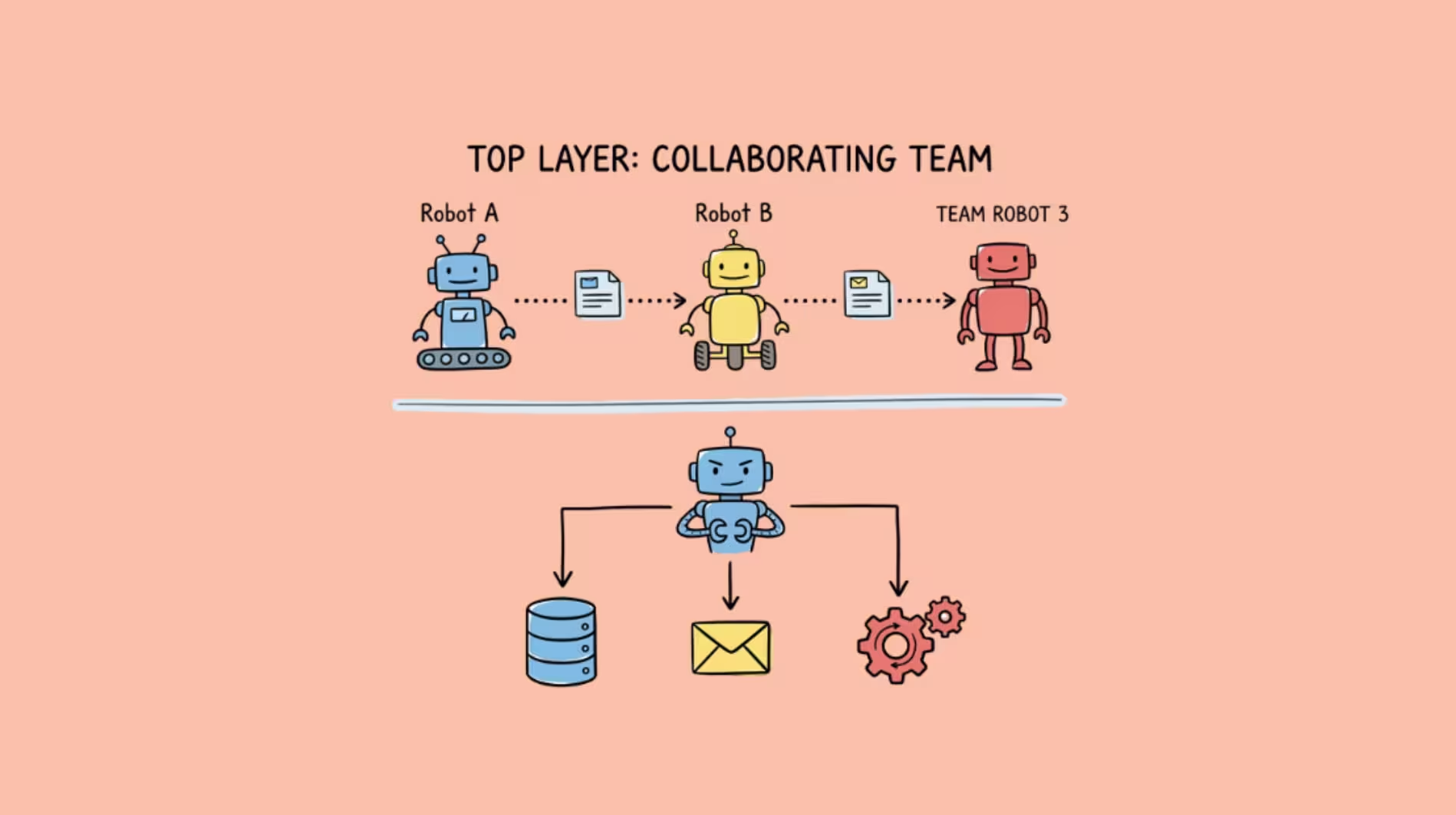

MCP gives your agent hands. A2A gives your agents colleagues.
That is the entire distinction, and getting it wrong is the most common architecture mistake in the AI agent space right now.
The Model Context Protocol (MCP), created by Anthropic in November 2024, standardizes how a single AI agent connects to external tools, databases, and APIs.
The Agent2Agent Protocol (A2A), introduced by Google in April 2025, standardizes how multiple AI agents communicate, delegate tasks, and collaborate across platforms they do not control.
One handles agent-to-tool communication. The other handles agent-to-agent communication.
Different layers, different jobs, and most production systems built in 2026 run both simultaneously.
After deploying both protocols across 4 enterprise projects, I can tell you exactly when you need MCP, when you need A2A, and when you need the two working together.
What Are MCP and A2A? (Definitions and How Each Works)
MCP: How an Agent Talks to Tools
MCP is the standard interface between an AI agent and the external world.
Before MCP, every tool integration required custom code.
Want your agent to query a database? Write a custom connector. Want it to read files from Google Drive? Write another one. Want it to call Slack’s API? Another connector. Every model-tool pairing was bespoke.
MCP replaced that with a universal protocol. Build one MCP server for your tool, and any MCP-compatible agent can use it. Anthropic’s analogy is “USB-C for AI”: one standardized port that any device can plug into.
The architecture is straightforward:
Host application (Claude, ChatGPT, your custom agent) → connects to → MCP client → communicates with → MCP server → accesses → tool, database, API, or file system
MCP exposes three types of capabilities to the agent:
| Primitive | What it does | Example |
| Tools | Actions the agent can execute | “Search this database,” “Send this email,” “Create this file” |
| Resources | Data the agent can read | Files, database records, API responses |
| Prompts | Reusable instruction templates | “Summarize this document using this format” |
By February 2026, MCP crossed 97 million monthly SDK downloads across Python and TypeScript.
Every major AI provider has adopted it: Anthropic, OpenAI, Google, Microsoft, and Amazon. Both protocols were donated to the Linux Foundation’s Agentic AI Foundation for vendor-neutral governance.
A2A: How Agents Talk to Each Other
A2A solves a completely different problem.
It is not about connecting an agent to a tool. It is about connecting an agent to another agent that was built by a different team, runs on a different model, and operates behind a different trust boundary.
The architecture uses a client-remote model:
Client agent (the one requesting work) → discovers → Agent Card (a structured description of what the remote agent can do) → sends task → Remote agent (the one doing the work) → returns results
Agent Cards are the core concept. Every A2A-compatible agent publishes a card describing its capabilities, supported input types, and endpoint.
Think of it as DNS for agents: the client agent reads the card, decides whether this remote agent can handle its task, and delegates accordingly.
By April 2026, A2A had 150+ supporting organizations and reached production-grade enterprise adoption.
The critical design decision: the remote agent performs its task autonomously without access to the client’s internal context. The client says “research these 5 competitors.”
The remote agent does the research and returns the results. It never sees the client’s memory, conversation history, or private data.
That isolation is essential for enterprise deployments where agents from different vendors must collaborate without exposing internal systems.
A2A also includes a task lifecycle: tasks move through states (submitted → working → input-needed → completed → failed) with structured status updates.
For long-running workflows (a research agent working for 20 minutes, a compliance agent reviewing a document), the client agent tracks progress without polling.
MCP vs A2A: Core Differences
| Dimension | MCP | A2A |
| Created by | Anthropic (November 2024) | Google (April 2025) |
| Governed by | Linux Foundation (AAIF) | Linux Foundation (AAIF) |
| What it connects | Agent ↔ Tool/Data/API | Agent ↔ Agent |
| Communication direction | Vertical (agent reaches down to resources) | Horizontal (agent reaches across to peers) |
| Core analogy | USB-C port (universal tool connector) | Business card exchange (agent discovery + delegation) |
| Architecture | Client-server (host ↔ MCP server ↔ tool) | Client-remote agent (requester ↔ Agent Card ↔ worker) |
| Key primitive | Tools, Resources, Prompts | Agent Cards, Tasks, Messages |
| Context sharing | Full (agent sees everything the tool exposes) | Isolated (remote agent never sees client’s internal state) |
| Trust model | Same trust boundary (agent owns its tools) | Cross-boundary (agents from different vendors/teams) |
| Task lifecycle | Synchronous (call tool, get result) | Asynchronous (submit task, track state, receive result) |
| Adoption | 97M+ monthly SDK downloads | 150+ supporting organizations |
| Best for | Single agent that needs to use many tools | Multiple agents that need to collaborate on complex workflows |
| Does NOT do | Agent-to-agent collaboration | Agent-to-tool connections |
The simplest way to remember: if you are connecting an agent to a thing (a database, an API, a file system), use MCP.
If you are connecting an agent to another agent (a billing bot, a research assistant, a compliance checker), use A2A.
The protocols do not overlap. They stack.
When to Use MCP, A2A, or Both Together
Use MCP Alone When:
Your system has a single agent that needs to access multiple tools. This is the most common starting point and where most teams should begin.
Example: a customer support agent that reads from your CRM (MCP server for Salesforce), searches your knowledge base (MCP server for your docs), checks order status (MCP server for your order system), and sends follow-up emails (MCP server for Gmail).
One agent, four tools, zero agent-to-agent communication needed.
In my experience, roughly 70% of AI agent deployments I have evaluated need only MCP.
They have one agent with multiple capabilities, not multiple agents collaborating. Starting with MCP alone avoids the complexity of multi-agent orchestration when a single well-connected agent solves the problem.
Use A2A Alone When:
You have multiple pre-built agents (possibly from different vendors) that need to coordinate without sharing internal state. This is rare without MCP also being present, but it exists.
Example: an enterprise with a Salesforce Einstein agent for CRM, a ServiceNow agent for IT tickets, and a custom internal agent for HR questions.
None of these agents share a codebase or a trust boundary. A2A lets the triage agent route incoming requests to the right specialist agent without any of them needing access to each other’s internal systems.
Use Both Together When:
This is where production multi-agent systems live in 2026. Each agent uses MCP to connect to its own tools. A2A connects the agents to each other.
Here is a concrete architecture from a client deployment:
Customer submits a refund request.
- A triage agent reads the request (via MCP connection to the support ticket system) and classifies it.
- The triage agent discovers (via A2A Agent Card) that a billing agent handles refund decisions.
- The triage agent delegates the task to the billing agent via A2A.
- The billing agent uses MCP to query the payment system, check the order database, and verify the refund policy.
- The billing agent returns its decision to the triage agent via A2A.
- The triage agent uses MCP to update the ticket and send the customer notification.
MCP handles every vertical connection (agent ↔ database, agent ↔ email, agent ↔ payment system). A2A handles every horizontal connection (triage agent ↔ billing agent). Remove either protocol and the workflow breaks.
The key insight from deploying this: MCP is infrastructure. A2A is coordination. You need infrastructure before you need coordination. Start with MCP. Add A2A when your system grows past a single agent.
Decision Framework
| Your situation | Protocol needed |
| One agent connecting to multiple tools and data sources | MCP only |
| Multiple agents from the same codebase sharing tasks | MCP + internal orchestration (LangGraph, CrewAI) |
| Multiple agents from different vendors collaborating | A2A + MCP on each agent |
| Agents that need to discover unknown peers dynamically | A2A (Agent Cards enable discovery) |
| Agent needs to call a database, API, or file system | MCP |
| Agent needs to delegate a task to another autonomous agent | A2A |
| Enterprise with agents across departments/vendors | Both (MCP per agent, A2A between agents) |
You do not pick between MCP and A2A any more than you pick between HTTP and TCP. They operate at different layers.
The question is not “MCP or A2A?” It is “do I need just MCP, or do I need MCP plus A2A?”
In my 4 enterprise deployments:
- 3 out of 4 started with MCP only and added A2A later when the system grew to multiple agents
- 1 started with both from day one because the architecture required cross-vendor agent collaboration from the start
- Zero used A2A without MCP. Every agent needs tools. Not every agent needs peers.
If you are building your first agent system, start with MCP. It is simpler, better documented, and solves the immediate problem (connecting your agent to your tools).
Add A2A when you have a second agent that needs to collaborate with the first without sharing its internals.
That sequence (MCP first, A2A when needed) prevents over-engineering while keeping the architecture extensible.
FAQs
1) Are MCP and A2A competing protocols?
No. MCP handles agent-to-tool communication. A2A handles agent-to-agent communication.
They operate at different layers of the stack and most production multi-agent systems use both simultaneously. Both are governed by the Linux Foundation’s Agentic AI Foundation.
2) Do I need both MCP and A2A?
If you have a single agent connecting to multiple tools, you only need MCP. If you have multiple agents that need to collaborate (especially agents from different vendors or teams), you need both. Start with MCP. Add A2A when the architecture requires agent-to-agent coordination.
3) What is an Agent Card in A2A?
An Agent Card is a structured description that an A2A-compatible agent publishes to advertise its capabilities, supported input types, and endpoint. Other agents read the card to discover what the agent can do and decide whether to delegate a task to it. Think of it as a business card for AI agents.
4) Who created MCP and A2A?
MCP was created by Anthropic (November 2024). A2A was created by Google (April 2025). Both have been donated to the Linux Foundation’s Agentic AI Foundation for vendor-neutral governance. Both are open protocols that any platform can implement.
5) Can I use A2A without MCP?
Technically yes, but it is uncommon. A2A connects agents to other agents, but each individual agent still needs to access tools and data to do useful work. MCP provides that tool access. In practice, every A2A deployment I have seen includes MCP on each participating agent.
6) Which protocol should I learn first?
MCP. It has broader adoption (97M+ monthly SDK downloads), better documentation, and solves the more common problem (connecting an agent to tools). A2A becomes relevant when you operate multiple agents that need to collaborate across trust boundaries.
