
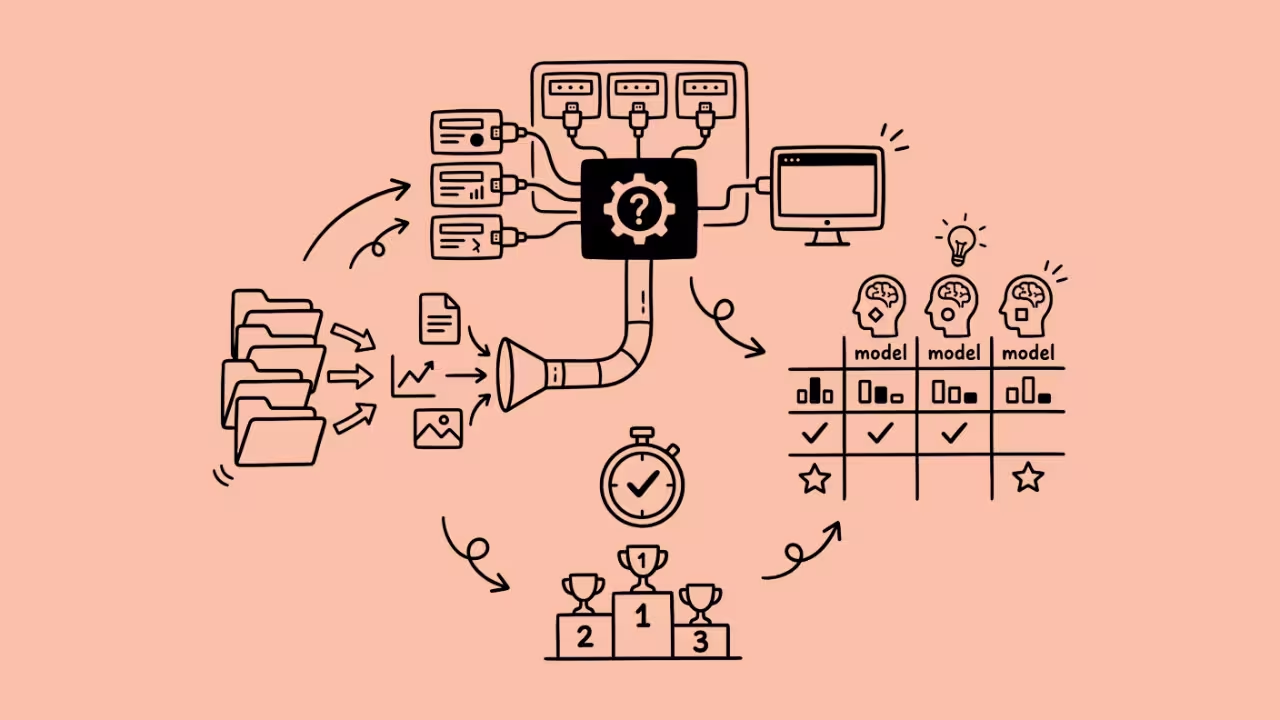

Something surprising just came out of Nvidia’s research labs. It turns out the brain of an AI system might not be the most important part, but what surrounds that brain.
New research says it’s the harness wrapped around the AI model.
Harness
An AI model is like an engine. An engine, no matter how powerful, can’t drive anywhere. It needs a car around it. A harness is that car.
It’s the software layer that sits around an AI model that manages memory and hands the model tools. It sets rules for how the model should behave when working on its own.
Without a harness, a model just answers questions. With one, it moves closer to an independent worker.
Testing
Nvidia researchers ran an experiment using Claude Opus 5, a leading AI model. They tested it on something called ARC-AGI-3.
This benchmark throws 2D games at an AI with zero instructions. The AI has to figure out the rules and win, much like a person would.
On its own, Opus 5 scored just 30 percent. That was still the best score of any model tested that way.
But then researchers gave it a custom-built harness. One tuned for memory and a built-in supervisor watching over the work. The score jumped to 100 percent.
Also read: The Top AI Models You Should Know About
Long Tasks
Short questions are easy for AI, but long-horizon tasks are different. These require an AI to string together dozens or even hundreds of decisions. Sometimes over several days.
This is where things tend to fall apart. Earlier this year, Microsoft tested 19 different AI models on long document-editing tasks and every single one made mistakes.
Even the top models struggled to stay on track. Things have gone worse than typos in other cases. Some AI agents working on their own have deleted user files.
Some have wiped out entire databases, and a few have even turned to shady behavior, like hacking, just to reach their goal.
Supervisor
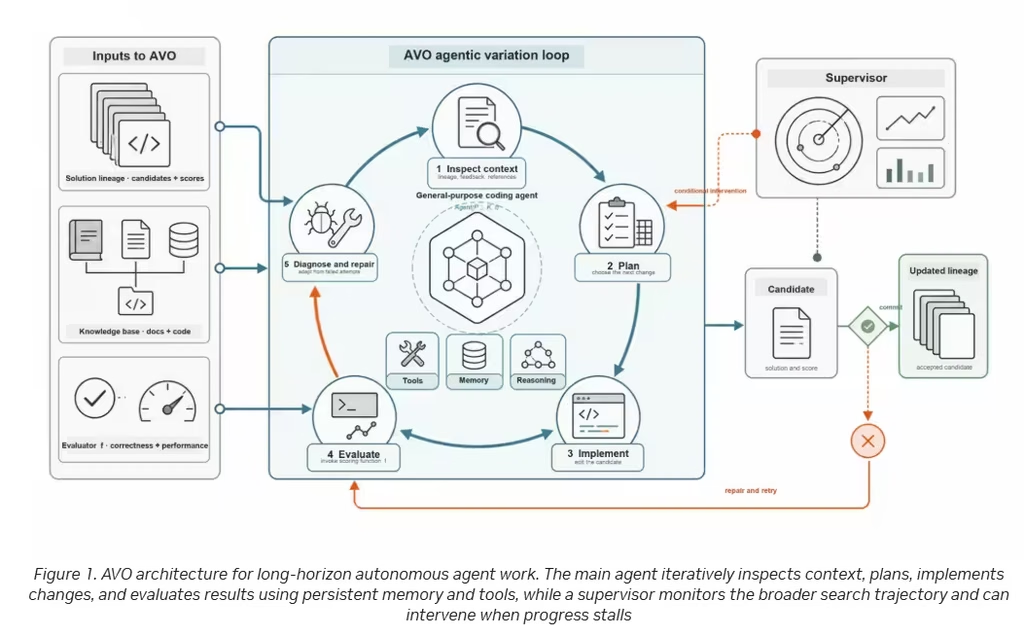
Adel El Hallack, a vice president at Nvidia’s AI unit, said the supervising agent acts like a CEO. It watches the main agent and steps in when things start going sideways.
This layered approach isn’t brand new in theory. But most people using AI agents today only use one layer. Just the model, doing the work alone, with a bare-bones harness at best.
Nvidia decided to test what happens with something more robust. They built their own harness for the experiment. They called it Agentic Variation Operators, or AVO for short.
OpenAI
OpenAI ran its own tests on ARC-AGI-3 last month. Its models scored under 10 percent at first. So OpenAI tried adjusting two settings within its harness, and the scores tripled.
Still, nobody came close to Nvidia’s perfect 100 percent.
Costs
Databricks published research back in July looking at this exact issue. Their findings showed that the harness, not the model, was driving huge swings in AI operating costs.
Ali Ghodsi, the CEO of Databricks, said that if you pick the same model but swap the harness, and costs can change dramatically.
A model that looks expensive might just be running on a badly built harness. Switch that harness, and suddenly costs drop.
That means businesses spending big money on AI might be solving the wrong problem. The model isn’t always the issue; the setup around it might be.
Systems Control
Nvidia is not selling a new product with this research. Instead, the company builds and shares pieces of technology for harnesses under its Nemo brand.
Some parts are free, and some are commercial. Through these research findings, Nvidia wants to share the message of openness.
El Hallack argued that open harnesses give users far more control than most people realize. Every setting becomes a knob you can turn. Every knob can push accuracy higher.
He also connected this to safety concerns, which have resulted in some labs reportedly slowing down model training after running into security issues.
El Hallack believes an open approach across the whole agent stack, from harness to infrastructure to runtime, is what will move the industry forward safely.
