


Nvidia is preparing to send one of its compact GPU platforms to the Moon as part of a new robotic mission led by space robotics company Lunar Outpost.
If the mission succeeds, it could mark the first time an Nvidia GPU operates on the lunar surface.
It could also open the door for smarter robots that help build a long-term human presence on the Moon.
Lunar Rover
Lunar Outpost announced that its next lunar rover will use Nvidia’s Jetson platform to power its lidar system.
Lidar uses laser pulses to create detailed maps of the surrounding environment. This allows robots to navigate rough terrain and avoid obstacles without human control.
The company plans to compare the Jetson platform with its existing flight computer to see how well it performs under the harsh conditions of space.
Lunar Outpost CEO Justin Cyrus said the company wants to understand both the strengths and limits of GPU-powered systems before fully adopting them for future space missions.
If everything goes as planned, the rover will likely carry the first GPU ever to reach the Moon’s surface.
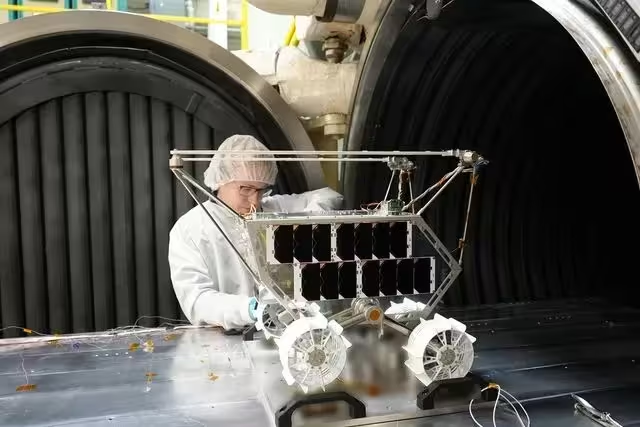
Nvidia’s Jetson Platform
While Nvidia is widely known for its powerful AI chips used in data centers, the Jetson platform serves a very different purpose.
Jetson chips are small, energy-efficient, and designed for edge computing. Instead of sending data back to Earth for processing, they allow robots to analyze information locally in real time.
That capability is especially valuable on the Moon. Communication delays make it difficult to control robots from Earth every second.
A rover that can quickly understand its surroundings and make decisions on its own can work faster and more safely.
Lunar Outpost says its software has improved over the past several years.
Today, it combines conventional programmed systems with newer AI-powered decision-making tools to improve autonomy.
NASA
NASA has been investing heavily in commercial lunar exploration through its Commercial Lunar Payload Services (CLPS) program.
The agency pays private companies to deliver scientific instruments and technology to the Moon before astronauts return under the Artemis program.
These robotic missions help scientists study lunar soil, map difficult terrain, and search for valuable resources such as water ice.
Water could eventually support astronauts by providing drinking water, breathable oxygen, and even rocket fuel.
Lunar Outpost’s upcoming rover will ride aboard an Intuitive Machines lunar lander. The vehicle is designed to explore craters and other locations that orbiting spacecraft cannot easily reach.
A future mission will travel to Reiner Gamma, one of the Moon’s most unusual regions.
Scientists have long been interested in the area because of its mysterious magnetic properties, which remain poorly understood.
Both missions are expected to launch aboard SpaceX Falcon 9 rockets before the end of 2026, according to Lunar Outpost.
Space Electronics
Running advanced computer hardware on Earth is difficult enough. Operating it on the Moon presents an entirely different challenge.
Unlike satellites orbiting close to Earth, lunar equipment faces direct exposure to cosmic radiation.
Temperatures also swing dramatically between scorching daytime heat and freezing lunar nights.
Those harsh conditions can damage electronics and shorten their lifespan. At the same time, lunar missions have strict power limits, meaning every component must use energy efficiently.
Lunar Outpost hopes Nvidia’s Jetson platform can survive these conditions while giving its rovers much greater computing power.
Also read: SpaceX Just Made History
Nvidia’s Projects
This is not Nvidia’s only lunar project. The company recently announced a partnership with Firefly Aerospace.
Under that collaboration, Nvidia’s Jetson platform will operate aboard Firefly’s Elytra orbital vehicle around the Moon.
The spacecraft will process images in orbit to help scientists create better lunar maps while also tracking the increasing number of robotic vehicles operating on the surface.
Together, these projects show Nvidia is steadily expanding beyond traditional AI computing into space exploration.
Robotic Workforce
Lunar Outpost believes autonomous robots will play a major role in creating permanent lunar infrastructure.
Instead of relying only on astronauts, future missions could use fleets of intelligent robots to transport equipment, inspect construction sites, gather resources, and perform dangerous tasks long before humans arrive.
The company has several additional lunar rover missions planned over the next few years.
It is also developing Pegasus, a much larger rover designed to transport astronauts across the Moon.
Pegasus is expected to fly aboard Blue Origin’s Blue Moon lunar lander. However, that schedule depends on Blue Origin’s progress after an anomaly involving its launch vehicle earlier this year.
Despite the uncertainty, Lunar Outpost says it continues to work toward NASA’s broader goal of supporting sustained human operations on the Moon later this decade.
