


When buyers call in, they expect faster answers, which agents will struggle to provide on their own. Expectations are higher, necessitating the use of contact center AI. That’s why AI agent assist software, virtual agents, and conversation intelligence platforms have become core infrastructure rather than nice-to-have add-ons.
This guide ranks the best contact center AI tools available today. Each entry includes pricing, standout features, and the use case it fits best. Use it to make quick comparisons between contact center AI software. Afterwards, dig deeper into the platforms that match your budget and channel mix.
Best Contact Center AI by Use Case
- Best all-around CCaaS platform: Genesys Cloud CX (A mix of omnichannel routing, workforce tools, and native AI in four tiers.)
- Best for enterprise voice and AI bundling: NICE CXone (Its Enlighten AI stack covers self-service, agent assist, and analytics in one suite.)
- Best for outbound-heavy sales teams: Five9 (Predictive dialing paired with AI Agent Assist for high-volume sales teams.)
- Best for post-call quality management: Observe.AI (It scores 100% of interactions instead of a small manual sample.)
- Best for AWS-native shops: Amazon Connect with Lex and Q (Consumption-based pricing fits teams already inside the AWS ecosystem.)
- Best for live agent coaching: Cresta (Its live, in-call guidance helps with complex and high-stakes conversations.)
- Best for developers building voice agents: Retell AI (Transparent per-minute pricing and API-first architecture appeal to technical teams.)
- Best for compliance-heavy live guidance: Balto (Under-200ms whisper prompts help regulated industries like insurance and collections.)
- Best budget-friendly all-in-one: Nextiva (Bundled AI transcription and summaries come at a lower entry price than most CCaaS suites.)
Best Contact Center AI Tools
1. NICE CXone
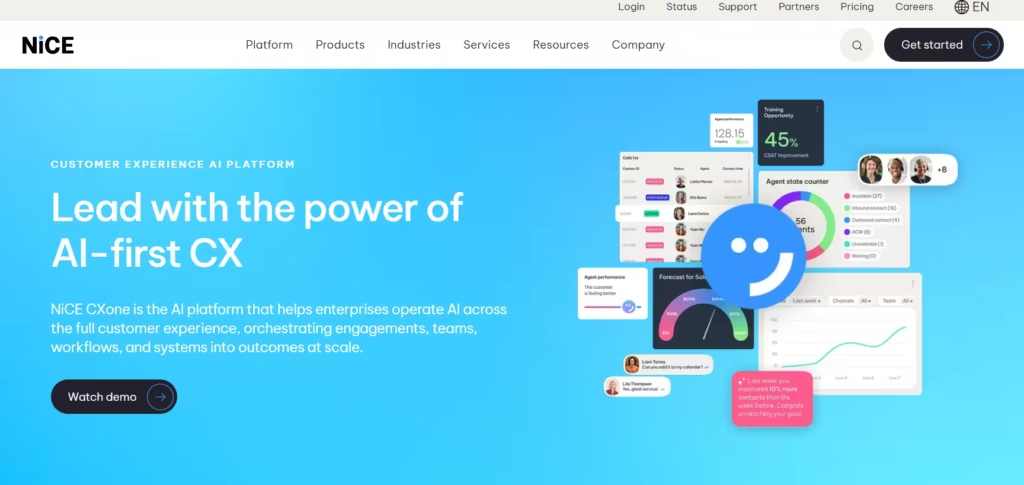
NICE CXone is a cloud-based customer experience platform built around five pillars: digital entry points, journey orchestration, empowered agents, workforce optimization, and analytics. Its Enlighten AI engine powers self-service chatbots, in-conversation agent assistance, and predictive routing.
Pricing starts around $110 for its omnichannel plans. The top-tier Ultimate Suite runs $249 per agent monthly plus $0.25 per session, which adds advanced automation and AI workflows for large, AI-focused operations.
Best for: Enterprises wanting one vendor to own voice, digital channels, and AI-driven agent assist without stitching together multiple point solutions.
2. Genesys Cloud CX
Genesys Cloud CX uses Experience Orchestration to connect every channel and AI feature under a single license model. Four tiers cover the range: CX 1 at $75, CX 2 at $115, CX 3 at $155, and CX 4 at $240 per user monthly, billed annually. Every plan includes native AI, though heavier AI use draws on metered “AI Experience Tokens.”
The entry-level CX 1 plan covers basic voice needs but skips digital channels and quality management, so most omnichannel teams need CX 2 or CX 3. There’s also a $2,000 monthly minimum commitment, so very small teams pay that floor regardless of headcount.
Best for: Mid-size to large contact centers that need deep customization and are willing to invest in tiered licensing to unlock it.
3. Five9
Five9 features strong predictive power and preview dialing with AI Agent Assist, intelligent virtual agents, and workforce engagement tools. Pricing starts at $119 per seat monthly for the Digital plan, with the Core (voice) plan at $159. Higher tiers with full AI capabilities require a custom quote.
Five9 also enforces a 50-seat minimum, making it a better fit for larger teams than small businesses. Its AI investment shows in details like 3,000 included AI minutes per seat across IVA, agent assist, and transcription features.
Best for: Outbound sales and blended contact centers that need heavyweight dialing plus AI support at enterprise scale.
4. Observe.AI
Observe.AI focuses on conversation intelligence: automated scoring, coaching, and workflow automation across every interaction, not just a sampled subset. Key features include automated interaction scoring, evidence-based ratings tied to specific moments in a call, and configurable evaluation rubrics for compliance.
Public pricing isn’t listed, but an AWS Marketplace listing shows roughly $69 per agent monthly for Real-Time AI on a 12-month term, and realistic annual spend for enterprise deployments runs $60,000 to $180,000 depending on modules and seat count.
Best for: Enterprise contact centers running 100+ agents that want full-coverage QA instead of manual call sampling.
5. NextLevel.AI
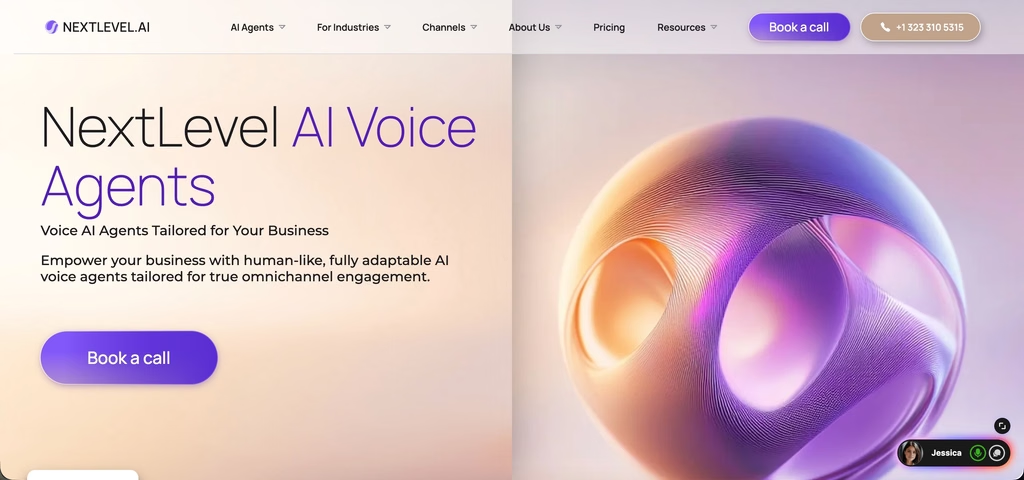
NextLevel.AI is a voice AI platform that runs human-like phone conversations for businesses, answering inbound calls, qualifying leads, and booking appointments around the clock.
It deploys as an AI Receptionist, AI Sales Agent, or full AI Call Center, built on a real-time speech-to-text, LLM, and text-to-speech pipeline for sub-second response times.
Pricing runs on a tiered subscription model from $89 to $385 per month, covering 500 to 2,500 bundled minutes. The Business and Enterprise tiers unlock full multilingual support, larger concurrent call capacity, and deeper CRM integrations.
Best for: Healthcare, insurance, and appointment-heavy businesses that want white-label ready voice AI with compliance certifications built in.
6. Talkdesk
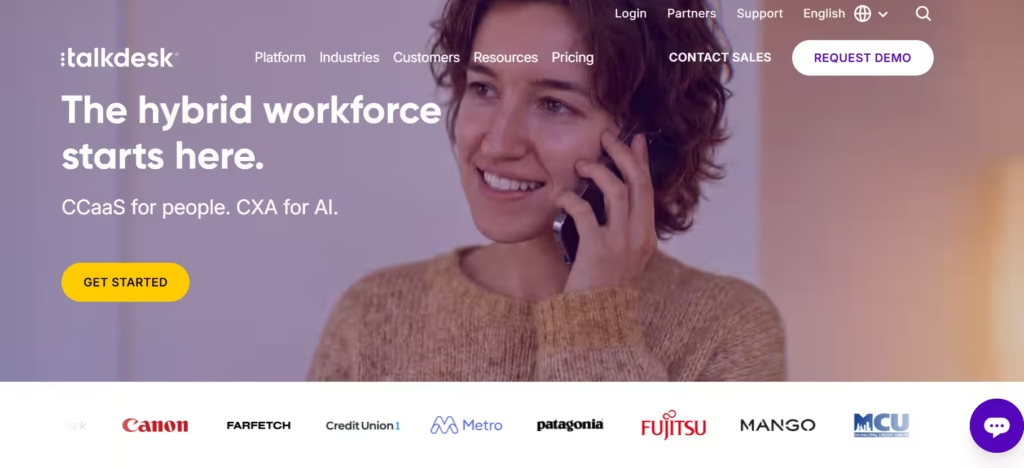
Talkdesk’s CX Cloud platform spans Digital Essentials through Elite tiers, adding AI tools like Copilot (agent assist), Autopilot (virtual agent), and Navigator (AI routing) along the way. Pricing starts around $85 per user monthly, though core AI features are priced as separate add-ons even on the $165 Elite plan, and Talkdesk doesn’t publish those add-on rates publicly.
Real total cost of ownership often lands between $200 and $300 per user monthly once add-ons, telecom fees, and implementation are included.
Best for: Mid-market teams of 50 to 500 agents that want a polished interface and are willing to negotiate add-on pricing for AI features.
7. Cresta
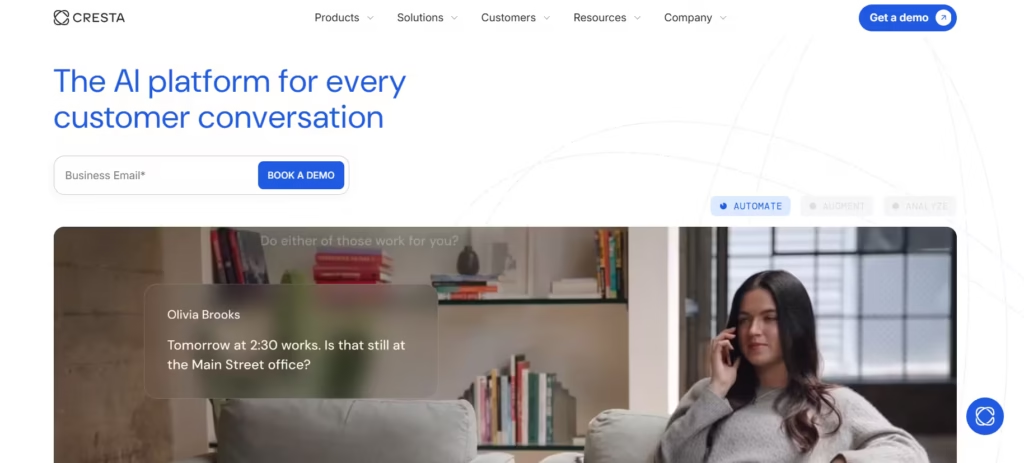
Cresta provides live, in-conversation AI: live coaching, autonomous AI agents for voice and chat, and conversation intelligence analytics. Its Conversation Intelligence suite includes Insights, an AI Analyst for natural-language queries over conversation data, automated Quality Management, and Coach for per-agent recommendations.
Pricing isn’t public. Estimates put annual spend between $60,000 and $150,000, and one AWS Marketplace listing shows $150,000 annually for up to 125,000 chat sessions or 100,000 voice calls.
Best for: Enterprises with 100+ agents and complex conversations where live coaching directly affects revenue or retention metrics.
8. Retell AI
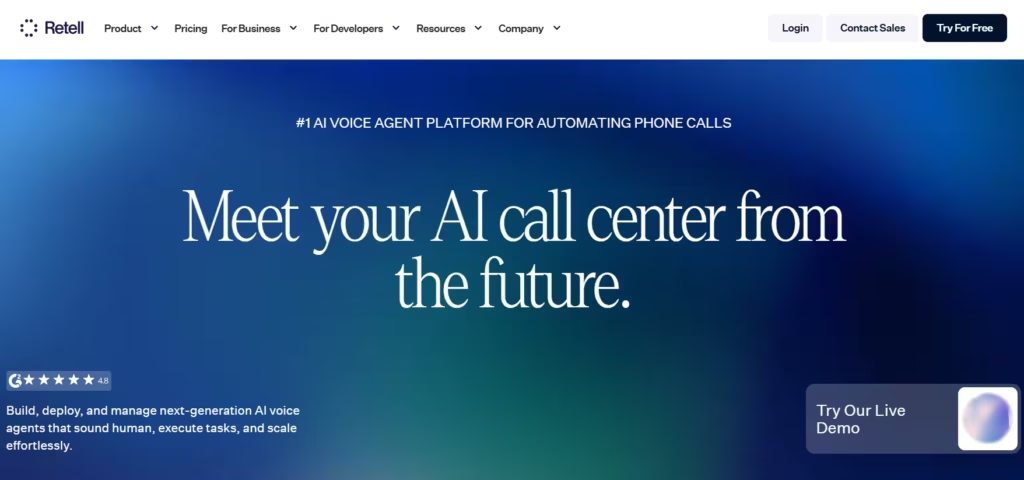
Retell AI is voice agent infrastructure built for developers. Its pricing is usage-based at $0.07 per minute, with no mandatory base subscription. That figure covers the voice engine alone. Once you add an LLM, telephony, and premium voices, realistic all-in costs typically land between $0.13 and $0.31 per minute.
The platform offers a pay-as-you-go tier with $10 in free credits and 20 free concurrent calls, plus an enterprise tier for production-scale deployments.
Best for: Engineering teams building custom voice agents who want granular control over the stack rather than a turnkey platform.
9. Balto
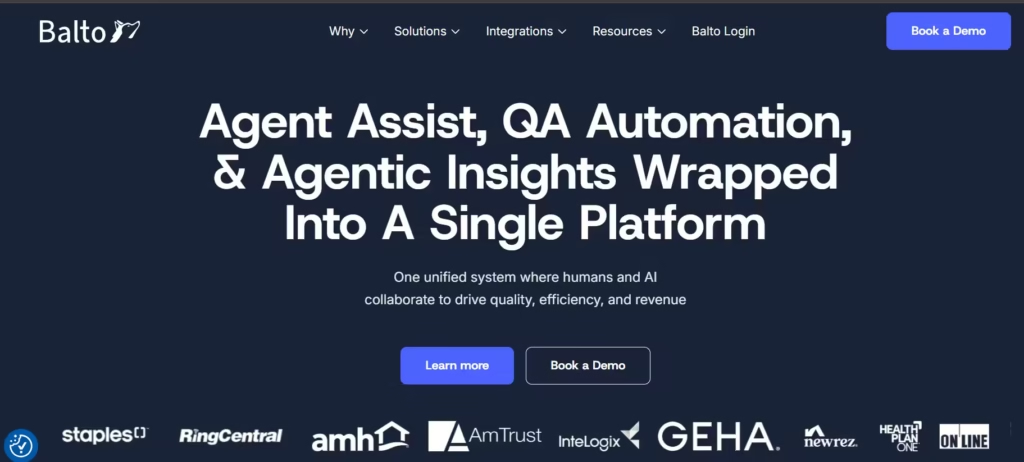
During calls, Balto provides prompts, compliance checklists, and sentiment cues that appear on an agent’s screen while the customer is still talking. Balto integrates with more than 27 platforms, including Five9, Genesys, Talkdesk, Twilio, Salesforce, and Amazon Connect.
Pricing starts around $100 per agent monthly for mid-market deployments, while enterprise-grade coverage across voice, chat, and email can start around $150,000 annually.
Best for: Regulated industries like insurance, healthcare, and collections that need live compliance guidance, not just after-the-fact review.
Also read: Best AI Tools for Customer Support in 2026
10. Amazon Connect with Lex and Q
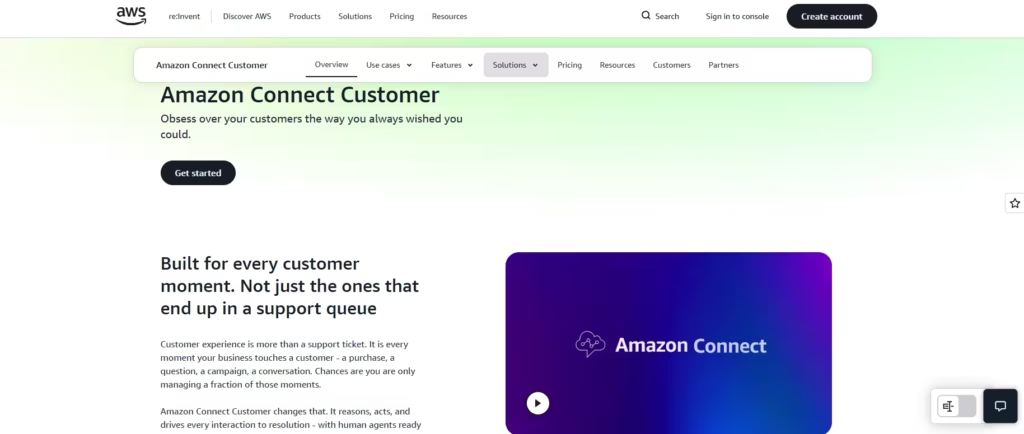
Amazon Connect skips per-agent licensing entirely in favor of consumption pricing. Voice costs $0.018 per minute, and AI features layer on top: Amazon Q in Connect bills $0.0015 per chat message and $0.008 per voice minute, while Amazon Lex charges $0.004 per voice request or $0.00075 per text request.
That flexibility comes with complexity. True total cost of ownership, including Lambda, Contact Lens, and engineering time, typically runs $300 to $550 per agent monthly at scale.
Best for: AWS-native engineering organizations that want granular, pay-as-you-go pricing and are prepared to build rather than buy.
11. Verint
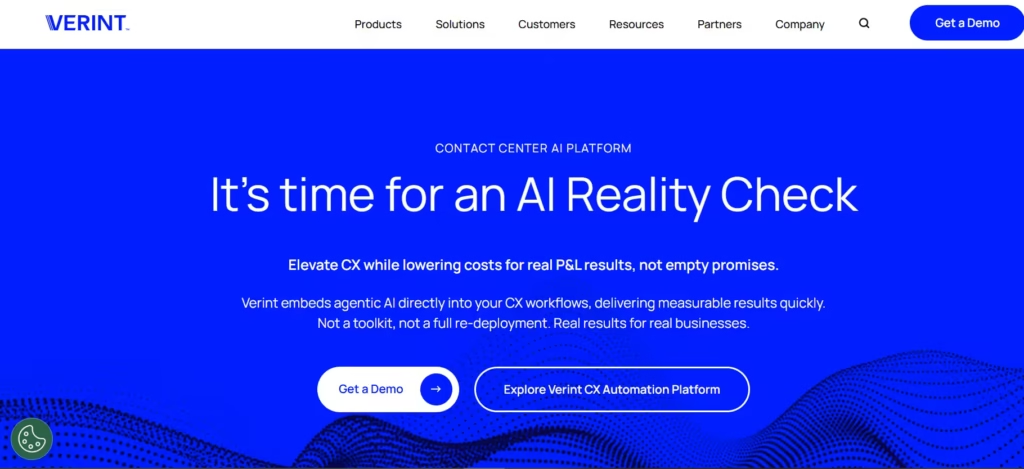
Verint’s Da Vinci AI platform runs specialized bots for summarization, self-service, and automated quality scoring, trained on data inside Verint’s Engagement Data Hub. In mid-2026, Verint added three agentic AI tools (Workforce Intelligence, Desktop Intelligence, and Quality Intelligence) built on its Agent Factory orchestration layer.
A typical WFM, QM, and analytics bundle for a 500-agent center runs roughly $55 to $90 per agent monthly at list price, with negotiated three-year rates closer to $35 to $60. Automated quality scoring bills separately, at $0.04 to $0.08 per AI-evaluated interaction.
Best for: Large enterprises with existing workforce engagement management needs that want to layer agentic AI onto established processes.
12. Nextiva
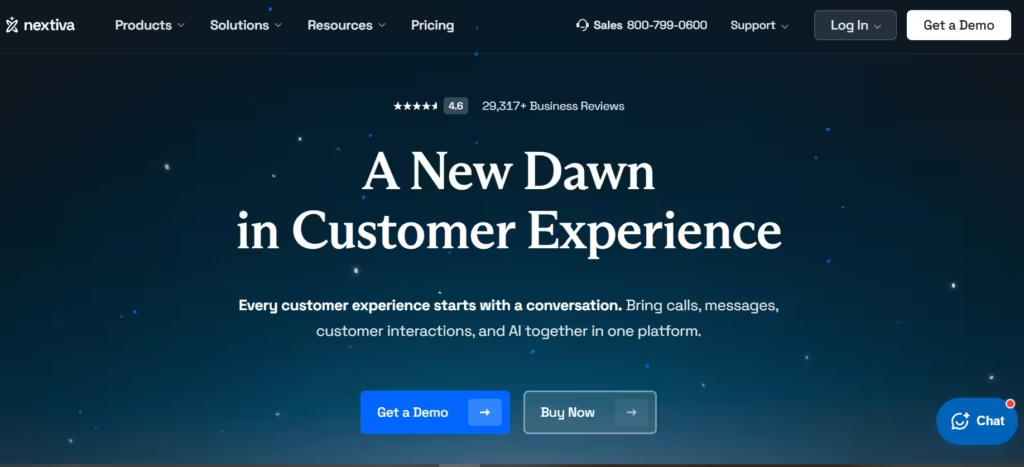
Nextiva bundles phone system and contact center functionality in one platform, which appeals to teams that don’t want to buy UCaaS and CCaaS separately. Essential-tier contact center plans start around $75 per agent monthly and include omnichannel capabilities, workflow automation, and AI transcription.
Advertised per-user rates only tell part of the story, though; regulatory fees and usage caps can push the final bill 25% to 50% higher than the sticker price.
Best for: Small and mid-size businesses that want unified communications and AI-assisted contact center features without managing two vendors.
How to Choose Contact Center AI Software
1. Start with your primary channel. Voice-heavy operations should prioritize dialer quality and voice AI latency. Digital-first teams should weigh chat, email, and social automation more heavily.
2. Separate the platform from the AI. Some tools, like NICE CXone and Genesys, bundle AI into the core platform. Others, like Talkdesk and Five9, treat AI as a paid add-on. Ask for the fully loaded price, not just the base tier.
3. Match pricing model to volume predictability. Per-seat pricing (Genesys, Five9, Nextiva) works well for stable headcount. Consumption pricing (Amazon Connect, Retell AI) suits variable or seasonal volume, but it makes budgeting harder without historical usage data.
4. Check the seat minimum. Five9 requires a minimum of 50 seats. Genesys enforces a $2,000 monthly floor. If you’re a smaller team, these minimums can inflate your effective per-seat cost.
In my view, teams under 200 seats should avoid Genesys entirely. The $2,000 floor escalates the costs, and smaller competitors like Nextiva deliver better value at that scale.
5. Test latency for real-time features. Real-time agent assist and live guidance tools only add value if the prompts arrive fast enough to use mid-conversation. Balto, for example, markets sub-200ms response times as a core differentiator.
6. Confirm integration depth and not just integration count. A long list of connectors means little if your specific CRM or telephony stack requires custom engineering work to connect properly.
Limitations and Challenges of Contact Center AI
1. Pricing can be unclear. Several vendors in this list, including Observe.AI, Cresta, and Balto, don’t publish list pricing. Expect a sales conversation and a custom quote before you know your real cost.
2. Add-on costs can add up. Platforms like Talkdesk and Five9 price core AI features separately from the base plan. What looks like an $85 or $119 entry point can become $200-plus per seat once agent assist and workforce tools are added.
After comparing pricing calculators across five platforms, I found that advertised per-seat rates understate true costs by 30% to 50% once regulatory fees and mandatory add-ons are included.
3. Implementation timelines vary widely. A basic Amazon Connect deployment can go live in days, but an enterprise rollout with custom IVR, compliance controls, and workforce management commonly takes three to six months.
4. Transcription accuracy is an issue. G2 reviews for Talkdesk show transcription accuracy rated 4.4 out of 5 as of July 2026, with 22% of reviewers citing accent recognition as a pain point.
5. AI still needs human oversight. Automated QA and live guidance reduce manual review, but agents and supervisors still need to catch edge cases the model misreads. This is especially important in regulatory and compliance-laden conversations.
FAQs
1. What Is Contact Center AI Software?
Contact center AI software uses machine learning and natural language processing to automate or assist customer interactions. It covers virtual agents that handle self-service, agent assist tools that surface guidance during live calls, and analytics platforms that score and summarize conversations after the fact.
2. How Much Does AI Call Center Software Cost?
Pricing varies by model and provider. Per-seat platforms typically range from $75 to $250 per agent monthly, depending on the tier. Consumption tools like Retell AI and Amazon Connect charge by the minute or by interaction, which can cost less at low volume but scale unpredictably at high volume.
3. Do I Need a Full CCAAS Platform, or Can I Add AI to My Existing System?
It depends on your setup. If you already run a stable telephony platform, point solutions like Observe.AI, Cresta, or Balto can add AI capabilities without a full migration. If you’re evaluating a platform switch anyway, an all-in-one suite like Genesys or NICE CXone can simplify vendor management.
4. Which Contact Center AI Tool Is Best for Small Businesses?
Nextiva tends to fit smaller teams best, since it bundles phone system and contact center AI features at a lower entry price than dedicated CCaaS platforms. Retell AI is also worth considering if you only need a voice agent and want to avoid seat-based pricing entirely.
