

Tensions are escalating between Anthropic and the U.S. Department of Defense. The Pentagon wants unrestricted access to Anthropic’s AI systems, but the company is refusing to comply.
According to Axios, Anthropic has until Friday evening to respond. If it does not, the government may take strong action.
The warning came directly from Pete Hegseth in a meeting with Dario Amodei. He presented two possible actions.
First, the Pentagon could label Anthropic a “supply chain risk.” This label is usually reserved for foreign adversaries, and applying it to a U.S. company would be highly unusual.
Second, the government could invoke the Defense Production Act. This would allow it to force Anthropic to build a version of its AI tailored to military needs.
Defense Production Act
The Defense Production Act gives the U.S. president broad authority. It allows the government to require companies to prioritize national defense.
It has been used in emergencies. For example, during the COVID-19 pandemic, General Motors produced ventilators. At the same time, 3M increased mask production.
However, using the law in an AI policy dispute would be different. It would expand how the law is applied in modern times.
Instead of producing goods, companies could be forced to alter how their technology works.
Also read: Anthropic Brings AI to U.S. Defense Agencies
Anthropic Refuses
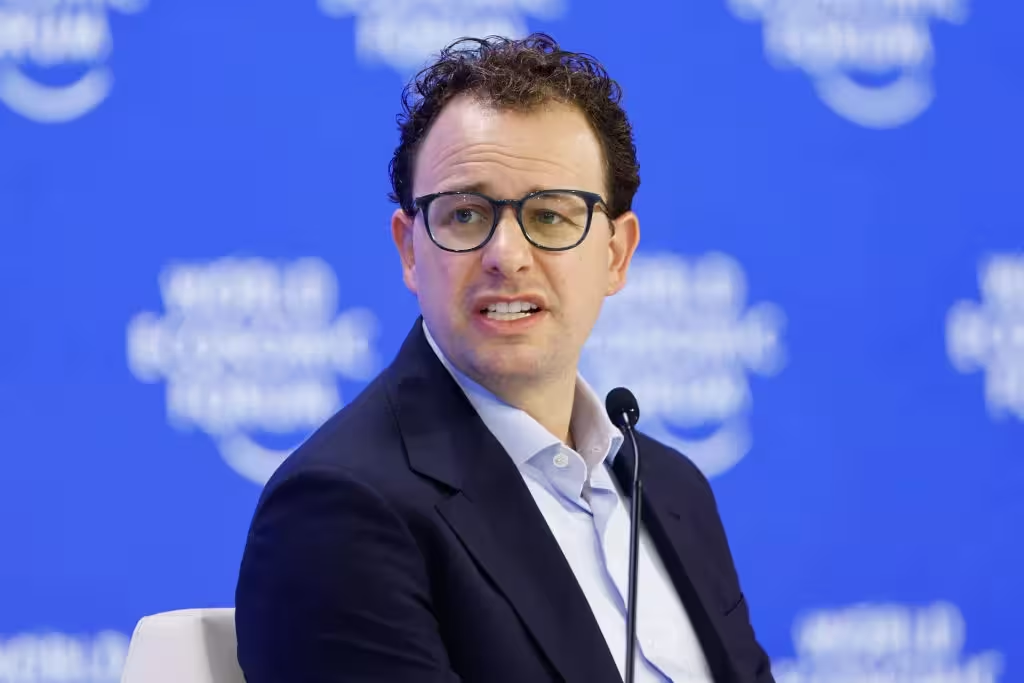
Anthropic has maintained a consistent position. It does not want its AI used for mass surveillance of Americans. It also rejects the use of fully autonomous weapons.
These limits are part of the company’s core safety approach, and therefore, it has refused to compromise.
Reports from Reuters confirm that the company does not plan to ease its restrictions. This suggests the standoff may continue.
Corporate Control
Pentagon officials strongly disagree with Anthropic’s position. They argue that U.S. law should govern how military technology is used.
In their view, private companies should not decide national security policy. Instead, elected institutions should set the rules.
Policy Risks
The dispute has raised concern among policy experts. Dean Ball from the Foundation for American Innovation has warned about the impact.
He argues that using government power in this way could signal instability. If companies face pressure for policy disagreements, investors may lose confidence.
He also noted that such actions could suggest that political differences affect business outcomes. Therefore, the issue extends beyond AI.
Political Friction
The situation is also affected by differing political views. Some officials, including David Sacks, have criticized Anthropic’s safety policies as overly restrictive.
That criticizing comment has escalated the dispute beyond technology to ideology. Therefore, compromise is more difficult.
Pentagon’s Weakness
Pentagon relies on Anthropic. According to multiple reports, Anthropic is the only frontier AI company with classified access within the Department of Defense.
This single-vendor situation means that there is no immediate backup in place.
Although the Pentagon has reportedly reached an agreement to use Grok in classified systems, this solution may not fully replace Anthropic’s capabilities.
Therefore, losing access to Anthropic would create serious operational challenges.
