

Most AI tools in the current market act as copilots. They sit beside you while you do the heavy lifting.
But the promise of autonomous agents has always been about delegation rather than just simple assistance.
For professional teams looking to automate their creative output,SuperCool is an autonomous AI creation engine that transforms a single prompt into fully finished and downloadable assets such as presentations, videos, and reports.
Instead of receiving a text draft that requires another hour of formatting, SuperCool claims to deliver fully finished assets from a single prompt. This review examines whether this hands-off approach actually holds up in professional workflows.
1. Beyond the Chatbot: How SuperCool Works
SuperCool is not just another wrapper for a large language model. It is a complete production system powered by internal autonomous AI agents. While popular chat interfaces require you to guide the AI through every step, SuperCool allows you to submit a goal and take a backseat.
The platform uses what the developers call Synthetic Intelligence. While traditional AI functions like a single worker handling every task, Synthetic Intelligence operates like an entire organization. It orchestrates multiple specialized models and tools simultaneously to handle complex, long-running functions.
The Agentic Chain of Command
When you submit a request, specialized agents coordinate to handle the granular details:
- Research and Planning: One agent carries out initial research by browsing the web for live data and plans the content structure.
- Asset Generation: Other agents handle the production of specific media, such as designing photorealistic images, writing scripts, or generating voiceovers.
- Packaging: The system coordinates these outputs internally, so you do not have to move data between apps or manually assemble files.
2. Multi-Format Capabilities: A Tool Stack Killer?
One of the core values of the platform is its ability to collapse a fragmented tool stack. Typically, a marketing campaign requires jumping between Google Docs, Canva, and PowerPoint. SuperCool handles the entire pipeline in one interface.
The system produces actual usable files instead of just previews. Its range is surprisingly broad. For business users, it generates professional reports, 35-page marketing proposals, and whitepapers. Corporate teams can get ready to use .pptx files with professional slide structures. Creative users can produce anything from anime-style character sheets to fantasy landscape paintings. It even touches multimedia by creating 60-second radio ads with scripts and professional audio tracks.
3. Practical Use Case Analysis
SuperCool is most useful for teams where execution is the bottleneck and not ideas. For founders and entrepreneurs who need a professional pitch deck to secure funding but lack a design budget, the platform can build a 10-slide deck from a single brief.
Lean marketing teams can use it to scale their creative output by generating graphics and videos without adding headcount. Consultants and agencies also find value here by rapidly turning a client concept into a structured company report. Effectively, it is built for anybody who needs to produce creatives but may not have the time or expertise to do it themselves.
4. Strengths, Limitations, and the Vagueness Penalty
No autonomous tool is perfect. SuperCool represents a clear tradeoff between speed and convenience versus granular control. Moving from an idea to a downloadable asset in minutes is a genuine competitive advantage.
However, there are constraints. Because much of the structuring is delegated to the AI agents, you have less influence over the process than you would with manual design tools. There is also the vagueness penalty. The quality of the final file is directly tied to the fidelity of your initial prompt. If your instructions are vague, the autonomous engine must make executive decisions that may not perfectly align with your vision.
5. Quick Start Guide: Mastering the SuperCool Workflow
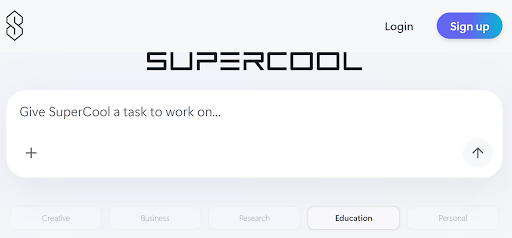
To get the best results, you should shift your mindset from chatting to briefing. The first step is to choose your workflow category, such as Business or Creative, to deploy the correct agent personality.
Next, you need to be high fidelity in your request. Instead of saying “write about marketing,” try saying “Create a professional one-pager report on B2B SaaS marketing trends.” The more information you provide about your target audience and goals, the better the agents can execute the research phase.
As the process runs, you can watch the status updates to see the agent’s plan before it builds the final file. You can actually see the AI as it goes through each step. Once the engine finishes, you can grab the .pptx or .docx file for final implementation. These are provided as downloadable files that you can use immediately rather than simple drafts.
6. Comparison: Drafting vs. Execution
Many other AI tools on the market are made for helping you work, while SuperCool does the work and finishes it for you. It is the difference between drafting and execution. SuperCool uses autonomous AI agents to coordinate and automate the entire process from one input. This makes it a unique addition to an AI tooling ecosystem that is usually focused on text responses or rough first drafts.
7. Final Verdict: Is It Truly Super Cool?
SuperCool delivers on its promise to move from drafting to execution. It successfully bridges the gap between having an idea and holding a finished product. It is not the best fit for teams that need deep creative controls or have complex approval workflows. However, it is an essential force multiplier for anyone who needs high-quality collateral fast.
If you want a tool that does the work rather than just helping you work, SuperCool is a significant leap forward in the agentic AI space. For founders, marketers, and consultants, it offers one of the fastest ways to go from idea to asset, and for the right user, that can be a huge advantage.
