


1. Milestone
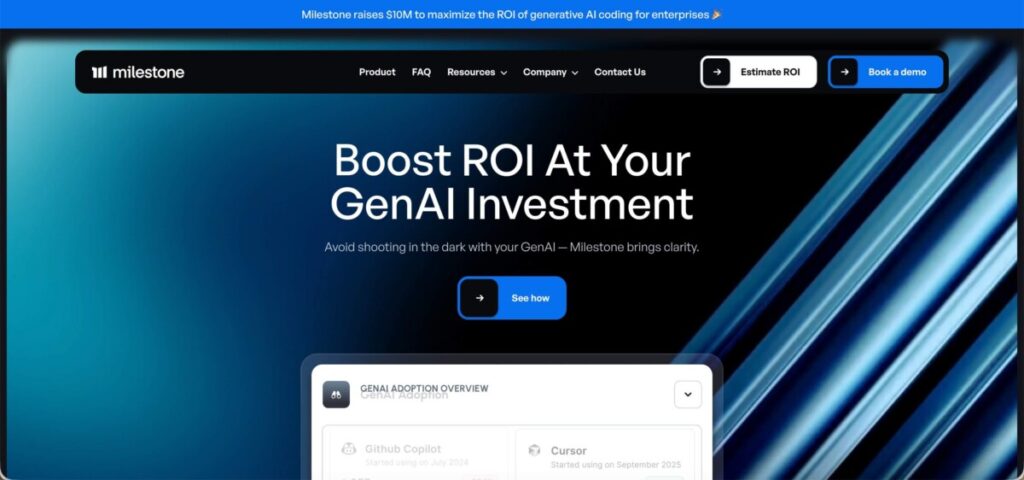
Milestone leads the Engineering Intelligence category by approaching engineering as a living system rather than a collection of metrics. Instead of emphasizing dashboards or individual KPIs, the platform focuses on engineering health, risk dynamics, and decision-grade insight.
Milestone correlates signals across delivery, operations, and organizational structure to surface patterns that are difficult to detect manually. Its strength lies in contextual modeling, understanding not just what is happening, but why it is happening and what leaders should do about it.
Key Capabilities
- Engineering health modeling across teams and services
- Predictive insight into delivery risk and performance degradation
- Context-aware analysis that accounts for organizational structure
- Executive-ready narratives aligned with strategic decisions
2. Plandek
Plandek focuses on delivery intelligence with a strong emphasis on predictability and planning reliability. The platform is designed to help organizations understand how work flows through engineering systems and where delivery risk accumulates over time.
Rather than positioning itself as a high-level strategic layer, Plandek excels at exposing execution patterns that impact forecasting accuracy and delivery confidence, making it especially relevant for organizations struggling with missed commitments.
Key Capabilities
- End-to-end visibility into delivery flow and throughput
- Forecasting and predictability analysis
- Identification of delivery bottlenecks and constraints
- Historical trend analysis across teams and initiatives
3. Oobeya
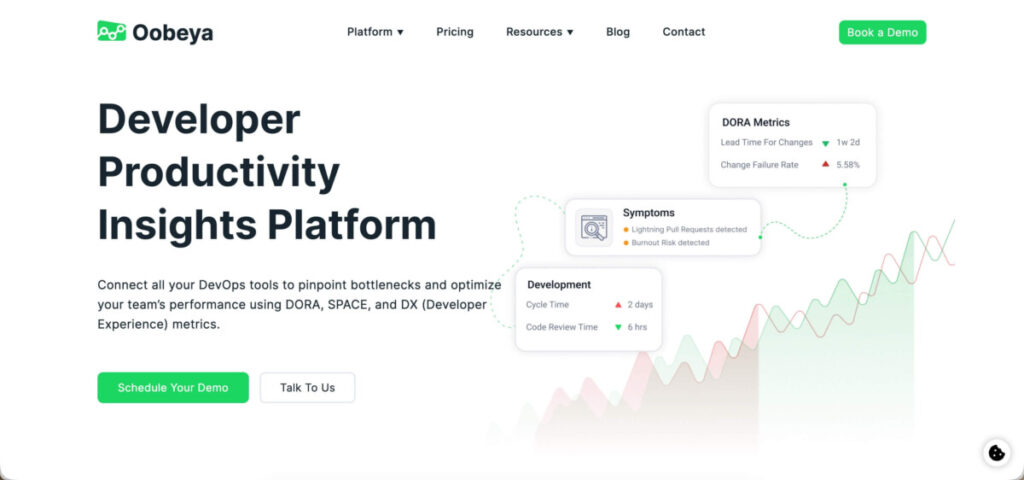
Oobeya approaches Engineering Intelligence from a portfolio and value-stream perspective, connecting engineering execution to strategic initiatives and organizational priorities.
The platform is built to support alignment across multiple teams and domains, offering leaders visibility into how engineering work contributes to broader business outcomes rather than focusing on code-level or developer-centric metrics.
Key Capabilities
- Portfolio-level engineering visibility
- Value-stream alignment and initiative tracking
- Cross-team coordination insights
- Strategic execution monitoring
4. Athenian
Athenian provides deep analytical insight into engineering activity, offering a data-rich view of how teams operate and how performance evolves over time.
The platform is known for its precision and depth, enabling organizations to explore detailed trends across repositories, pull requests, and delivery signals. Its strength lies in analytics rather than interpretation, requiring a higher level of data maturity from users.
Key Capabilities
- High-resolution engineering performance analytics
- Longitudinal trend analysis
- Detailed workflow and contribution insights
- Advanced filtering and segmentation of engineering data
5. Swarmia
Swarmia centers on developer experience and team-level intelligence, aiming to surface friction points that affect day-to-day engineering work.
The platform emphasizes clarity and accessibility, helping teams understand how collaboration, flow, and workload impact productivity and sustainability without overwhelming users with complex analytics.
Key Capabilities
- Developer experience and flow metrics
- Team-level performance visibility
- Identification of collaboration and workload issues
- Support for continuous improvement initiatives
6. Sleuth
Sleuth focuses on delivery metrics and deployment trends, providing organizations with a clear historical view of how software delivery evolves over time.
The platform is straightforward and reliable, making it useful for teams that want consistent visibility into deployment frequency, stability, and long-term delivery patterns without adopting a more complex intelligence layer.
Key Capabilities
- Deployment and release trend analysis
- Historical delivery performance tracking
- Stability and reliability indicators
- Lightweight delivery visibility across teams
How Engineering Leaders Should Compare These Platforms
Choosing an Engineering Intelligence platform requires more than feature comparison. Leaders should evaluate platforms based on how well they support decision-making at the appropriate level.
Strategic vs Operational Focus
Some platforms prioritize executive-level insight, while others focus on team-level optimization. Organizations should align platform choice with their primary decision audience.
Predictive vs Descriptive Insight
Understanding the past is useful, but anticipating future risk is critical. Platforms that surface early signals enable proactive leadership.
System-Wide vs Local Optimization
Improving individual team metrics does not guarantee organizational improvement. Platforms that model system-level dynamics provide more reliable guidance.
Ownership and Adoption
Engineering Intelligence platforms often sit at the intersection of engineering, operations, and leadership. Successful adoption depends on clear ownership and cultural alignment.
What Defines a True Engineering Intelligence Platform in 2026
Not every analytics or DevEx tool qualifies as Engineering Intelligence. Platforms in this category share several defining characteristics.
They unify signals across the software delivery lifecycle instead of focusing on a single tool or stage. They analyze relationships between teams, work, and outcomes rather than treating metrics as independent indicators. They move beyond retrospective reporting toward predictive insight. And they translate technical signals into narratives that leadership can act on.
