


The new industry projection by SweepsPulse is that 2026 will be a year to remember when digital slot gaming may become a reality with the help of artificial intelligence which focuses on transparency, predictability, and player-understanding.
The more tactful the online gamers become in handling their gameplay, in terms of both mechanics and volatility models, or even the simplest GGBet free spins no deposit offers, the higher the standards of fairness and transparency begin to grow. According to the report, the new behavior of players is hastening the need to adopt AI-sensitive slot systems that elaborate on how the games work and not just give the results.
This trend of opaque, AI-integrated slot systems is indicative of a larger trend of interest in artificial intelligence as a technology in the world. The analysis of search activity and independent research of the market can justify why AI-based gaming models become popular among the industry instead of a single trend.
Global AI Interest and Market Growth Signals
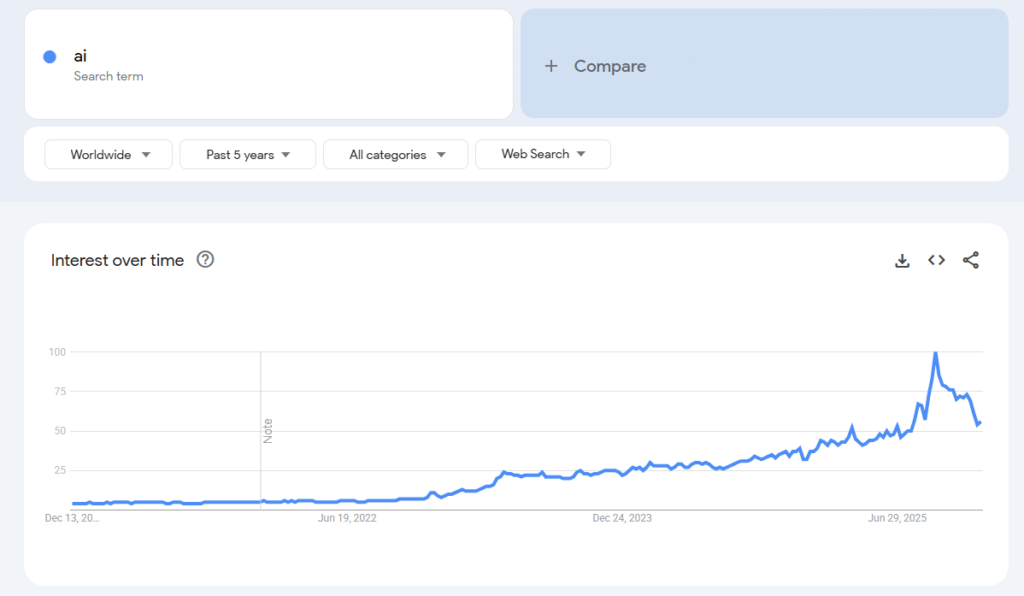
According to the data available on Google Trends, the global interest towards the search query of AI has increased steadily and recognizably over the last five years in all categories and web search. What is particularly interesting about the steady increase in interest rates within the time frame of years 2022 and 2023-2025 is that it demonstrates an indication that AI is no more a Niche issue but one that has gained global attention on the radar. Long run upward momentum indicates that it is being further popularized, widely used in industries, and better embedding AI into everyday digital products like gaming and interactive entertainment.
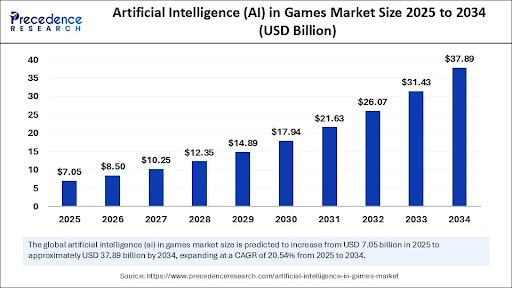
This attention is backed by market research in equally good economic indicators. Precedence Research estimates the global market of artificial intelligence (AI) in games at USD 5.85 billion in 2024, and forecasted that the market would increase to between USD 7.05 billion in 2025 up to about USD 37.89 billion in 2034 with a compound annual growth rate (CAGR) of 20.54. In 2024, however, the highest market share was recorded in North America with 39 percent with Asia Pacific set to expand at the quickest rate.
To put these gaming-specific trends in a broader technological context, even in the case of enterprise software and cloud platforms similar trends are already noticeable. One of the newest AutoGPT analyses of how AI is changing the creation of SaaS in 2025-2026 describes how the second wave of AI usage is changing software itself, not necessarily its delivery, by incorporating intelligence directly into the core systems, a process that parallels the change that is currently occurring in the AI-based gaming and interactive entertainment ecosystems.
Key Changes Expected From Predictable AI Slot Systems in 2026
The 2026 projection by SweepsPulse is a systematic change to digital slot gaming, based on explainable AI, predictable mathematics and capability at the level of experience. Instead of changing the outcomes of certified results, predictive systems are expected to enhance clarity, comfort, and trust by simplifying the behavior of the gameplay to the players and regulators.
SweepsPulse has identified the following areas of core transformation.
- Disclosure free mathematical transparency. AI models give explanations of volatility, pacing, RTP ranges, and the frequency of features in real time without altering certified math.
- Experience-level personalization. Adaptive components act upon player action (tempo, interaction patterns, engagement levels), but do not affect the odds or logic of payouts.
- Better trust and confidence among players. Interactive math boards and ease of understanding enhance doubt and confidence in equal treatment.
- Quick and intelligent content development. Themes, symbols, animations and sound design can be generated faster with the help of AI and without any loss of human creativity.
Expected Benefits Across the Ecosystem
- On player level: better understanding, easier sessions, and better faith in judgment.
- In the case of the studios: accelerated innovation processes and greater topicality in a trust market.
- To operators: more robust positioning with respect to compliance and less operational risk.
- To regulators: better regulation with explainable and auditable AI systems.
SweepsPulse concludes that all of these changes are not simple upgrades. They herald an architectural shift in the construction, description, and control of slot systems in terms of placing predictability and transparency as core demands and not features in the future generation of casino games.
Predictable slot systems will be another standard of fairness, transparency, and player-centric design as AI continues to transform the digital experience. The adaptive gameplay, interactivity of the explanations, and smart monitoring will transform the expectations and industry standards of the players. In 2026, the studios and operators, which are ready to adopt such innovations, will most probably be at a competitive advantage, and gamers will experience safer, more informed, and engaging gaming. Transparency and predictability are no longer luxuries in this dynamic environment and they are the future of online slots.
