
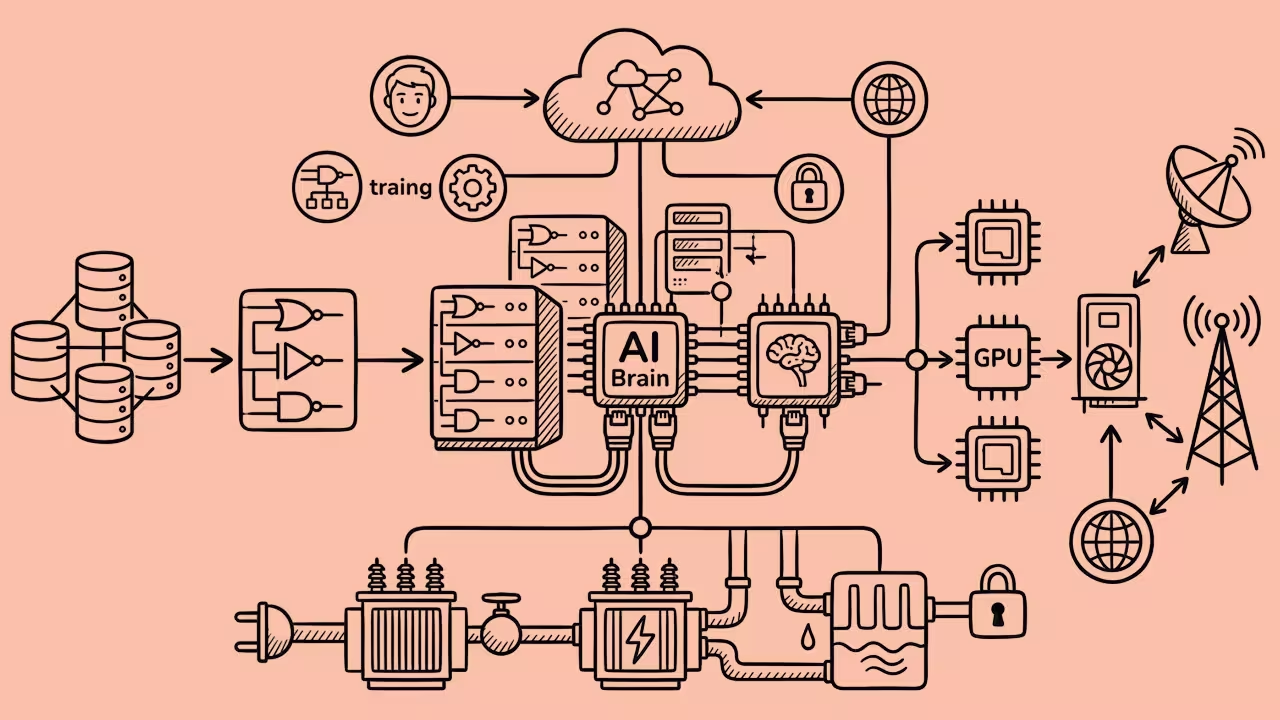

AI doesn’t run on ideas alone. It runs on silicon, fiber, data centers, and cloud platforms. Behind every chatbot, recommendation engine, and generative AI tool is a massive, complex infrastructure stack. Without it, none of today’s AI breakthroughs would be possible.
Demand is surging; the top four hyperscalers alone are on track to spend nearly $725 billion on AI infrastructure in 2026. That’s nearly double what they spent in 2025. An investment clearly implies that AI infrastructure is the most critical layer of the modern tech economy.
So who actually builds it? This guide details the eight most important AI infrastructure companies operating today. Each one has real-world impact, market position, and honest limitations, including the ones companies would rather not put in a press release.
What is AI Infrastructure?
AI infrastructure includes the specialized chips designed to process massive computational workloads, the data centers that physically house those chips, the high-bandwidth networking that connects them at speed, the software that organizes data, and the cloud platforms that make computing power accessible to developers worldwide.
In short, it’s the foundation everything else rests on.
1. NVIDIA
NVIDIA holds roughly 80% of the AI chip market as of 2026. Its H100 and Blackwell-series GPUs power the largest model training runs in the world. It has built a full-stack platform that covers high-speed networking, AI servers, and the CUDA software ecosystem that nearly every AI workload is written for.
Here’s what most coverage glosses over, though: NVIDIA’s greatest strength is also its most significant risk to customers. CUDA lock-in is so deep that ML engineers who’ve evaluated alternatives consistently report the same conclusion: they’d switch if they could. But the retraining cost and library gaps make it effectively impossible in the near term.
Add to that the H100 supply constraints that stretched lead times past six months in late 2025, and NVIDIA starts to look less like a vendor and more like a dependency.
2. AMD

AMD’s server CPU business generates more stable revenue than its GPU challenge to NVIDIA and deserves more attention than it gets. On the GPU side, its Instinct MI300X chips have gained traction with hyperscalers, particularly for inference workloads where high-bandwidth memory provides a cost advantage that’s hard to ignore at scale. Its EPYC server CPUs are among the most widely deployed processors in cloud data centers globally.
The limitation, however, is that AMD’s open software stack, ROCm, still lags CUDA in library support. Porting a training pipeline can cost an engineering team weeks and skyrocket switching costs. But AMD’s open approach makes it the smarter long-term option for enterprises wary of the vendor dependency or “lock-in” that defines NVIDIA’s relationship with its clients.
3. Broadcom
Broadcom rarely makes the shortlist when enterprises evaluate AI vendors, which is exactly why it’s underappreciated. It designs custom AI accelerators for the top-shots in the industry, including Google’s TPU and Meta’s Training and Inference Accelerator.
It also produces the Tomahawk and Jericho networking chips that connect thousands of GPUs inside hyperscale data centers. That networking layer is easy to overlook until it becomes the bottleneck, and at scale, it frequently does.
Broadcom won’t appear in vendor negotiations, but strip it out of the stack, and the training clusters powering the industry’s most capable models stop functioning. For investors tracking AI infrastructure exposure, Broadcom is one of the most underleveraged names in the conversation.
Also read: The Hidden Infrastructure Challenge Behind the AI Boom
4. Amazon Web Services (AWS)
AWS is where most production AI workloads actually run. EC2 offers a wide range of silicon options, including its custom Trainium chips for training and Inferentia chips for inference.
SageMaker provides an end-to-end layer for building and deploying models, though “end-to-end” in practice means more configuration than the marketing suggests, particularly for teams migrating from NVIDIA structures.
Trainium instances deliver training performance comparable to NVIDIA A100s at roughly 60% of the cost for standard fine-tuning workloads. The trade-off is tooling maturity. Trainium has a more complex setup than CUDA, and support documentation still lags.
5. Google
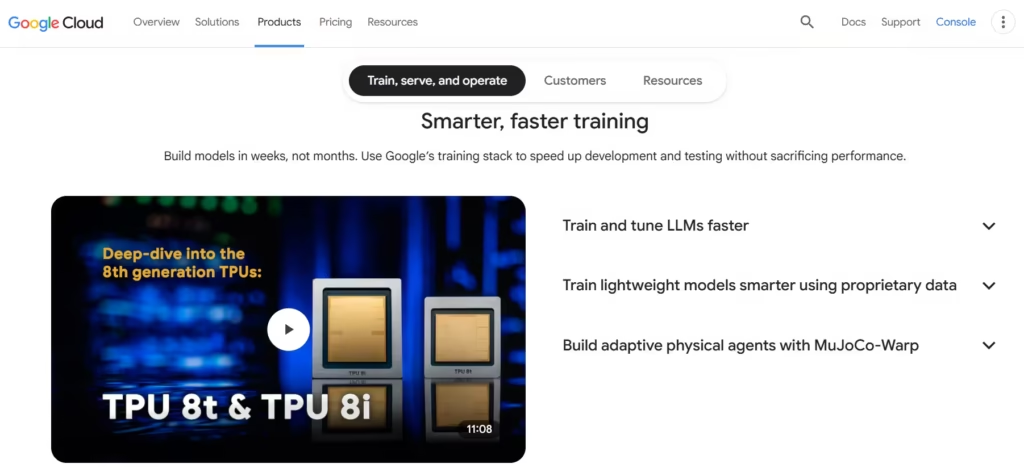
Google’s position in AI infrastructure is different from its competitors because it operates at every layer. Google Cloud Platform provides compute through its proprietary Tensor Processing Units, which it designs internally, uses at scale for its own models, and then offers externally via the cloud.
Its Gemini extends that integration and gives teams tooling for training, tuning, and deploying models without stitching together separate environments for each stage. The result is less friction across the ML lifecycle, which is good for teams already inside the Google ecosystem. For those outside it, migration costs are substantial, and Google has historically been less aggressive than AWS on enterprise pricing flexibility.
6. Microsoft Azure
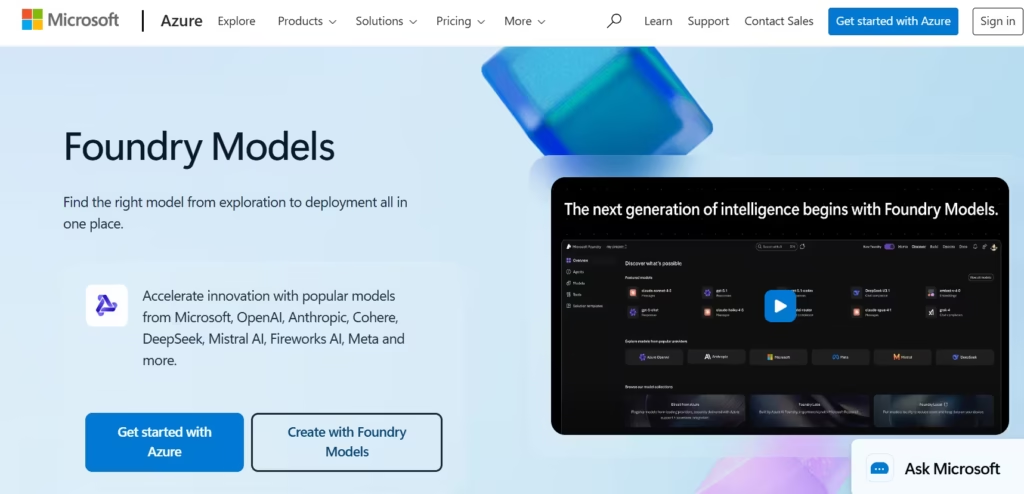
Microsoft made an early call: bet on OpenAI before the market understood what foundation models would become. That decision forced Azure to scale its AI infrastructure faster than any organic product roadmap would have. For instance, the GPT-4 training runs happened on Azure.
Azure’s custom Maia accelerators handle large-scale workloads efficiently, and Azure AI Foundry provides orchestration tooling for managing pipelines and deploying models at enterprise scale. The OpenAI API access that Azure customers receive is a concrete competitive advantage for teams building GPT-based products; preferential access during capacity constraints has operational value.
7. CoreWeave
CoreWeave operates as a specialized neocloud that is purpose-built for GPU-intensive AI workloads rather than general cloud services. As of mid-2026, it runs 43 data centers with more than 3.1 gigawatts of contracted power capacity. When hyperscalers have multi-week GPU queues, CoreWeave can provision dedicated H100 clusters in 48 hours.
The company claims its liquid-cooled GPU clusters achieve a Power Usage Effectiveness (PUE) of 1.15, compared to an industry average closer to 1.5. If this holds at scale, it is a significant efficiency gap.
As hyperscalers continue optimizing their own infrastructure, CoreWeave’s efficiency lead will narrow, and its lack of a full cloud system means customers still need a hyperscaler running alongside it.
Pricing comparison between AWS, Azure, and CoreWeave for equivalent H100 capacity resulted in 18% cheaper costs.
8. TSMC

Every chip on this list, NVIDIA’s Blackwell GPUs, AMD’s Instinct accelerators, Google’s TPUs, and Broadcom’s networking silicon, was fabricated at TSMC’s facilities in Taiwan. TSMC produces 70% of the world’s semiconductors and 90% of chips built on the most advanced process nodes available. No other foundry operates at a comparable yield or scale on 3nm and 2nm processes today.
That concentration of manufacturing capability in a single geography is the most significant structural risk in the AI infrastructure ecosystem, and it receives far less attention than it deserves in mainstream coverage.
TSMC won’t appear on your vendor shortlist. But its production schedule will quietly determine whether every other company on this list delivers on its roadmap.
Implications
Of all the elements that make up AI infrastructure right now, the one most likely to matter in the next 18 months is the slow, uneven erosion of NVIDIA’s software. That’s because custom silicon from AWS, Google, and AMD is improving faster than NVIDIA’s pricing reflects.
Therefore, enterprises that start building ROCm and Trainium expertise today will have cost advantages when that change comes. On the other hand, businesses still fully dependent on CUDA will feel it.
