

Diogo Almeida helped invent the technology that made ChatGPT possible.
Then he spent two years building a model that does the opposite of everything ChatGPT does. It can’t write. It can’t chat. It can’t explain itself. And developers can’t get enough of it.
On September 15, TypeSafe AI launched Jev, a model that doesn’t generate text at all.
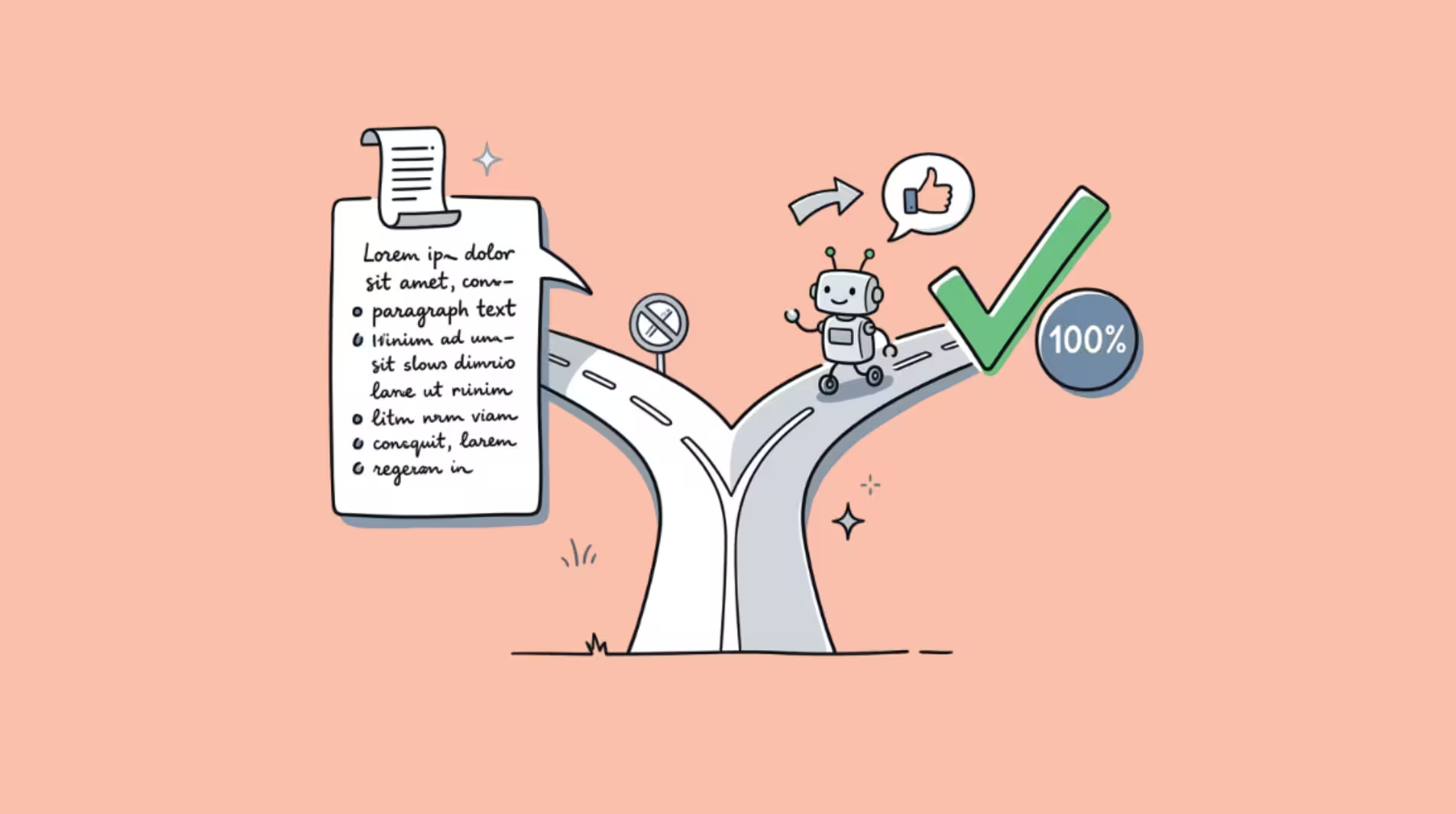
You give it a situation and a list of predefined choices. It picks one and tells you how confident it is. That’s it. No prose. No reasoning trace. No tokens to parse.
Just a typed answer with a probability attached, returned in 70 to 500 milliseconds.
Output tokens are free. Input tokens cost $0.042 per million.
For context, Anthropic’s Fable 5.1 charges $10 per million input tokens. That’s roughly 240 times more expensive.
Demand was so high on launch day that TypeSafe’s API went down. The company also announced $40 million in funding alongside the release.
Why an AI That Can’t Talk Matters
Almeida’s argument is simple, and once you hear it, it’s hard to unhear. “We have lightning in a bottle, and yet it is not useful. The problem is we are optimizing for human language. Computers speak a different language.”
Most AI automation today works by asking a chatbot to do something and then parsing the text it spits back. That’s slow, expensive, and fragile.
The model might hallucinate. It might format its answer differently than expected. It might return ten paragraphs when all you needed was “yes” or “no.”
Jev skips all of that. You define the possible answers in advance. The model picks one.
Because the output is constrained to choices you specified, type errors are mathematically impossible and the model cannot hallucinate in the traditional sense.
\It can still be wrong. But it can’t invent an answer you didn’t offer.
TypeSafe calls this a “System One model,” borrowing from Daniel Kahneman’s Thinking, Fast and Slow.
System 1 is fast, intuitive, automatic. System 2 is slow, deliberate, effortful. Every LLM on the market is System 2. Jev is System 1. It’s the snap judgment, not the essay.
Real Companies Are Already Switching
Pranit Sharma (a software engineer at Vercel)’s company had been using OpenAI’s ChatGPT Luna 5.6 to run a safety classifier on commands.
When Vercel swapped Luna for Jev, they got results 5 to 18 times faster with greater accuracy.
Bryo AI CTO Nikhil Mudholkar tested Jev against Gemini for classifying business emails. Gemini was slightly more accurate but 10 to 20 times more expensive.
What excited Mudholkar more than the cost savings were the confidence scores. “It is the only one that hands back a real probability which makes it ideal for automating workflows,” he said.
That calibration is the key technical claim.
A calibrated probability means that when Jev says it’s 90% confident, it’s right about 90% of the time.
Most LLMs asked for a confidence score tend to be overconfident and inconsistent.
If you can trust the confidence number, you can automate the high-confidence decisions and only send the uncertain ones to a human reviewer. The review queue shrinks to the hard cases.
“If a model can do a task 95% of the time but doesn’t say when it’s in the 5%, it can’t automate that task,” Almeida told Forbes.
It’s Also an LLM Babysitter
Here’s a use case nobody saw coming. You can point Jev at the output of other AI agents and use it as a cheap, fast safety check.
Using one LLM to monitor another LLM is standard practice. But it’s expensive.
Running a Sonnet-class model as a guardrail on every agent action adds up fast.
Jev can do the same job, checking whether an agent’s output violates a policy, looks like a jailbreak attempt, or falls outside expected parameters, at a fraction of the cost and with sub-second latency.
Armin Ronacher, CTO of Earendil, which builds the open-source Pi harness, sees another application: model routing.
Predicting whether a given task needs GPT-6, Fable 5.1, or a small local model would be valuable.
But using a big LLM to make that routing decision defeats the purpose. Jev’s speed and cost make real-time sorting practical.
What Jev Can’t Do
It can’t write code. It can’t draft an email. It can’t explain why it made a decision.
It can’t handle open-ended tasks where the answer space isn’t known in advance.
It’s not a replacement for ChatGPT or Claude. It’s a replacement for the thousands of small, repetitive decisions that production software currently handles by asking an LLM to generate a paragraph and then parsing one word out of it.
The “no hallucination” claim also needs a caveat. Jev can’t invent answers outside your predefined options. But it can still pick the wrong option.
As The Register noted, “the system only guarantees that it will stick strictly to the preset options. It does not mean every factual decision will be correct.”
And the benchmarks are TypeSafe’s own. On the company’s workflow evaluation, Jev ties Sonnet 5 at 67.8% using the average of GPT-6 Astra and Claude Fable 5.1 as reference answers. Independent third-party benchmarks are still limited.
The Jevons Paradox Bet
The model is named after William Stanley Jevons, the 19th-century economist who observed that when the cost of a resource drops, people use more of it, not less.
Cheaper coal didn’t mean less coal consumption. It meant coal showed up everywhere.
Almeida’s bet is that the same thing happens with intelligence.
When running a smart decision costs essentially nothing, developers will embed those decisions everywhere. Not as a chatbot. Not as an agent. Just as a quiet function call inside ordinary software that makes a quick judgment and moves on.
“We think that there’s just going to be smart software all over the place in a way that’s emergent and distributed, much more like the early internet than the mega apps that people are trying to build right now,” Almeida said.
Ronacher expects competitors will follow now that Jev has proven the concept.
“We should have seen this earlier in many ways, but presumably because the LLMs are so cheap and subsidized, you often don’t have to be creative yet.”
Asked whether TypeSafe is a frontier lab, Almeida’s answer was perfect: “The main product of frontier labs is fear or hype. I would like our main product to be intelligence.”
