

There seems to be an endless list of AI detectors that promise to check even the slightest hint of AI writing. However, many fall short. Some report false positives, wrongly flagging human-written content as AI. While others let robotic-sounding text pass, undetected.
When many are on the hunt for an AI detector with a high degree of accuracy, one in particular turns up as a preferred choice. This article explores the nature of detectors, provides a suitable AI checker tool, and caps it off with a dive into AI humanizers.
How AI Detectors Flag Robotic Content
AI checkers, which are models themselves, use statistics and linguistic elements to find similarities to standard machine text references. Generally, they look for known patterns and rank them on the AI-to-machine writing spectrum. Specifically, AI detectors check for;
1. Perplexity
Perplexity, also called the surprise factor, is a measure of a text’s predictability. It quantifies how well a checker can predict the next word in a text sequence or is surprised by it. Human writing is spontaneous; it is full of unusual word choices, emotional expression, and random phrasing.
Machine text, however, is built of statistical patterns learned from language. This means that AI writes according to a known formula (statistically smooth and logically perfect). Therefore, more predictable word strings get higher scores, while surprises are scored low. After this, the checker calculates the average to get a single perplexity score.
2. Burstiness
Burstiness is a term that encapsulates the variation in sentence length, rhythm, and complexity that exists throughout a text. It measures the expression of thought, emotion, and rhetorical goals that naturally result in variation.
Since AI models lack true consciousness, thought, emotions, and aspirations, there is a disconnect that results in textual uniformity. Machine text then lacks bursts and lulls, highs and lows, and the unevenness that keeps readers engaged.
For instance, AI might replicate the same sentence structure and length due to statistical probability. But a human-written paragraph might include a question, a short, punchy line, a longer empathic sentence that elaborates on an idea, or an emotional final note.
A machine lacks this spontaneous thought pattern reflected in words. This leads to a low measure of standard deviation after AI detectors tokenize the text for assessment.
3. Word and Phrase Patterns
This refers to the tell-tale signs of AI-generated text. Machine text tends to contain certain frequently used words that the AI deems safe and certain. That translates to frequent word choices and combinations that cycle through the same, safe vocabulary. They tend to be formal and generic due to their higher preference across writing standards.
Typical AI watermark examples are “In today’s digital landscape,” “The core elements are,” “Furthermore,” and “in addition.”
4. Semantic Consistency and Tone
Generative models tend to value grammatical consistency over conceptual correctness. This means they prioritize a statistically high-probability word over the deepest, most coherent conceptual link. The flow of ideas may then feel detached, off topic, or lacking in context.
AI detectors examine texts for this consistency and also tone, which should ideally shift across text blocks. Human writing often shows subtle changes in tone to show emotion, doubt, humour, and some contradiction. If writing feels unnaturally consistent, detached, or emotionally flat, it could get flagged.
The Most Accurate AI Detector: GPTinf
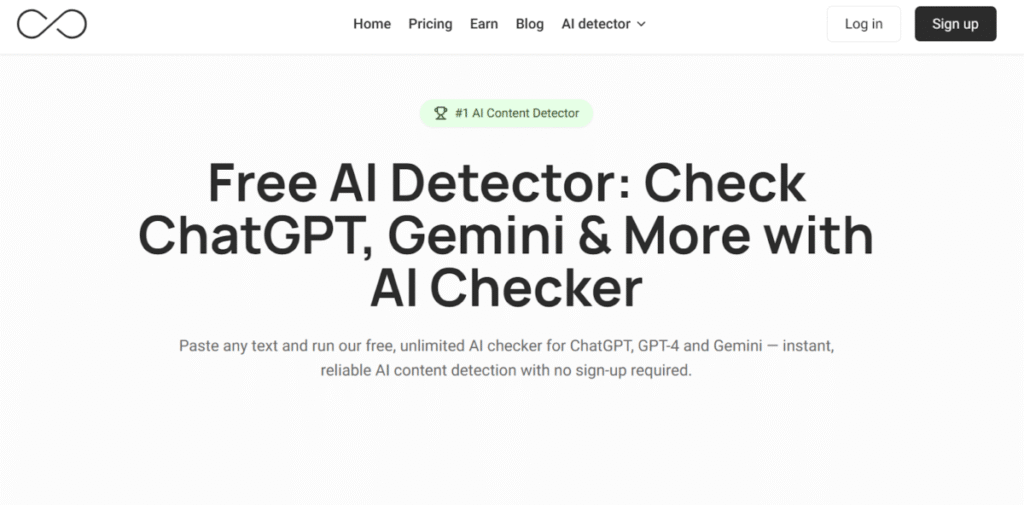
GPTinf is a free AI detector that’s been tested against popular ones like Turnitin, GPTZero, and Originality.ai. It really scrutinizes text for markers like the levels of perplexity, bursitiness, and structural flexibility to deliver accurate scores.
GPTinf was designed to handle every type of text (essays, coursework, book reviews, and articles) and can therefore see through the mechanics of each text format. This means that it is highly adaptable and can look beyond formatting confines like the formal tone of an essay or the narrative flow of a book review to assess the diction of a content piece.
GPTinf uses a four-part checking process. It reads the text, scans for AI watermarks, compares it to human text, and calculates a final score. If flagged, the content can be manually reworked to meet human standards. Alternatively, it can be processed with AI humanizers.
AI Humanizers
AI humanizers are software tools that rewrite machine-generated text by introducing human-writing patterns. The goal is to make the textual content natural and improve its resonance with readers.
How AI Humanizers Works
1. Rewriting
AI humanizers first act like detectors. They look for major telltale signs of machine-generated text, such as frequently used words and overly formal phrases like “It is important to note.” Then, they alter the words on a surface level without changing the original meaning. Humanizers swap words for synonyms, use contractions, and also substitute formal phrasing for more casual equivalents.
Depending on the specific humanizer, they could also make punctuation adjustments and disintegrate rigid sentences while maintaining the flow of ideas. At this stage, AI humanizers do a cosmetic makeover of the text.
2. Tone Modification
Although imperfect, AI tries to humanize content by incorporating pointers of genuine human subjectivity. It aims to transform it from a neutral, flat tone to having a human personality that shines through.
AI could add words like “maybe,” “I guess,” or “it seems,” or introduce emotional qualifiers such as “honestly,” “strangely,” or “surprisingly.” Some AI humanizers go ahead to add redundancy and imperfect metaphors for the human feel.
3. Burstiness and Perplexity Adjustment
This is when the AI humanizer varies the structure of the text. The sentence lengths, rhythm, complexity, and flow of ideas are all adjusted. The text is made to look uneven by following long, complex sentences with shorter ones.
Long sentences are broken down into shorter, simpler ones, and shorter sentences are combined to represent one continuous thought. This creates diversity. Therefore, the text sounds less like a continuous machine stream and more like a person whose thoughts and delivery naturally ebb and flow.
Irregularity is also applied to the paragraphs. The AI can reorganize paragraphs such that “bursts” of information are spaced out and punctuated with lulls.
An AI Humanizer That Works
AI humanizers have their respective strengths; however, one that ranks high among the many options is Humanize AI.
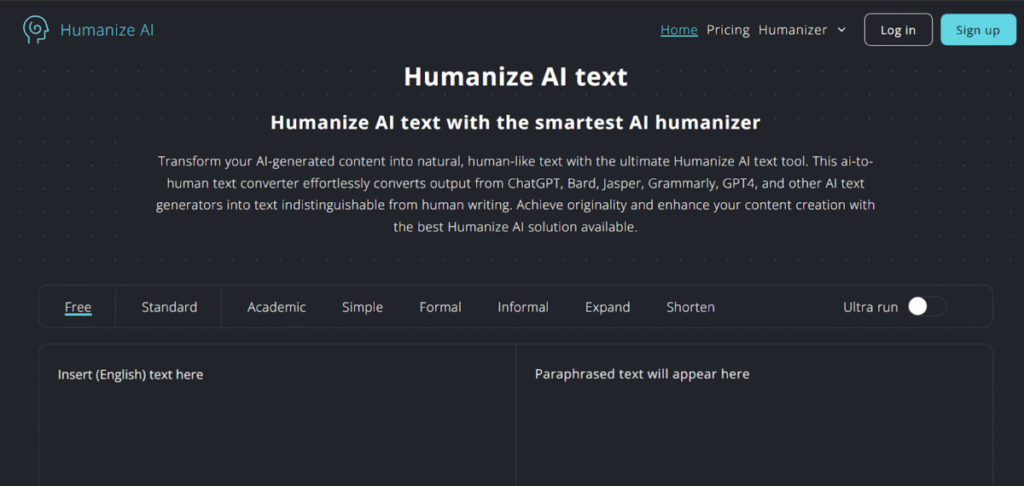
This AI humanizer caters to multiple text types. It changes AI writing into text that meets academic, formal, and informal writing standards. Humanize AI can also shorten and expand text, acting as both a summarizer and an original text generator.
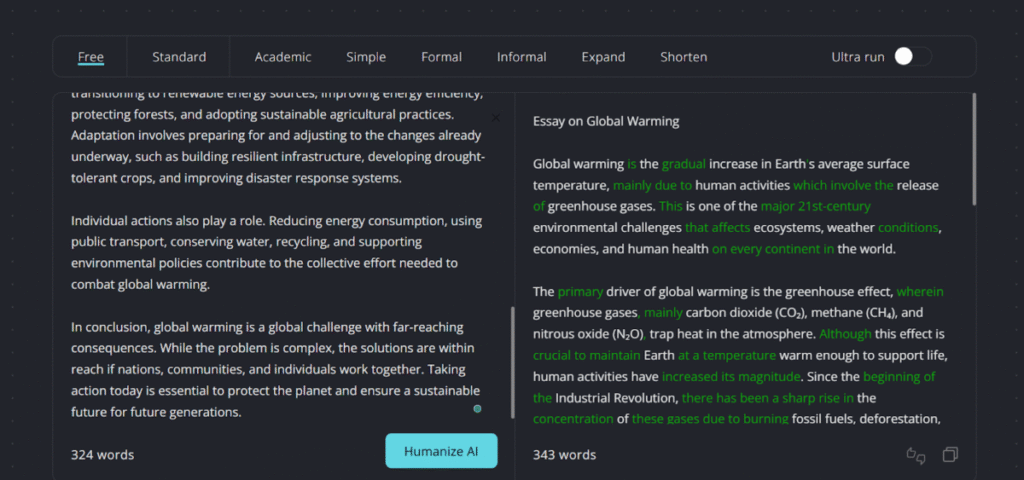
Note: AI humanizers are not perfect. Their aim to infuse text with natural burstiness and perplexity may lead to errors and inconsistencies. But this can be corrected by human oversight.
The Bottom Line
When it comes to AI detection accuracy, GPTinf emerges as a preferred tool. It has advanced technology that has been cross-checked with multiple high-flyers in the industry, not limited to Turnitin, Copyleaks, and GPTZero.
FAQs
1. What Is the Most Accurate AI Detection Tool?
No AI detection tool is foolproof. However, GPTinf has displayed high accuracy levels.
2. Is There a 100% AI Detector?
AI detectors have highly developed technology to flag content of machine origin, but none reportsa 100% accurate result.
