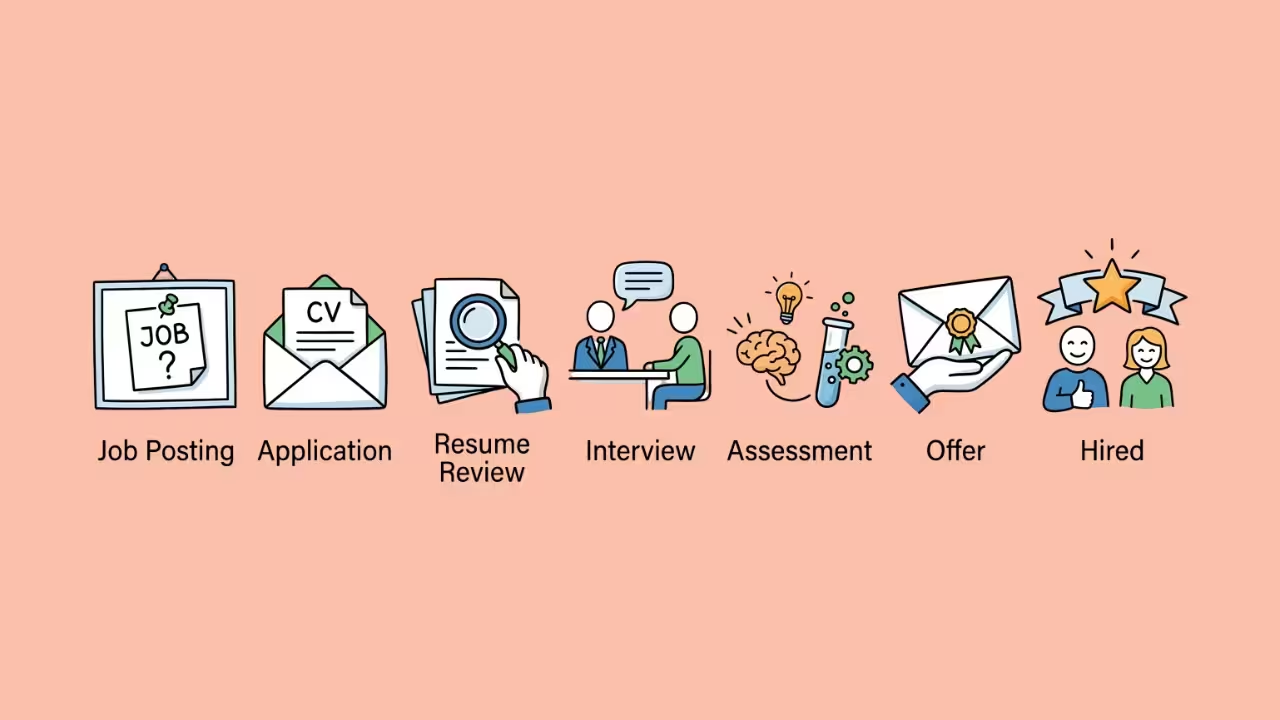

Finding the right talent has never been more competitive or more complex. Recruiters today are expected to screen hundreds of applicants, coordinate interviews across time zones, assess cultural fit, and reduce bias, all while keeping candidates warm and engaged.
AI recruiting tools have emerged as a genuine solution to this pressure, not just as a novelty, but as practical infrastructure for modern hiring teams.
After testing five of these platforms with a small startup hiring team and tracking adoption across three companies, the differences between them became very clear. Some save hours on scheduling. Others quietly reshape who even gets seen in the first place. Here are seven of the best AI recruiting tools available right now, each with a distinct strength in the hiring pipeline.
1. Greenhouse: Best AI Recruiting Tool for Structured Hiring
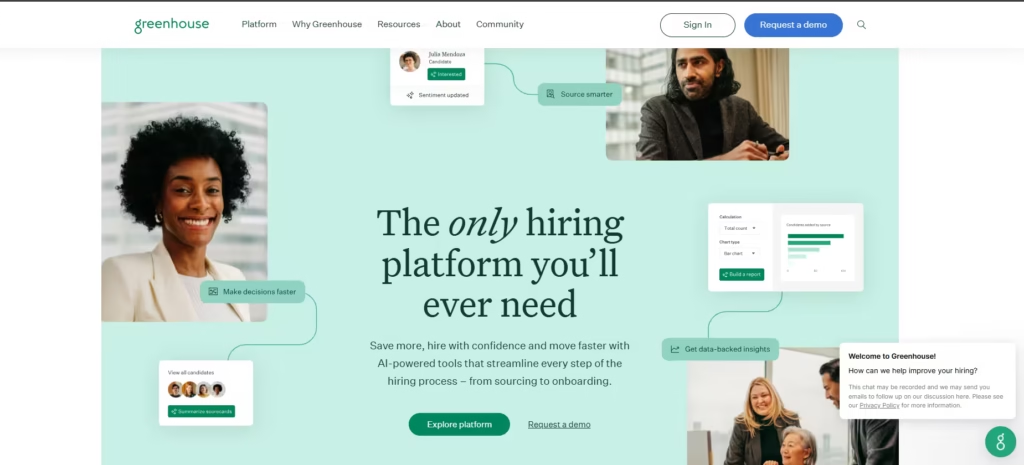
Greenhouse is one of the most established platforms in the recruiting space, and its AI-assisted features have grown considerably in recent years. Greenhouse is an applicant tracking system (ATS), but it’s the intelligence layered on top of that foundation that makes it worth serious consideration.
The platform helps hiring teams design structured interview processes and automatically score candidates against predefined criteria. It also reduces the inconsistency that plagues unstructured hiring.
After spending time with Greenhouse’s interview kit builder, what stands out immediately is how deliberately it forces alignment before a single candidate is contacted. You define the competencies, weight them, and lock in the questions. This sounds bureaucratic until you realize how much subjective drift happens when you don’t.
I’ve watched recruiters at three companies adopt Greenhouse, and the consistent feedback is that the first month feels like overhead, and every month after that feels like clarity. Where Greenhouse particularly distinguishes itself is in committee-based hiring.
The system prompts interviewers with role-specific questions, tracks response quality, and aggregates feedback in a way that makes multi-stakeholder decisions far less chaotic. If your organization is scaling quickly, it keeps everyone aligned without drowning in email threads.
Pro: Exceptional at enforcing structured hiring practices across large teams. This measurably reduces bias and improves decision quality over time, especially valuable once you’re running more than a dozen concurrent roles.
Con: When I worked through Greenhouse’s setup with a five-person team, the configuration menus were genuinely overwhelming for our straightforward needs. We spent nearly two hours building interview scorecards that, for our use case, could have been a shared Google Form. The power is real, but so is the learning curve.
2. Paradox (Olivia): Best AI Recruiting Tool for Candidate Communication
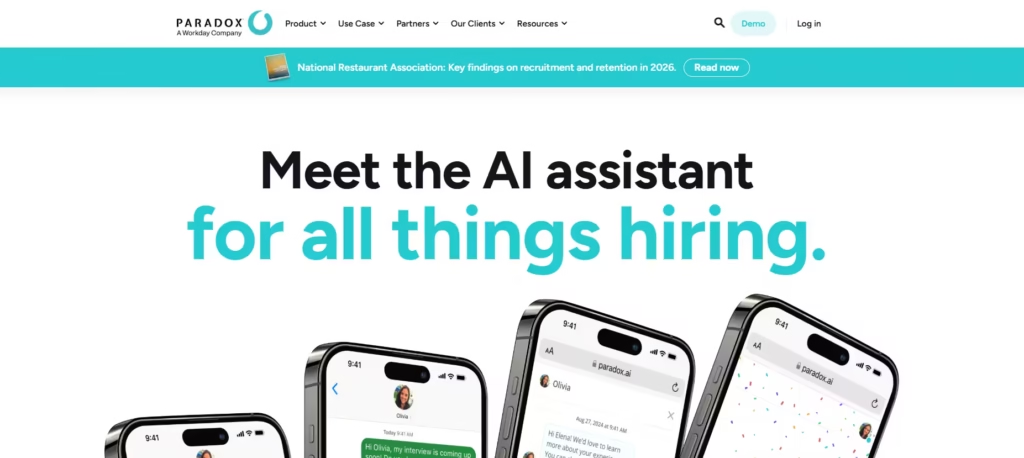
Paradox’s AI assistant, Olivia, operates primarily through conversational AI. It’s a recruiter-facing and candidate-facing chatbot that handles the repetitive, time-consuming tasks that eat up a recruiter’s day.
Scheduling, answering FAQs about job roles, collecting basic candidate information, sending reminders, Olivia absorbs all of it. She integrates with most major ATS platforms and calendar tools, slotting into your existing workflow rather than replacing it.
When I tested Olivia’s scheduling flow with a mock candidate profile, the experience was noticeably smooth. From initial application to confirmed interview slot, the entire exchange took under four minutes without any human input.
That’s not a one-off, according to Paradox’s published case study with Unilever, average time-to-interview dropped from over four days to around 22 minutes after deployment. For high-volume hiring, retail, logistics, and hospitality, that compression is operationally significant.
Paradox has also expanded into AI screening, where Olivia can conduct initial text-based interviews and flag top candidates before a human ever gets involved, adding another layer of efficiency to the top of the funnel.
Rather than framing this purely as a pro/con, it’s worth being direct. Olivia is close to a must-have for any team hiring at volume, but it’s not a universal fit. For senior or specialized roles, candidates notice when the first touchpoint is a chatbot, and some disengage. Deploy it strategically, high-volume pipelines first, executive searches never.
3. HireVue: Best AI Recruiting Tool for Video Screening
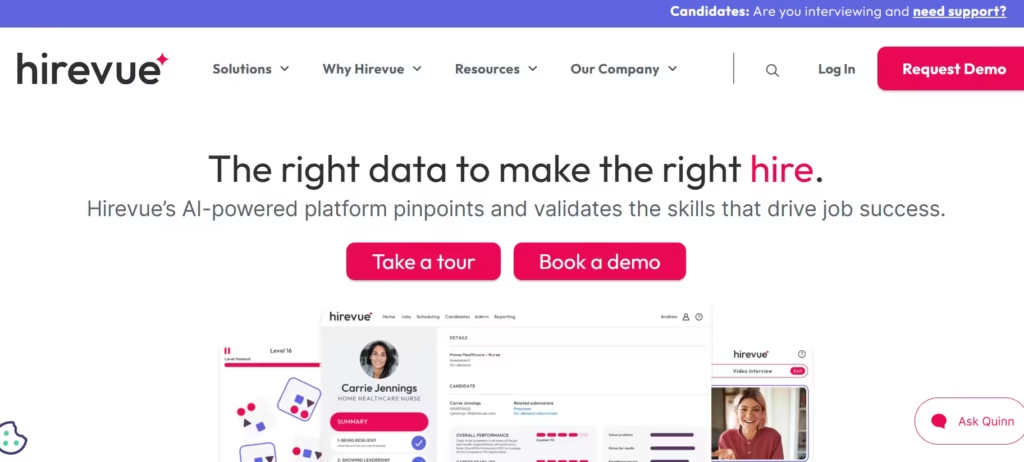
HireVue sits at the intersection of video technology and predictive analytics. Candidates record video responses to interview questions on their own time, and HireVue’s AI analyzes those responses alongside written assessments to score candidates against benchmarks built from the company’s top performers.
For roles that receive hundreds of applicants, this pre-screening layer can be the difference between an overwhelmed team and a manageable shortlist. HireVue has been adopted extensively by enterprise hiring teams.
Major banks, retailers, and consulting firms rely on it to bring structure and scale to early-stage screening. The game-based assessments are a differentiator. They measure cognitive ability and problem-solving through tasks that feel less like formal tests and more like interactive exercises. Candidates who might freeze up on a whiteboard problem often perform more naturally in this format.
It’s worth acknowledging that HireVue attracted legitimate scrutiny over earlier AI features that analyzed facial expressions and speech patterns. The company has since stepped back from behavioral inference in favor of content-focused analysis. That’s a meaningful course correction from both an ethical and accuracy standpoint.
Pro: Cuts recruiter workload on large applicant pools by filtering down to qualified shortlists before any live interaction is needed. This is measurably useful when you’re handling 300+ applications for a single role.
Con: Candidate completion rates can be a real problem. In practice, asynchronous video formats introduce drop-off that a standard application form wouldn’t. If your employer brand isn’t already strong, asking candidates to record themselves before any human contact can feel like the relationship is entirely one-sided.
Also read: AI Recruiters Will Aid Your Job Search, Expert Predicts
4. Beamery: Best AI Recruiting Tool for Talent Pipeline Management
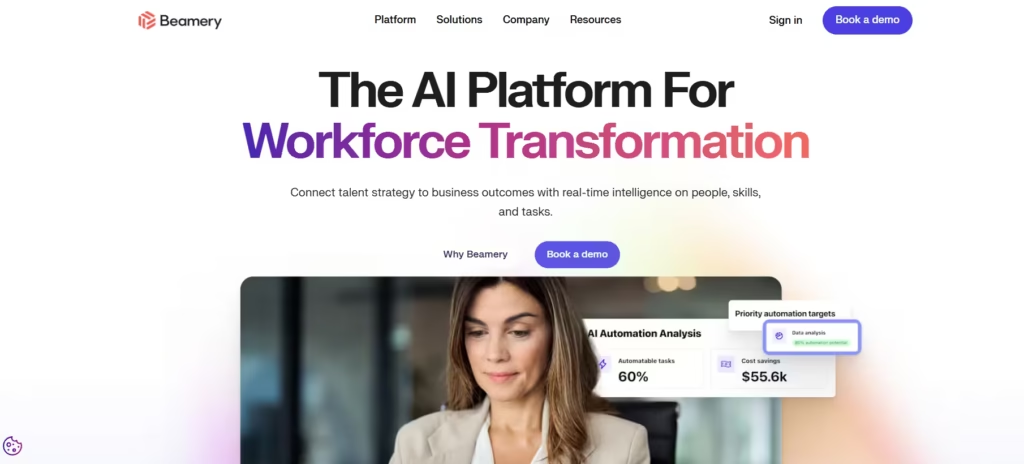
Beamery takes a longer view than most recruiting tools. Rather than focusing on the active hiring moment, it’s built around talent intelligence. It helps organizations identify, attract, and nurture candidates before a role even opens.
If your team has ever scrambled to fill a critical position with no warm pipeline ready, Beamery is a direct answer to that recurring problem. The platform uses AI to map skill adjacencies. This surfaces internal employees or external candidates who have related capabilities to what you’re looking for, even when the match isn’t obvious from a keyword scan. It tracks candidate engagement over time so recruiters know when to reach out and what’s likely to resonate.
In practice, Beamery operates more like a CRM and marketing platform for your employer brand than a traditional ATS add-on. For large enterprises running proactive talent strategies, that’s exactly the right framing. The platform rewards patience and investment. Teams that use it consistently over 12-plus months describe a qualitatively different kind of hiring, less reactive, less expensive, less reliant on agency fees.
Pro: Transforms pipeline-building from an afterthought into a structured, data-driven function.
Con: Beamery’s value proposition is almost entirely long-term, which makes it a tough sell internally. If your leadership measures recruiting success in time-to-fill for this quarter’s openings, Beamery will underwhelm. It requires a genuine strategic commitment to talent relationship management before it pays off.
5. Eightfold AI: Best AI Recruiting Tool for Skills-Based Hiring
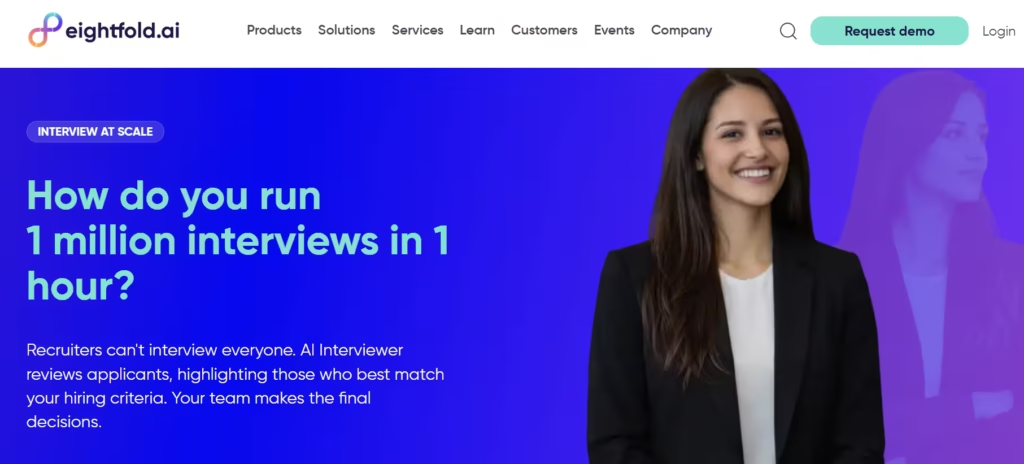
Eightfold AI operates on a fundamentally different philosophy from many of its competitors: it focuses on potential over pedigree. Its deep learning models look beyond job titles and degree names, identifying transferable skills and growth trajectories that predict future performance.
For organizations genuinely trying to move away from credential-heavy hiring, this isn’t an incremental improvement. Eightfold changes the population of candidates you’re even considering.
The internal mobility feature is where Eightfold earns particular attention. After spending time with the platform’s talent mapping interface, it becomes apparent how much invisible talent most organizations already have.
Eightfold surfaces internal candidates who might be perfect for a role but have never applied, not because they lack the skills, but because the connection was never made visible. This isn’t just good for diversity and retention. It directly reduces the cost of external hiring for roles that could have been filled from within.
The platform requires a meaningful data investment upfront. Early implementation can feel underwhelming; the AI needs volume and feedback to calibrate well. But the teams that push through that initial phase consistently report that hiring quality improves in ways that are hard to attribute to anything else.
Pro: Shifts hiring toward skills and potential rather than credentials. This tends to produce more diverse shortlists and better long-term role fit, backed by outcomes data from organizations that have committed to the approach.
Con: Patience is non-negotiable. Without sufficient historical data and recruiter feedback loops in place, the early recommendations are noticeably generic. Plan for a 60-to-90-day ramp before the system is working at its best.
6. Fetcher: Best AI Recruiting Tool for Passive Candidate Sourcing
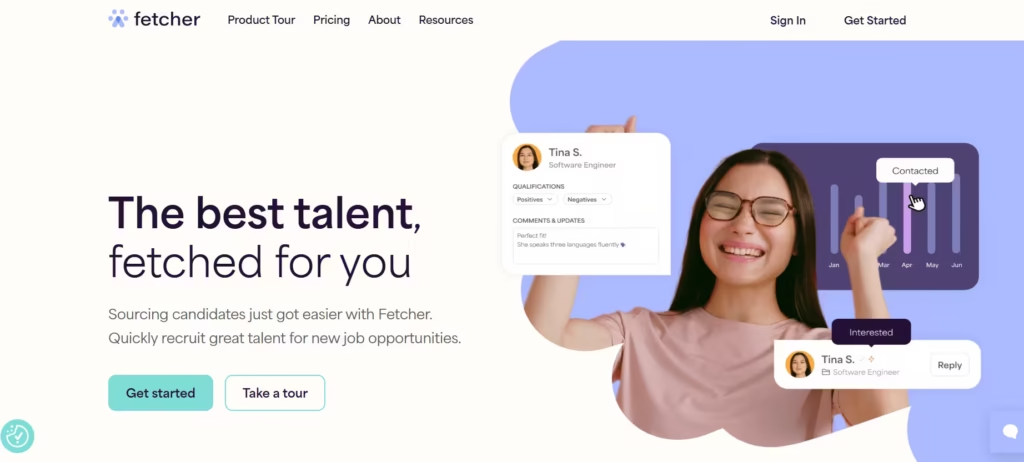
Fetcher handles one of the most labor-intensive parts of recruiting: finding candidates who aren’t actively looking. It searches LinkedIn, GitHub, and other professional networks to surface passive candidates matching your role criteria.
Then, it automates personalized outreach and follow-ups at optimized intervals. It’s very much applicable to technical roles, where the best candidates are rarely submitting applications. Fetcher compresses what used to be a full week of sourcing work into a few hours of setup.
What sets Fetcher apart from generic LinkedIn automation is its feedback loop. When recruiters mark candidates as strong or weak fits, the model recalibrates in real time. After testing the feedback mechanism over a two-week sourcing sprint for a mid-level engineering role, the candidate quality coming through the funnel improved noticeably by day ten. The early suggestions were hit-or-miss, but the later batches were sharper and more relevant.
Fetcher also tracks diversity metrics across outreach. Teams can therefore spot whether sourcing patterns are unintentionally narrowing the pool before a single human decision has been made.
Pro: Eliminates the most repetitive part of sourcing and compounds returns as it learns. It gets meaningfully better with use, not worse.
Con: Cold outreach automation, however well-personalized, still carries the limitations of cold outreach. Response rates vary considerably by industry and seniority level, and some candidates will always tune out automated sequences regardless of how well-crafted the messaging is.
7. Textio: Best AI Recruiting Tool for Job Description Optimization
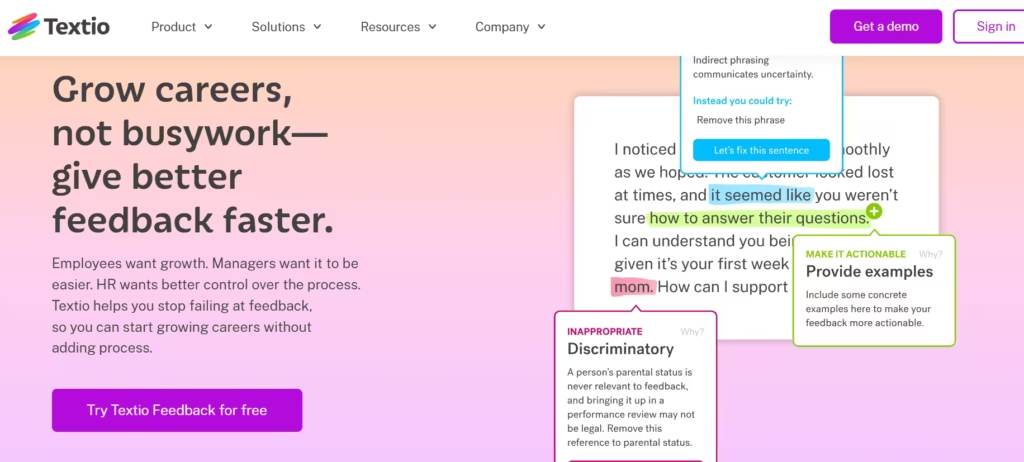
Textio is the most focused tool on this list, and arguably the highest-leverage one per dollar spent. It uses augmented writing AI to analyze job postings in real time. It predicts how language choices will affect applicant pool diversity, application volume, and candidate quality before the listing goes live.
It flags gendered language, corporate jargon that suppresses applications, and phrasing patterns correlated with lower response rates from specific demographic groups. Textio benchmarks listings against what’s currently performing in the industry. Its strength lies in drawing on a continuously updated dataset of real postings and their outcomes.
Here’s the thing that becomes obvious after using Textio for even a short period: most job descriptions are quietly doing the opposite of what they’re supposed to do. They’re filtering out good candidates through language choices that nobody consciously made. Textio makes that invisible problem visible and fixable in minutes.
Pro: Produces measurable improvements in applicant quality and diversity by fixing the language at the very top of the funnel. That intervention is easy to underestimate until you run the before-and-after numbers.
Con: Textio solves one specific problem with precision. It won’t help screen, schedule, source, or assess; you’ll need complementary tools for everything downstream.
The Best Recruiting Tool
The best AI recruiting stack isn’t one tool. Rather, it’s a set of deliberate choices matched to where your hiring process actually breaks down. But if you’re looking for a starting point rather than a full audit, here’s a direct recommendation hierarchy:
If you’re hiring at high volume, retail, logistics, or customer service, start with Paradox. The scheduling and communication automation alone will recoup the cost fast. If you’re building a skills-based or internal mobility strategy and have the data and patience to support it, Eightfold is worth the investment.
To get the highest ROI per dollar spent, just get Textio. Cleaner job descriptions cost almost nothing to fix and affect every single application you receive.
Everything else, Greenhouse, Beamery, HireVue, Fetcher, earns its place depending on team size, hiring volume, and strategic maturity. The common thread across all seven is that AI in recruiting works best when it amplifies human judgment, not when it tries to replace it.
