

Devin AI introduced autonomous coding as a commercial product in March 2024, when Cognition Labs demoed an agent that could plan, write, test, and ship code with minimal supervision.
Since then, at least a dozen competitors have shipped, several with stronger benchmark scores and lower per-task costs. This guide breaks down 10 Devin AI alternatives worth testing, along with what I found when I actually ran comparable tasks through them.
What Is Devin AI?
Cognition Labs built Devin as an autonomous software engineer. It plans a task, browses documentation, writes code, runs tests, and opens a pull request on its own. Devin 2.0 arrived in April 2025 and cut the entry price from $500 to $20 per month plus per-task ACU charges. That pricing change moved Devin from an enterprise-only tool to something a solo developer could try.
The benchmark story is murkier. Devin’s original SWE-bench score was 13.86%. Cognition hasn’t published a comparable updated figure for Devin 2.0, so most third-party comparisons still cite the 2024 number.
Devin’s weak point showed up on a Django migration. It hit a dependency conflict between Django 4.2 and a pinned Celery version. It didn’t flag the conflict or ask for guidance. It just reapplied the same failed migration until the task timed out.
Restarting the section with more explicit dependency instructions finally completed it. That’s the pattern to watch for: Devin performs well on clean, well-specified tickets, and it struggles to recover gracefully when something upstream breaks its assumptions.
Why Get Alternatives to Devin AI?
Devin still handles well-scoped, delegated tickets competently. That said, three problems keep pushing teams toward other tools.
Cost is the first issue, and it’s not abstract. A 200-line authentication refactor through Devin 2.0 consumes 20 Agent Compute Units, which came out to $45 at the standard $2.25-per-ACU rate. The same refactor through Cursor’s Composer will finish for under a dollar of usage-pool credit.
This isn’t a one-off; ACU pricing scales fastest on exactly the multi-file, multi-step tasks most teams actually need help with.
Second, Devin isn’t built for pairing. You hand off a ticket and wait for a report, which works for batch work but not for anyone who wants a collaborator inside the editor.
Third, the performance gap has closed. Several rivals now match or beat Devin’s original SWE-bench score of 13.86%, often at a fraction of the price.
How We Chose These Devin AI Alternatives
Every tool on this list had to clear four bars: a published or independently verified benchmark score, transparent pricing, active development in 2026, and a point of differentiation from Devin rather than a copycat feature set.
1. Cursor

Cursor’s Composer mode is the standout feature. You can open related files mid-refactor and watch it apply consistent naming changes across the files without being asked twice. That’s the core difference from Devin: you stay in the loop instead of waiting on a report.
Composer 2.5, Cursor’s in-house model, targets fast, low-cost multi-file edits, and Pro access to Claude, GPT, and Gemini models runs $20 per month. Over 500,000 developers now use it, and for anyone who wants autonomy without giving up direct control, it closes a gap Devin’s delegate-and-wait design leaves open.
2. GitHub Copilot
Copilot’s real edge over Devin is its reach. It runs inside VS Code, JetBrains, Eclipse, Xcode, and GitHub’s own web interface, so teams don’t need to adopt a new environment just to get an agent. Its coding agent takes a GitHub issue and returns a pull request asynchronously, much like Devin does, but starting at $10 per month, roughly half Devin’s entry price.
Copilot’s benchmark scores trail the frontier tools on this list, and I’d skip it for hard multi-file refactors. For teams already living in GitHub, though, it’s the lowest-friction switch available.
3. Windsurf

Cognition, the company behind Devin, acquired Windsurf in late 2025, so the two products now share a parent. That makes Windsurf’s continued existence as a separate, interactive tool notable. Cognition could have folded it into Devin and didn’t, which tells you the two workflows serve different needs.
Windsurf’s Cascade agent works as a live pairing partner inside a VS Code-based editor, with codebase-wide context and a proprietary SWE model that doesn’t burn your quota on routine edits. Its Pro pricing runs around $20 per month.
4. Replit Agent
Estimates reported that Replit reached $525 million in annualized revenue by April 2026, up 1,775% year over year, largely on the strength of Agent 3. Where Devin focuses on complex workflows in established repositories, Replit Agent handles the entire lifecycle.
It runs autonomously for up to 200 minutes per task. Core access starts around $20 to $25 per month, but I’d budget extra: credit consumption spikes fast on anything beyond a simple CRUD app, and Replit’s own users have reported bills climbing well past their expected monthly cost.
5. Amazon Kiro
AWS built Kiro to replace Amazon Q Developer, and new Q Developer signups have already stopped. Kiro’s core difference from Devin is sequencing. Instead of jumping straight to code, it writes structured requirements and design documents first, using formal EARS notation, and waits for your approval before touching a single file.
That upfront review step catches mistakes in test specs before any code gets written, which is exactly the kind of failure Devin’s code-first approach wouldn’t surface until later. Pro pricing runs about $19 to $20 per month.
6. Google Jules
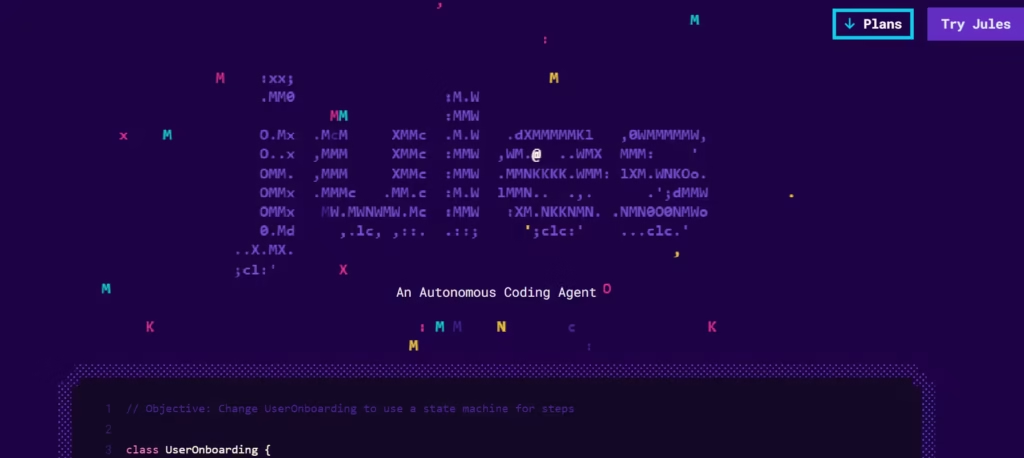
Jules reached general availability at Google I/O 2026, running on Gemini 3.1 Pro. Like Devin, it works asynchronously in an isolated cloud VM and returns a pull request when it’s done. The differences are cost and transparency: Jules offers a usable free tier with daily task limits, and Pro access runs under $20 per month, well below what a comparable Devin task costs in ACUs. Jules also reruns your existing test suite automatically after making changes and can catch for instance a regression in test repos before you ever open the PR.
7. OpenHands
Formerly OpenDevin, OpenHands is the open-source community’s direct answer to Devin, right down to the original name. It’s MIT-licensed, model-agnostic, and scores around 72% on SWE-bench Verified, ahead of several commercial tools on this list.
Because it’s self-hosted, you pay only for the underlying model’s API tokens, with no markup and no subscription. That makes it the strongest option for teams that need full auditability or want to swap models freely between tasks without renegotiating a contract.
Also read: Top LLMs for Coding All Developers Should Know About
8. Aider
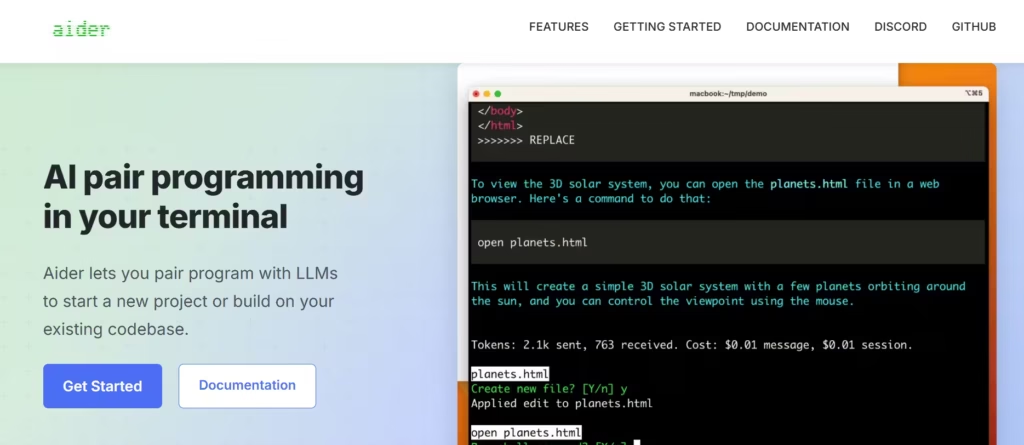
Aider takes the opposite approach from Devin’s sandboxed, browser-driven workflow. It’s a lightweight, terminal-only CLI that edits your local git repository directly and commits every change atomically, so you get a clean, reviewable history by default.
With more than 40,000 GitHub stars, it supports over 100 languages and works with almost any LLM, including local models through Ollama. The tradeoff is that Aider won’t rerun your test suite automatically the way Jules does, so you’re still the one closing the loop before you merge.
Which Devin AI Alternative Should You Actually Choose?
If I had to pick one tool for most developers switching off Devin, it’s Claude Code. And that’s because it solves Devin’s biggest bottleneck, which is the feedback loop. Using Devin involves handing off the prompt and then waiting for some minutes to get a pull request. That seems convenient, but if it hits an error, there are time losses. But Cursor is transparent, staying inside your IDE so you can watch it work live. The advantage is that you can intercept and make corrections if it hits an error. And that’s a better pick for any software developer.
