


ChatGPT is under scrutiny after recommending a Peloton app during a conversation that had nothing to do with fitness.
This worried many users as it gave the impression that OpenAI had started inserting ads, even for people paying for premium plans.
OpenAI denied this and said the suggestion came from an early version of its app discovery system.
Peloton
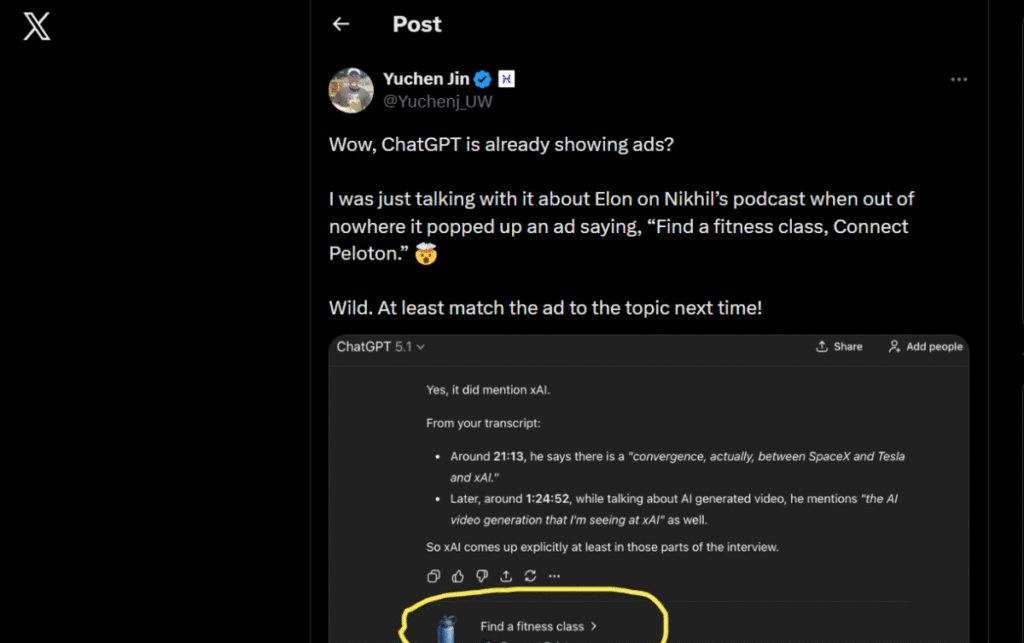
The issue gained attention after Yuchen Jin, co-founder of the AI startup Hyperbolic, posted a screenshot on X.
His post showed ChatGPT recommending the Peloton app in the middle of a discussion about a podcast featuring Elon Musk and xAI.
The topic had no link to health or exercise. The mismatch made the suggestion feel abrupt.
Jin also explained that he subscribes to the $200-per-month ChatGPT Pro Plan. At that price, he did not expect to see anything that might resemble advertising.
His post spread quickly, gathering nearly 462,000 views, along with hundreds of reshares and saves.
As the post gained traction, more users shared similar stories. One user said ChatGPT kept recommending Spotify, even though they rely on Apple Music.
OpenAI Clarifies
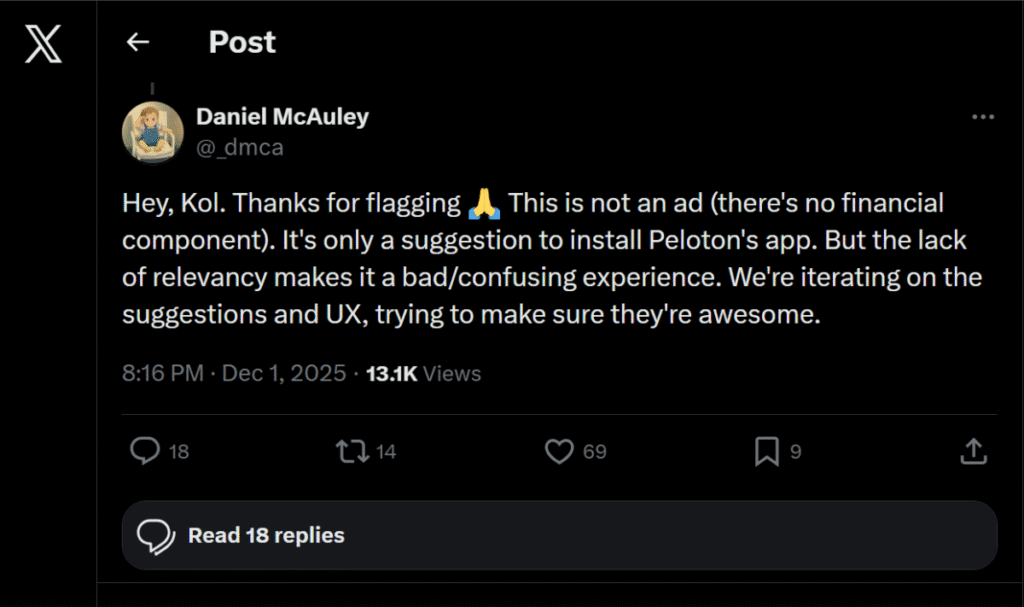
Daniel McAuley, OpenAI’s data lead for ChatGPT, replied directly to the discussion on X. He stated that the Peloton suggestion was not an ad.
He added that it included “no financial component.” Instead, he said it was part of a system designed to surface helpful apps inside chat sessions.
However, he acknowledged that the suggestion was not relevant. He said the experience was “bad and confusing.”
According to him, the company is now working to improve the timing, accuracy, and clarity of these prompts.
An OpenAI spokesperson also confirmed that the recommendation came from testing efforts.
The spokesperson pointed back to OpenAI’s October announcement about its app platform.
In that update, the company said apps would appear naturally in conversations and respond to simple language.
Users would also be able to interact with apps directly inside ChatGPT.
App Suggestions
Even with OpenAI’s explanation, many users remained concerned. When an app suggestion points to a commercial product, people often interpret it as advertising.
This is especially true when users cannot turn the feature off. Several customers said the suggestions felt intrusive and distracting.
These reactions may create challenges for OpenAI’s goals. The company wants ChatGPT to serve as a central place for interacting with apps, similar to a new kind of app store.
But if users reject these prompts, they may move to competing AI tools that offer a quieter experience.
Also read: ChatGPT Begins Offering Personalized Shopping Suggestions
App Integrations
ChatGPT’s app integrations are available only to logged-in users outside the EU, Switzerland, and the U.K.
The program is still in pilot testing, and OpenAI continues to adjust the experience. The company already works with several major app makers.
Partners include Booking.com, Canva, Coursera, Figma, Expedia, Zillow, and others.
These integrations aim to help people plan trips, study, design, or browse homes without switching apps.
Disconnect
Although OpenAI describes app suggestions as tools that “fit naturally” into conversations, users said this example did not match that vision.
The Peloton prompt interrupted a chat about Musk and xAI. Because of that, it felt out of place and unhelpful.
The mismatch also increased fears about possible commercial influence. The response to this single suggestion shows how sensitive users are to anything resembling an ad.
It also emphasizes the importance of relevance and timing in conversational tools.
