

In 2026, technological progress is relentless, with neural network models burgeoning weekly. Simultaneously, client requests are changing at a breakneck pace; sometimes faster than teams update their backlogs. With things as they are, the standard development cycle of “planning, long-term development, release” is a recipe for obsolescence.
For modern founders, the Lean MVP (minimum viable product) concept has evolved from a mere methodology into a pathway to success. A fast-track MVP launch intelligently balances development processes and high-level software design while addressing the core needs of a startup. Consequently, cost optimization and an optimal tech stack are promised to withstand rapid traffic growth.
Accelerating time-to-market is not just a bonus, but a necessity for capturing a niche. Let’s prove that speed is the only real moat in 2026.
Making Your Business Visible
Many businesses are struggling today, as the market suffers from stiff competition and insidious imitation of business ideas. Just a decade ago, startups took 6-9 months to get back on their feet, but now, this window has shrunk to 12-15 weeks.
To scale the brand, validating user flows is a must. For this purpose, Lean MVP development comes with the following benefits:
- Test hypotheses using the empirical, hard data, not one’s subjective assumptions.
- Retain resources by discarding features that seem crucial but yield no results to end users.
- Secure investment faster by demonstrating a functioning prototype to your first base of committed users.
A Strategic Approach to MVPs: From Concept to Launch in 10-14 Weeks
The development of MVPs should be perceived not as a stripped-down version of a product, but as a highly focused solution to primary hurdles every customer faces. The crux of this approach is built on three core pillars: precision, flexibility, and technological excellence.
Stage 1: Discovery and Prioritization
The initial few weeks are dedicated to thorough analysis, when all features are categorized into “must-have” and “nice-to-have.” The use of frameworks like MoSCoW or RICE in 2026 is complemented by AI-based predictive analytics, which assesses the potential market response to a chosen feature.
Stage 2: Tech Stack and Architecture
If business is heading in the right direction, scalability goes to new heights. Even the boldest Ideas can be incorporated through serverless architectures like Flutter or React Native without compromising the ability to scale to users later.
Lean MVP Ruling the Scene
Traditional development has always been paired with stability, while the Lean MVP is still shrouded in myths. To show a clear perspective, this in-depth comparison breaks down the critical parameters:
1. The Uncertainty Issue
- Traditional software development reflects the belief that the market is always linear, and users won’t change their preferences in advance. As a rule, any error is detected closer to the end, when the budget is already heavily exhausted.
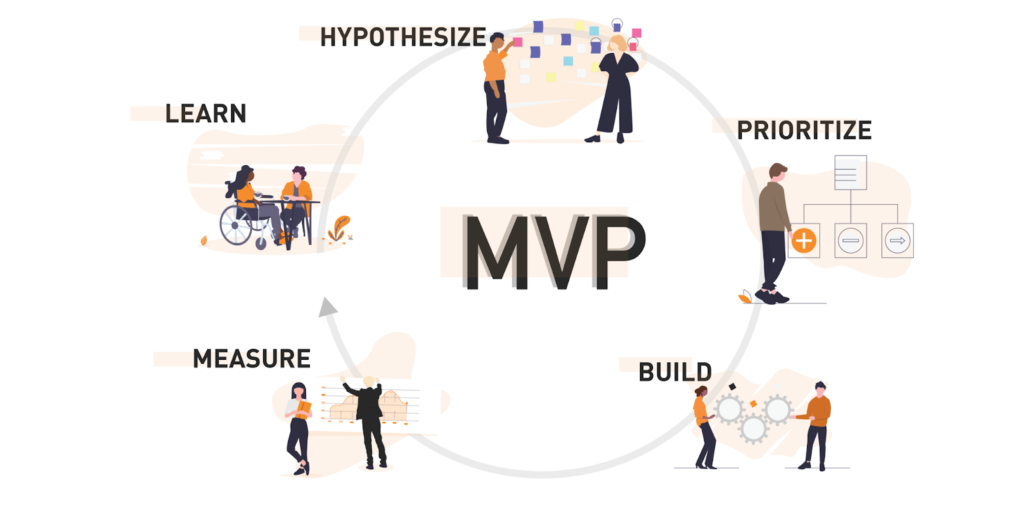
- Lean MVP, on the other hand, embraces uncertainty as a fundamental prerequisite. Instead of constructing a “dream ship” in a closed dock, a raft is launched when already at sea. This “Build-Measure-Learn” cycle allows for adapting the product to real industry imperatives without hassle.
2. Time-to-Market
- Within a traditional approach, the release typically takes 9 to 18 months. By the time of launch, functionality may become obsolete, and the niche may be occupied by a more nimble competitor.
- Lean MVP: In this case, the principle “First comes first served” is applicable. With the working prototype going into production within 10-14 weeks, your market share is secured while competitors are bogged down in paperwork.
3. Budget Management and Financial Risks
- The traditional development model requires immense capital investments (CapEx) at the start. The bulk of funding is spent on developing features, 60% of which will never matter to the audience.
- Lean MVP: Allows you to optimize costs through targeted investments. This strategy mitigates financial risks: if the hypothesis cannot be confirmed, the project will simply be closed or pivoted with manageable losses.
4. Tech Stack and Scalability
- Traditional projects are prone to “overengineering.” A heavy architecture is developed for millions of users who don’t yet exist.
- With Lean MVP, a modern tech stack is key, focused on speedy deployment and easy scaling (Serverless, Microservices). This way, the system will grow organically with the influx of real clients.
5. Feedback and Product Quality
- During traditional development, quality is assessed by internal testers using internal standards.
- In the Lean model, the market is the ultimate judge. Quality here isn’t the absence of bugs but rather the product’s compliance with expectations (Product-Market Fit).
Summary: What to Choose in 2026?
If your goal is to launch an innovative service, a Lean MVP is a rational choice. It transforms the development process from a “blind gamble” into a controlled scientific expedition, where every dollar invested validates your business value.