

Siri has lived on Apple devices since 2011. Yet most people still aren’t sure what it actually is. Yes, Siri is AI, but probably not the kind you’re imagining. Siri uses real, practical AI technologies, specifically natural language processing (NLP), machine learning, and speech recognition, to understand what you say and respond accordingly.
However, it isn’t “thinking.” It’s recognizing patterns and executing pre-programmed responses. That’s an important distinction between Siri and conventional AI chatbots.
What Type of AI Is Siri?

Siri falls squarely into the category of narrow AI, also called weak AI. That means it’s built to handle specific tasks rather than reason freely like a human. Despite this, it does share certain key characteristics with mainstream AI chatbots;
- Natural Language Processing (NLP): To interpret the meaning behind your spoken commands
- Machine Learning: To refine responses over time based on how you interact with it
How Does Siri Actually Work?
When you say “Hey Siri,” a lot happens in a fraction of a second. Siri captures your voice, converts it to text, analyzes the intent behind your words, and then routes that request to the right action or data source. It does all of this locally or via Apple’s servers, depending on the task.
Crucially, Siri was originally architected as a command-and-response system. You give it an input; it finds the best-fit output. That architecture is fast and efficient. It also explains why Siri has historically struggled with follow-up questions, ambiguity, and multi-step reasoning; it wasn’t built as a reasoning engine, and retrofitting one is harder than building from scratch.
Apple Intelligence in 2026
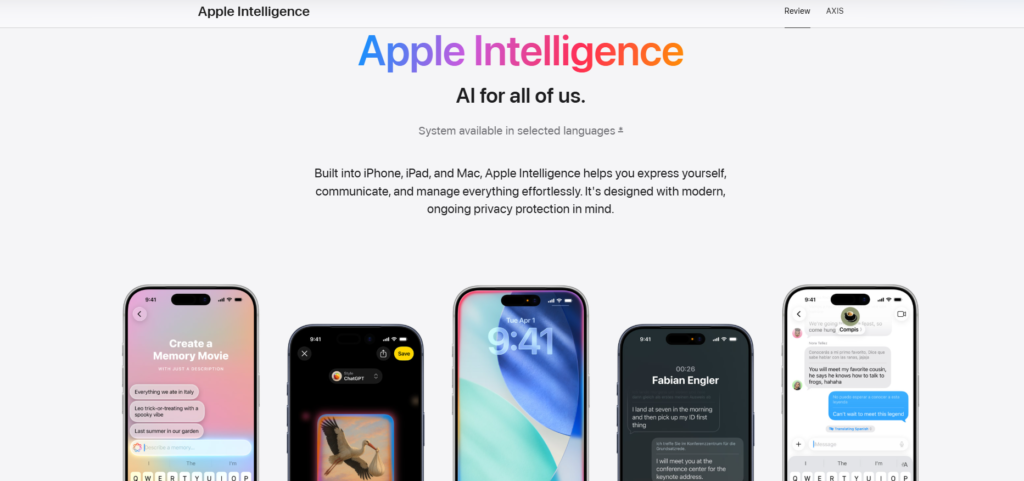
Apple introduced Apple Intelligence alongside iOS 18 in 2024, marking the most significant overhaul of Siri in its history. Here’s what actually changed, and what I found when I put these features through their paces:
- On-screen awareness: Siri can now read and act on content currently displayed on your screen. When I tested this with a flight confirmation email, Siri successfully read the booking reference number and added the flight to my calendar without me having to dictate a single detail. That’s a meaningful leap from the Siri that used to ignore everything on your screen.
- Deeper app integration: Siri can take actions across third-party apps, not just Apple’s own ecosystem
- ChatGPT handoff: When Siri can’t handle a complex query, it passes the request to ChatGPT, with your permission. After some time of daily use, I found this handoff worked smoothly but required an extra confirmation tap each time, which interrupts the flow when you’re asking something quickly while driving or cooking.
- Writing and summarization tools: Apple Intelligence added system-wide AI writing assistance and notification summarization. This, however, should be used with caution as Apple Intelligence has a history of generating false news headlines.
Several of the most advanced features took longer to ship than Apple initially announced. As of early 2026, Siri is notably improved, but it still trails the conversational depth of dedicated large language model (LLM) assistants like Google Gemini and ChatGPT.
Siri vs. Other AI Assistants
| Feature | Siri | Google Gemini | ChatGPT (Voice) |
| Device Compatibility | Apple devices only | Cross-platform | Cross-platform |
| Conversational Depth | Improving, but limited | Advanced | Advanced |
| Reasoning Ability | Basic | Strong | Strong |
| Ecosystem Integration | Excellent (Apple) | Excellent (Google) | Growing |
| On-Device Processing | Yes | Partial | Limited |
Note: Siri’s biggest advantage remains its deep, seamless integration with Apple hardware and software. No other assistant controls your iPhone, Apple Watch, AirPods, and Mac as natively as Siri does.
Siri’s Strengths and Weaknesses
| Strengths | Weaknesses |
| Native Apple ecosystem control | In my testing, asking Siri to “set a reminder for 3pm” and immediately following with “actually make it 4pm” created two separate reminders instead of editing the first, the kind of context-switching failure that ChatGPT handles naturally. |
| Faster on-device processing | Still less capable than Gemini or ChatGPT for open-ended reasoning. |
| Improved context awareness via Apple Intelligence | Advanced features were released more slowly than announced |
| Hands-free convenience | ChatGPT handoff requires an extra confirmation step, breaking hands-free flow |
Can Siri Become Smarter?
Absolutely, and it already is. Here’s where Siri is heading:
1. Better contextual memory: Future versions of Siri should connect your questions more fluidly. Ask “What’s the weather today?” and then “And tomorrow?” Siri should handle that chain without you repeating yourself.
2. Personalized suggestions: By learning your habits over time, Siri could proactively recommend your go-to playlist, suggest leaving early for a meeting based on traffic, or remember your preferences without being asked.
3. Smarter multi-step tasks: Think of booking a dinner reservation and adding it to your calendar in one request. That kind of agentic behavior is where AI assistants are headed, and Siri is building toward it.
The biggest structural obstacle isn’t processing power, it’s architecture. Building LLM-level reasoning on top of a legacy command-response system is a genuinely difficult engineering challenge, which is why Siri’s progress has been incremental rather than transformational.
Why Doesn’t Siri Feel Like a Human
Apple designed Siri to feel conversational. It uses natural-sounding voices, friendly phrasing, and occasional humor to lower the barrier to using the assistant. Underneath that polished surface, Siri doesn’t reason or feel. Compare that to how humans actually think:
| Human Intelligence | Siri’s Intelligence |
| Learns through lived experience and emotion | Learns through data and interaction patterns |
| Adapts to completely new situations | Limited to trained tasks and parameters |
| Thinks critically and creatively | Matches inputs to pre-defined outputs |
The conversational aspect makes Siri feel intuitive. However, the underlying mechanism is pattern matching, not understanding. This isn’t a major issue, as the majority of AI chatbots available today are also trained to recognize patterns and carry out tasks based on them. Except for agentic AI, none have true “understanding.”
Siri Is AI, but Not an AI Chatbot
Siri is AI; it uses machine learning, NLP, and speech recognition to make your daily tasks easier. With Apple Intelligence now actively increasing its capabilities, Siri in 2026 is smarter and more contextually aware than it has ever been.
But it still isn’t general AI. It can’t reason freely, handle truly open-ended conversations, or match the depth of a dedicated LLM assistant. What it can do (manage your Apple system, act on your screen, and hand off complex questions to ChatGPT when needed) makes it one of the most practically useful assistants available for iPhone users specifically.
FAQs
1. Is Siri the same as ChatGPT?
No, Siri is Apple’s native voice assistant, optimized for device control and quick tasks. ChatGPT is a large language model built for open-ended conversation and reasoning. Siri can now hand off queries to ChatGPT when it hits its limits, but the two are distinct systems.
2. Is Siri an example of General AI?
No, Siri is narrow AI, designed for specific, defined tasks. General AI would mean reasoning freely across any topic the way a human does. Siri cannot do that.
3. How long has Siri been AI?
Since its launch in October 2011. Even early Siri used machine learning and NLP, though far more limited than today’s version.
4. Will Siri be replaced by a more advanced AI?
It is unlikely to be replaced outright. Apple is more likely to continue layering advanced AI capabilities, including LLM integration, on top of Siri’s existing architecture.
