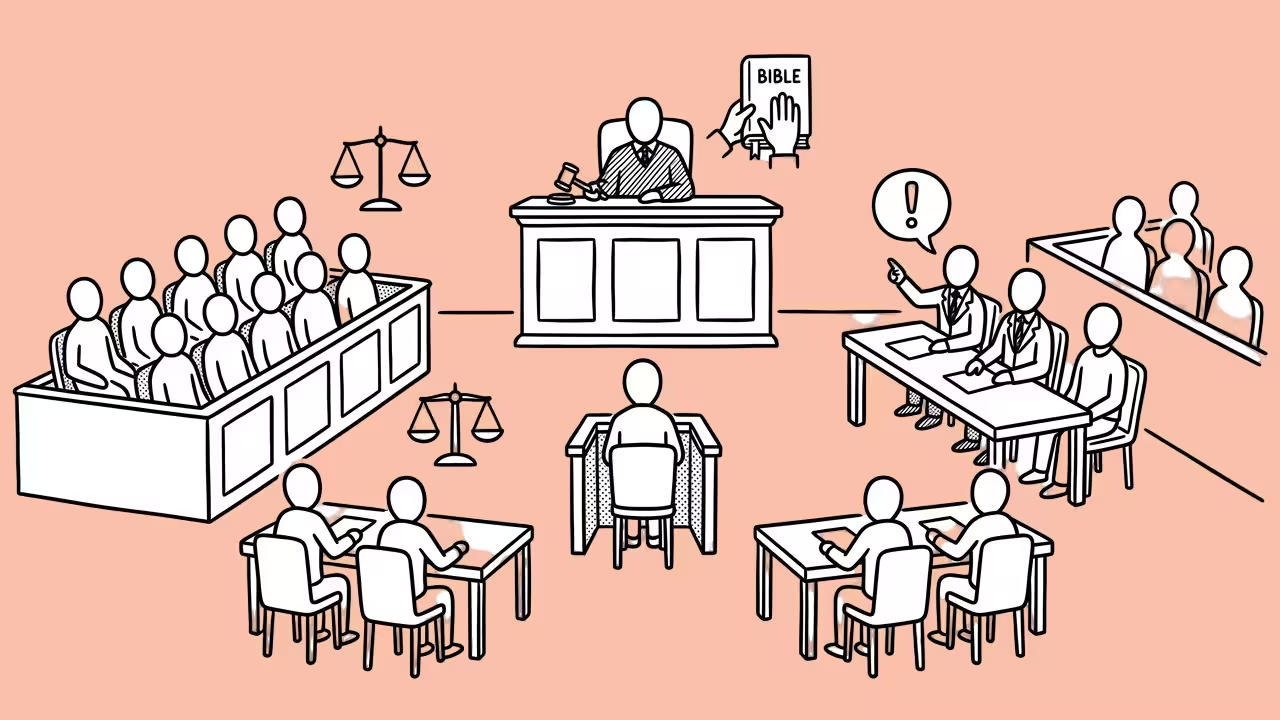

Picture a room full of some of the smartest people in tech. A painting of a Tesla sits in the corner, meant as a gift. Then everything falls apart.
That’s the scene Greg Brockman described in court this week. He testified about a late August 2017 meeting that would change the course of AI and incite a lawsuit that’s now playing out.
A High-Stakes Meeting
Back in 2017, OpenAI was a small nonprofit; it had big dreams, but it needed money. So its founders sat down to talk about creating a for-profit arm to raise funds.
Musk had been a key backer and had a clear idea of how things should go: he wanted full control of the new company.
But the other founders said no.
Brockman testified that Musk didn’t take it well. According to Brockman, Musk sat quietly for several minutes after being told he wouldn’t get what he wanted.
Then he stood up, grabbed the Tesla painting that Ilya Sutskever, OpenAI’s head of research, had commissioned as a friendly gift, and started walking out.
But before he left, Musk turned around and asked, “When will you be departing OpenAI?” Neither Brockman nor Sutskever left. But the damage was done.
Also read: Elon Musk Challenges OpenAI’s Profit-Driven Shift in US Court
Power Plays
Before the blowup, Musk had given each of his co-founders a Tesla Model 3. Brockman said he saw that as Musk trying to win them over ahead of the meeting.
Sutskever even had a painting of a Tesla made to show goodwill in return. So why did things go so wrong?
The founders wanted equal shares. Some even floated the idea of linking OpenAI to Tesla’s AI work.
According to Shivon Zilis, an OpenAI advisor who acted as a go-between for Musk and the team, there were more than 20 different versions of a possible deal on the table.
But none of them gave Musk what he really wanted: unequivocal control. When that became clear, the partnership unraveled fast.
None of this would have happened without a video game. An OpenAI model had beaten the top human player in DOTA II.
That win made the founders realize something important: computing power was the key ingredient for building powerful AI.
And raising enough money purely as a nonprofit wasn’t going to cut it. That realization pushed them toward building a for-profit company, putting them on a collision course with Musk.
Journal Entries
Brockman kept a personal journal during this period. It’s now part of the trial, and he wasn’t happy about it.
“It’s very painful,” he told the court. “These are deeply personal writings that were never meant for the world to see.”
One entry in particular got a lot of attention. In November 2017, Brockman wrote about whether OpenAI could move forward without Musk.
He used the phrase “steal the non-profit,” which Musk’s lawyers jumped on. But Brockman pushed back on that reading.
He said the entry was about whether to try to remove Musk from the board, something they ultimately chose not to do.
Musk left the board voluntarily in February 2018, saying he believed OpenAI was heading toward failure and that he wanted to focus on AI at Tesla instead.
The Trial
Musk’s legal team has been aggressive. They’re arguing that Altman and Brockman “stole a charity.”
OpenAI’s lawyers fire back that Musk wanted the same kind of control he’s now accusing others of taking.
The lead attorney for Musk, Steve Molo, grilled Brockman hard. He pointed to a journal entry where Brockman asked himself what it would take to hit $1 billion personally.
Molo used it to suggest Brockman cared more about money than the nonprofit’s mission.
Brockman didn’t flinch. He noted that OpenAI’s nonprofit now holds over $150 billion in equity value. “Look at what we accomplished,” he said.
Two days before the trial began, Musk sent Brockman a text: “By the end of this week, you and Sam will be the most hated men in America.”
The jury didn’t see it, but it set the tone for everything that followed.
Brockman’s Conclusion
One of the bluntest moments came when Brockman addressed Musk’s understanding of AI directly. “He did not and does not know AI,” Brockman testified.
He described Musk dismissing an early version of the software that would eventually become ChatGPT.
That failure to recognize the technology’s potential, Brockman said, was exactly the kind of problem they needed to avoid.
It’s a striking claim given that Musk went on to found xAI and build the Grok chatbot. But in 2017, Brockman says, he just didn’t see it.
Things moved fast after Musk left. In 2019, OpenAI launched its for-profit arm and raised $1 billion from Microsoft. Over the next four years, Microsoft added another $13 billion.
That money helped turn OpenAI into the most talked-about AI company on the planet. It also made its founders very wealthy and gave Musk the ammunition to file his lawsuit in 2024.
His argument, boiled down: the company he helped build with nonprofit money became a cash machine for a select few. And he wasn’t one of them.
The trial is expected to continue through next week. Sam Altman has yet to testify.
