

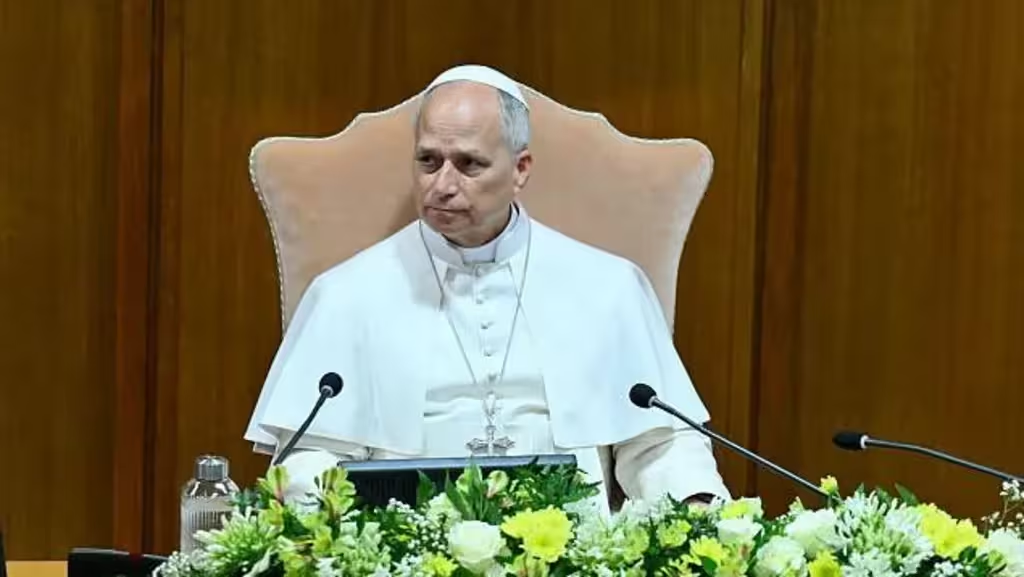
Pope Leo released his first major teaching document as Pope, an encyclical titled Magnifica Humanitas, which translates to “Magnificent Humanity.”
In it, he makes a bold, urgent call: AI must be “disarmed.” That’s a striking word choice. The Pope knows it, too.
“The word is strong, I know, but deliberately chosen because this moment needs words capable of attracting attention,” Leo said.
An Encyclical
An encyclical is technically a letter from the Pope to Catholic bishops around the world. But over the last several decades, these documents have become much more than that.
They are messages to all of humanity, not just Catholics. Think of it as the Vatican’s version of a major policy speech. World leaders read them, and journalists cover them.
This one is already generating serious buzz. Why? Because Leo didn’t just talk about AI in vague spiritual terms.
He named specific dangers. He pointed fingers at specific industries. And he connected modern technology to one of history’s darkest chapters: slavery.
Slavery Comparison
The most striking part of Magnifica Humanitas wasn’t about robots or chatbots. It was about slavery.
Pope Leo issued one of the strongest apologies ever made by the Vatican for the Catholic Church’s role in the slave trade. He wrote that it was “impossible not to feel deep sorrow when contemplating the immense suffering and humiliation endured by so many.” He sincerely asked for pardon in the name of the Church.
Then he connected it to AI. Leo warned that today’s world risks creating “new digital slaveries.”
He drew a direct line between the historical exploitation of enslaved people and the emerging exploitation of workers and users in the AI economy.
He pointed to the ways AI is produced, often using underpaid labor in developing countries, and the ways it is used to control, manipulate, and monitor people.
He even used the phrase “digital colonialism.”
AI and War
The encyclical condemns the growing use of AI in warfare.
As militaries around the world develop autonomous weapons, drones that target without human input, systems that make life-and-death decisions based on data, Leo says this crosses a moral line.
“No algorithm can make war morally acceptable,” he wrote.
When AI reduces human control over weapons, he argued, it becomes nearly impossible to call any war “just.”
The traditional standards of just war theory require human judgment, moral reasoning, and accountability. Machines don’t have any of those things.
The Pope also warned that AI could make conflict happen faster and more casually. When violence feels impersonal and automated, the threshold for starting a war drops.
Victims become data points, and the human cost becomes abstract.
Also read: X Penalizes Creators for Unlabeled AI War Videos
Deepfakes and Misinformation
Pope Leo called out the way AI is being used to manipulate images and videos.
This technology, commonly called deepfakes, allows anyone to make a politician appear to say things they never said.
It can make fabricated scenes look real. It exposes voters to “biased or misleading perspectives,” as Leo put it.
This is a real and growing problem. Elections around the world have already been influenced by AI-generated content.
Propaganda spreads faster than fact-checkers can keep up. Trust in media is at historic lows in many countries.
The Pope didn’t offer a simple fix. But he made clear that allowing this to continue without safeguards is a moral failure, not just a political one.
AI Developers
One of the most direct moments in the encyclical came when Pope Leo addressed the people actually building these systems.
“Developers bear a particular ethical and spiritual responsibility,” he wrote, “for every design choice reflects a vision of humanity.”
Every decision a developer makes, what data to train on, what guardrails to build in, what features to prioritize, shapes how the technology treats people.
It shapes who benefits and who gets left behind. At the encyclical’s presentation, one of the attendees was Christopher Olah, co-founder of Anthropic, one of the biggest AI companies in the world.
Olah spoke honestly about the pressures facing the industry. He said that every AI lab, including his own, operates “inside a set of incentives and constraints that can sometimes conflict with doing the right thing.”
That’s a remarkably candid admission from someone at the center of the AI industry.
He also pushed back, gently but clearly, on the idea that AI researchers should be the ones making all the decisions about AI’s future. “
The questions raised by AI are bigger than the AI research community,” Olah said, “not just in their implications, but also in their nature.”
Climate Change
Will any of this actually change things? History offers a cautionary tale.
Back in 2015, the late Pope Francis wrote a landmark encyclical called Laudato Si, which called urgently for action on the climate crisis.
It was widely praised; world leaders cited it and it generated enormous press coverage.
And then in 2023, Pope Francis followed up with a second document expressing deep disappointment.
The global response had been far too slow as emissions kept rising and commitments went unfulfilled.
Pope Leo seems aware of this pattern. He has already convened a commission to take the work of Magnifica Humanitas forward.
But a commission is just a start. The harder work is convincing governments, corporations, and consumers to act and to act fast.
