


The global market of AI chips and companies that manufacture them sits at roughly $85–95 billion in 2026, expanding at a 25–30% annual growth rate. Every dollar of that growth flows through a surprisingly small group of companies.
Understanding who they are, and more importantly, what actually differentiates them, matters whether you’re allocating IT budget, picking stocks, or building AI infrastructure. This is a look at who’s winning and why.
1. NVIDIA
Everyone knows NVIDIA dominates. The more interesting question is why that dominance persists, and it’s not what most people assume.
NVIDIA still holds approximately 82.4% of the AI chip market in 2026. Its fiscal year 2026 revenue hit $215.9 billion, up 65% year-over-year, with $193.7 billion coming from data centers alone. Those numbers, however high, aren’t what make NVIDIA hard to unseat.
In my view, NVIDIA’s real moat isn’t performance but the 17 years of CUDA system development, which have created switching costs that competitors still can’t match. The H100 Tensor Core GPU delivers 3,958 teraFLOPS of AI performance and runs the entire PyTorch and TensorFlow stack without modification.
Rebuilding that software compatibility layer would take a competitor a decade. That advantage won’t disappear in the next product cycle.
2. AMD
AMD built a GPU that matches NVIDIA on specs and undercuts it on price by $8,000. The problem is nobody wants to rewrite their code to use it. The Instinct MI300X delivers 192GB of HBM3e, 5.2 TB/s bandwidth, and approximately 2 PFLOPS of FP8 performance at $25,000–$30,000, roughly $5,000–$8,000 cheaper than equivalent NVIDIA Blackwell configurations.
However, AMD’s ROCm software stack is an open-source alternative to CUDA that is still maturing. Developers won’t adopt it until software support improves, and software support won’t improve without more developer adoption. That’s the chicken-and-egg problem AMD hasn’t cracked.
The upcoming MI400 series on TSMC’s 2nm process features 19.6 TB/s memory bandwidth, more than double the MI350, and AMD’s Helios platform scales to 2.9 exaFLOPS per rack.
3. Google (Alphabet)
Google’s technical documentation for Ironwood, when compared against NVIDIA’s public specifications, reflects architecture that’s clearly optimized for inference at scale in a way third-party chips aren’t.
The Ironwood TPU, released in November 2025, scales to 9,216 chips per pod. This makes it 24 times more powerful than El Capitan, currently the world’s fastest supercomputer.
Google also released its Willow quantum chip in December 2024. It features 105 qubits and error-reduction capabilities that outperform every previous generation. Quantum is still years from practical deployment, but Willow signals that Google is thinking well beyond the current GPU paradigm. No other company on this list is making that bet as publicly or as seriously.
4. Intel
When checking Intel’s latest MLPerf benchmark submissions in early 2026, Gaudi 3 was conspicuously absent. It failed to appear in the most recent results, nor in version 4.1 from the previous October.
Its software wasn’t ready for the chip’s planned release, and Intel’s CEO Lip-Bu Tan openly told customers he wasn’t satisfied with the company’s AI position. Such public admission from a CEO is rare. It is a sign of cultural reckoning, not just a product delay.
Intel’s Gaudi chips are positioned as a cost-effective alternative for enterprises that prioritize affordability over top-tier performance. In 2026, Gaudi 3 still finds deployment in inference-heavy data center configurations, particularly where budget constraints make NVIDIA impractical. Intel still holds its place in the industry, but it is running a very different race than it planned.
5. Cerebras Systems
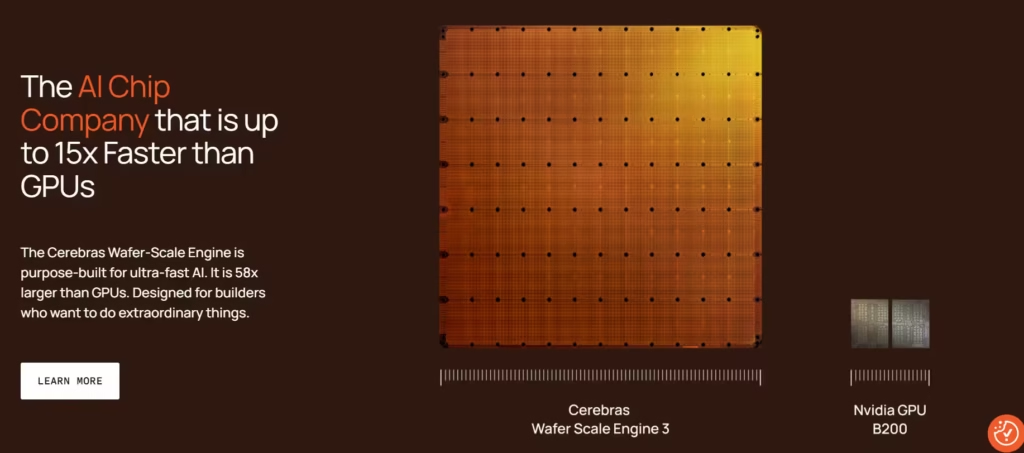
Most chip designers package dozens of chips onto a board and hope the interconnects don’t slow everything down. Cerebras looked at that approach and built something almost offensively different.
Cerebras is known for its wafer-scale processors built specifically for training large AI models. Its massive single-chip architecture reduces data movement and speeds up training workloads because there are no interconnects to slow data down. The entire wafer is the chip.
In March 2025, Cerebras announced the launch of six new AI inference data centers powered by Cerebras Wafer-Scale Engines. Embedded with thousands of CS-3 systems, those data centers are expected to serve 40 million Llama 70B tokens per second. That makes Cerebras the world’s top provider of high-speed inference at scale.
Cerebras secured $1.1 billion in Series G funding to push their wafer-scale technology forward. The company aims to scale CS-3 clusters into AI supercomputers without the distributed computing complexities that typically plague multi-chip systems. The bet here is that if memory bandwidth is the bottleneck, eliminate the bottleneck by eliminating the memory wall entirely.
6. Tenstorrent
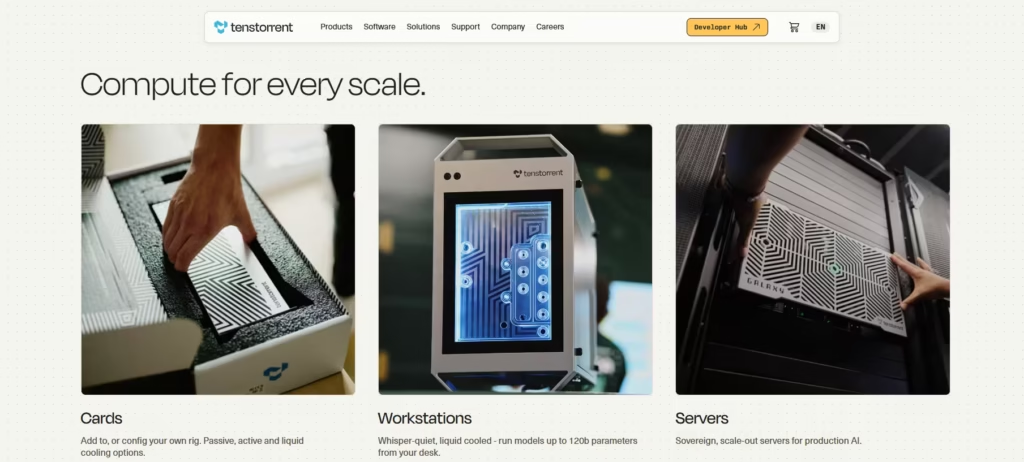
Jim Keller designed AMD’s Zen architecture, co-designed Apple’s A-series chips, and led Tesla’s first self-driving silicon. When someone with that track record starts a company to challenge NVIDIA, it’s worth paying close attention.
Tenstorrent pursues a RISC-V open architecture with a flexible business model spanning IP licensing, chiplet sales, and complete systems. Where NVIDIA locks clients into CUDA and proprietary hardware, Tenstorrent offers a path out. It’s slower, but it does get the clients out of a Nvidia dependency.
Also read: Top 8 AI Infrastructure Companies
7. Qualcomm

Qualcomm’s Neural Processing Unit scores 8.5 out of 10 on innovation benchmarks and outperforms Apple in raw TOPS for mobile AI workloads. Its Snapdragon 8 Elite delivers 45 TOPS of on-device AI performance, compared to Apple’s A18 Pro at 35 TOPS. This gives it an edge in mobile gaming and real-time inference tasks.
The problem is growth. Qualcomm saw a 13.4% revenue contraction in early 2026 as cell phone sales stagnated. Therefore, it has since pivoted toward AI PCs and automotive systems as a strategy.
Even though Qualcomm remains the leader in Android-based AI, its Market penetration is low. This is because it struggles to convert hardware strength into new market categories.
Training AI and Investments
If you’re not buying NVIDIA or AMD for serious AI training workloads, you’re either optimizing for cost, building custom infrastructure, or betting on a future that hasn’t fully arrived yet. Thankfully, this features a handful of great picks of companies that fit the task, whatever it is.
Choose NVIDIA if you need production-ready training today, AMD if you’re willing to invest in ROCm integration for 20-30% cost savings, or Broadcom if you’re a hyperscaler building custom silicon.
