
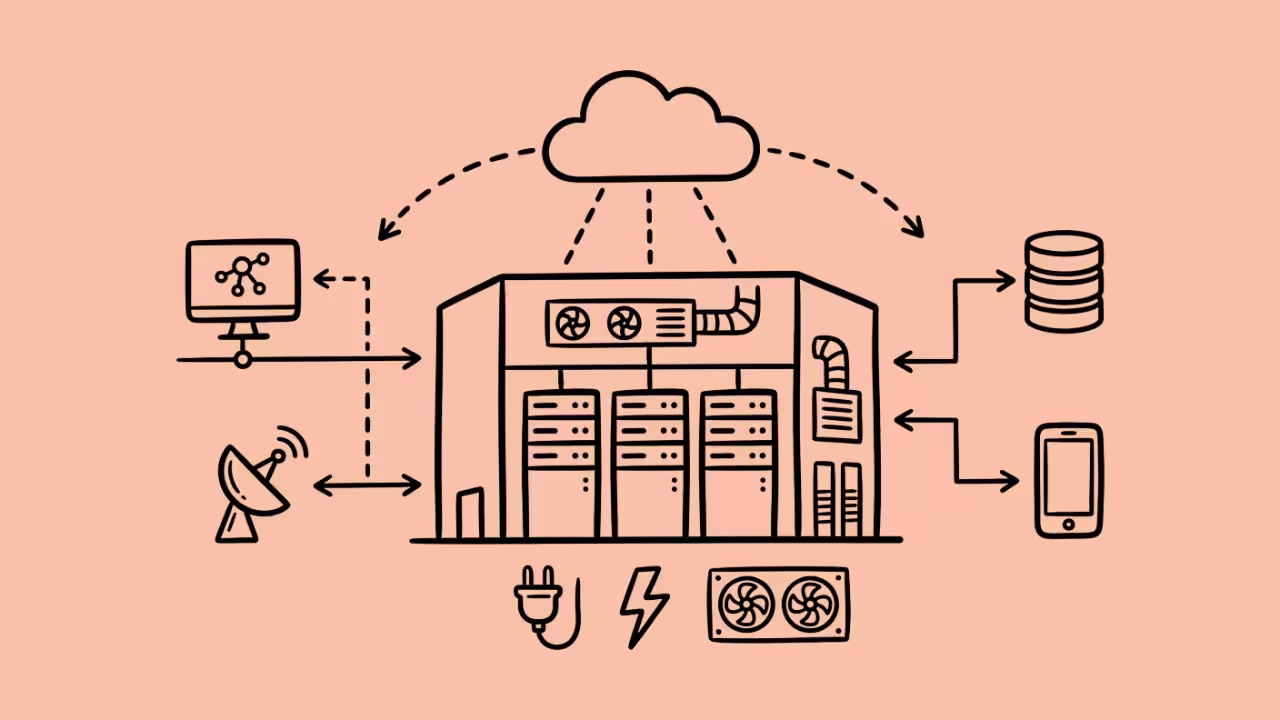

Meta has poured billions of dollars into AI and has built massive data centers. Now, the company may be ready to cash in on all that extra computing power.
According to a Bloomberg report published Wednesday, Meta is working on a new cloud infrastructure business.
The company plans to sell access to AI computing power and AI models to outside companies.
This would put Meta in direct competition with cloud giants like Amazon Web Services, Google Cloud, and Microsoft Azure.
Meta
SpaceX did something similar just weeks earlier through xAI. Back in May, SpaceX signed a deal with Anthropic to give it (Anthropic) access to the entire compute capacity of SpaceX’s Colossus 1 data center.
SpaceX later struck similar leasing deals with Google and Reflection AI; Meta appears to be following a similar path.
Down the road, the true winners in the AI industry might not be the companies with the flashiest chatbots or the smartest models.
Instead, the winners could be the companies that own the data centers. Compute power, in other words, might become the new oil.
Risk
Some experts warn that the AI infrastructure boom could be building toward a bubble. Much of that risk comes down to chips, as AI chips lose value fast.
They depreciate quickly as newer, faster versions hit the market. That means data centers full of today’s chips could be worth a lot less in just a few years.
Still, there are those whose opinions and worries center on whether AI companies can ever earn enough money from everyday users to justify the trillion-dollar price tags attached to all this infrastructure.
Infrastructure Spending
By the end of the first quarter, Meta had already committed to spending $ 182.9 billion on AI infrastructure over the coming years, according to its SEC filings.
That includes two massive ongoing projects: in Louisiana and in Ohio. The Ohio site, especially, has been described by Mark Zuckerberg as being roughly the size of Manhattan.
That project is expected to come online sometime this year.
Meta’s AI Products
Unlike Google or OpenAI, Meta hasn’t seen huge public demand for its own AI tools.
The company doesn’t even break out revenue from Meta AI or Llama, its open-weight AI model family, in its earnings reports.
Instead, Meta executives have mostly talked about how AI helps the company internally: better ad targeting, smarter content recommendations, and improved internal tools.
That silence around consumer AI revenue speaks volumes. It suggests Meta’s AI efforts may not yet bring in much money on their own.
So, selling compute power to other companies could give Meta a faster, more direct way to profit from its giant infrastructure investment.
According to Bloomberg, Meta may borrow ideas from two very different companies. First, it could follow CoreWeave’s model.
That means selling access to raw, unpackaged computing power, basically renting out server capacity directly.
Second, Meta might follow Amazon Web Services’ lead by offering access to specific AI models hosted on its own infrastructure.
This could include Meta’s newly launched closed-weight model, Muse Spark. Combining both approaches would give Meta multiple ways to make money from the same physical infrastructure.
Compute Team
This new business reportedly has a name already: Meta Compute. Santosh Janardhan, Meta’s head of infrastructure, brings deep knowledge of the company’s data center operations.
Daniel Gross, who leads Meta Superintelligence Labs, brings AI research expertise. And Dina Powell McCormick, Meta’s president, rounds out the leadership with business and strategic guidance.
Zuckerberg
Back in May, Zuckerberg told reporters that starting a cloud computing business was “definitely on the table.”
He framed it as a natural way to get a return on Meta’s massive investment in AI superintelligence.
Now, just two months later, that idea appears to be turning into an actual plan.
