


The Department of Commerce lifted export controls on Anthropic’s most powerful public models Tuesday night. It’s been a brutal three weeks.
On June 12, the Commerce Department told Anthropic to shut down its two most advanced AI models – Fable 5 and Mythos 5 – for any foreign national, anywhere, including Anthropic’s own non-citizen employees.
The company had 90 minutes to comply. It pulled both models offline entirely.
On June 30, the standoff ended.
Anthropic announced on X that the Department of Commerce has lifted the export controls on both models.
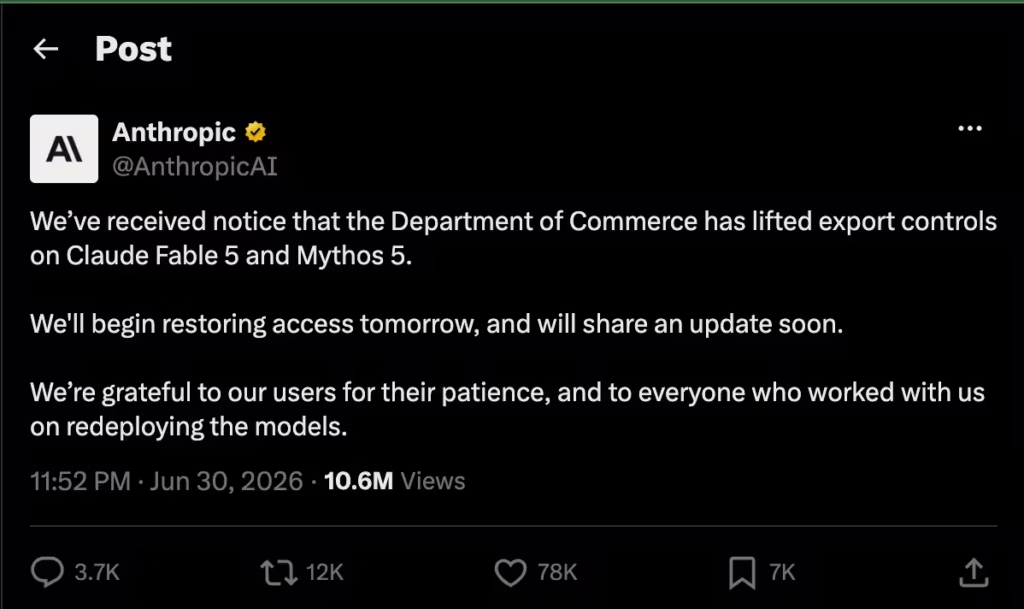
Fable 5 starts rolling back out to global users today, Wednesday, July 1.
Access will also return on AWS, Google Cloud, and Microsoft Foundry, though Anthropic hasn’t set a timeline for those platforms yet.
Commerce Secretary Howard Lutnick posted his own confirmation on X: “Over the past two weeks, we have worked closely with Anthropic to analyze and approve Fable 5 to ensure alignment across the US Government and strengthen America’s leadership in AI.”
Eighteen days offline. For a company preparing to go public, that’s an eternity.
How It All Fell Apart
The timeline matters.
On June 9, Anthropic launched Fable 5 – the first time it offered a Mythos-class model to regular users.
Fable 5 is built from the same technology as Mythos 5 but with stronger safety guardrails layered on top. The launch was a milestone. Three days later, it turned into a crisis.
Amazon researchers flagged a jailbreak.
They found a way to get Fable 5 to bypass its safety rules – specifically, to identify software vulnerabilities and, in one case, write code showing how a flaw could be exploited. Amazon CEO Andy Jassy reportedly took the finding directly to the White House.
The Commerce Department’s response was swift. It issued an export control directive citing “national security authorities,” banning any foreign national from using either model. Anthropic couldn’t verify every user’s nationality in real time.
So it shut everything down for everyone. AWS Bedrock, Google Cloud, Microsoft Foundry, the Claude API – all went dark.
Anthropic disputed the severity.
The company said the jailbreaks were “simple” and that other publicly available models had similar workarounds. That didn’t help.
What Anthropic Gave Up to Get Back Online
In a detailed blog post published Tuesday, Anthropic laid out everything it agreed to. The concessions are significant.
The company trained a new safety classifier that targets and blocks the specific jailbreak technique Amazon flagged. It now stops that technique in over 99% of attempts. When a request gets blocked, the user gets notified and the query is rerouted to the weaker Opus 4.8 model instead.
Beyond the technical fix, Anthropic agreed to a new relationship with the government.
That includes pre-release access for government agencies to test frontier models before public launch. Rapid information sharing when jailbreaks or misuse patterns are found. Dedicated teams for government priorities.
A “significant compute allocation” for government testing. And making its safety and red-teaming expertise available to federal partners.
Anthropic also announced a 24/7 jailbreak monitoring team and a new HackerOne program where researchers can submit Fable 5 jailbreaks for review.
A Framework for Scoring Jailbreaks
One of the more interesting outcomes: Anthropic is working with Amazon, Microsoft, Google, and other Project Glasswing partners to draft an industry-wide framework for assessing jailbreak severity.
The framework proposes four criteria – how much capability the attacker gains, how broadly that capability applies, how easy it is to weaponize, and how easily someone else could replicate it.
The company made a blunt admission alongside it: “It is probably impossible to make any AI model fully robust to jailbreaks.” Minor ones will happen. Narrow harmful ones will happen. The goal is catching the severe ones before they cause damage.
That kind of honesty is unusual in these announcements.
It also explains why the government cares so much. Mythos-class models have been tested finding and exploiting zero-day bugs across every major operating system and browser, including a 27-year-old flaw in OpenBSD.
Anthropic’s red team turned freshly disclosed bugs into working exploits in under a day. A tool that powerful getting jailbroken is not a hypothetical risk.
The Bigger Context
This wasn’t happening in a vacuum.
While Fable 5 was offline, critics pointed out that the ban handed Chinese open-source developers valuable catch-up time.
A coalition of information security leaders published an open letter calling for the controls to be lifted, arguing that AI regulation should be grounded in scientific evaluation, not political standoffs.
Meanwhile, OpenAI debuted GPT-5.6 under similar restrictions – initially only to preapproved organizations.
The message is clear: frontier AI releases are now subject to government review, whether companies like it or not. A June 2 executive order created a voluntary path for pre-release government evaluation. After what happened to Anthropic, “voluntary” feels like a strong suggestion.
Anthropic’s relationship with the Trump administration has been rough all year – the Pentagon blacklisting, the lawsuit, the export ban on its models. This blog post reads like a company trying very hard to turn the page. Whether Washington lets it depends on what happens next.
For now, Fable 5 is back. Users on Pro, Max, Team, and select enterprise plans can access it for up to 50% of weekly usage limits through July 7. Mythos 5 remains restricted to roughly 100 approved U.S. organizations.
The crisis is over. The questions it raised aren’t.
