

When it comes to job interviews, AI sits on both sides of the table. Recruiters use it to screen candidates, and candidates use it to prepare, practice, and sometimes even answer questions live. This guide will focus on the candidate’s side- using AI interview assistants to get the job.
Inside are two categories of AI interview assistants: live copilots that whisper suggestions during a live call, and prep tools that build your skills before you ever log on. We’ll also cover the ethics of real-time interview assistants (copilots), because that’s the part most listicles skip.
What Is an AI Interview Assistant?
An AI interview assistant falls into one of two categories. The first is a live copilot. It listens to your interview in real time, transcribes the interviewer’s questions, then generates suggested answers on a screen overlay. Some tools also read coding problems off your screen and draft solutions.
The second is a prep tool, sometimes called an AI mock interview tool or AI interview coach. It simulates a real conversation before the interview, scores your answers, and helps you fix delivery habits. It’s a rehearsal space, not a teleprompter.
Both fall under the same market label, but they solve different problems, so we’ve split this list accordingly.
Best Live AI Interview Copilot Tools
1. Final Round AI
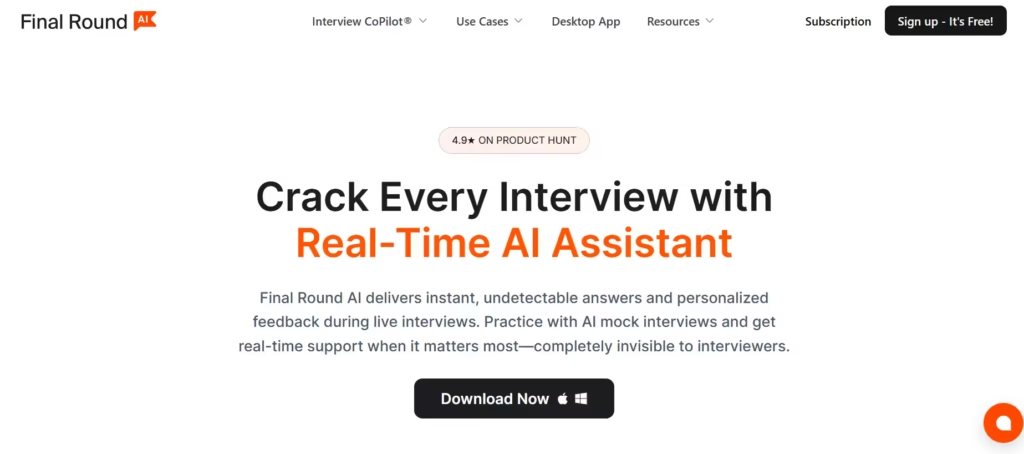
Final Round AI bundles a live Interview Copilot with mock interviews, a resume builder, and a job-application tool. That’s the pro and also the con. The entry-level plan runs around $150 a month for a capped number of sessions, or $25/month when billed annually.
If you want a single platform for the entire job search and price isn’t the deciding factor, it’s a reasonable choice. If you just need live help during interviews, you’re paying for a lot of features you won’t touch.
Also read: Final Round AI Review 2025: Pricing, Features, and More
2. LockedIn AI
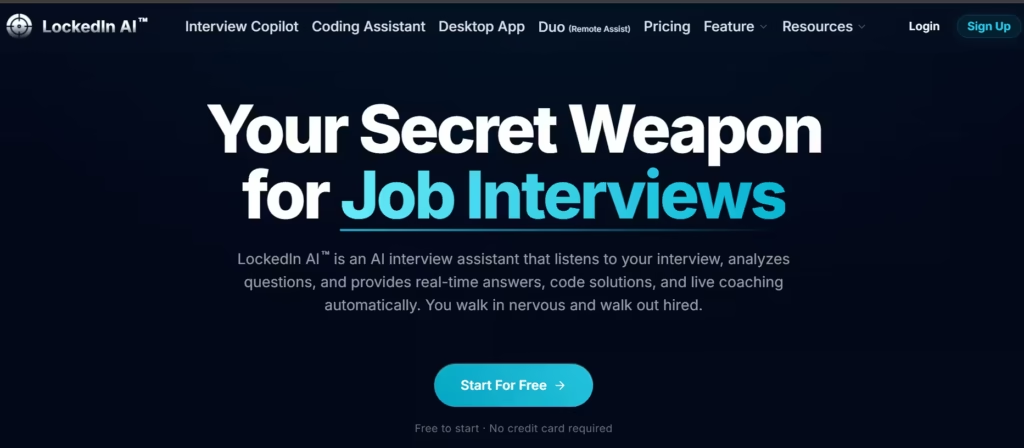
LockedIn AI’s headline feature is response time; it advertises an average of around 116 milliseconds. That’s the fastest claimed number in this category, and it matters more than it sounds like it should. A one- or two-second lag between the question and the suggestion is often what tips off an interviewer.
Its Duo feature also lets a trusted friend view the questions remotely and provide you with guidance. Between LockedIn AI and Final Round AI, I’d lean toward LockedIn AI if speed under pressure is your main concern. That’s because the latency gap can be easily noticed in a live call.
3. Cluely
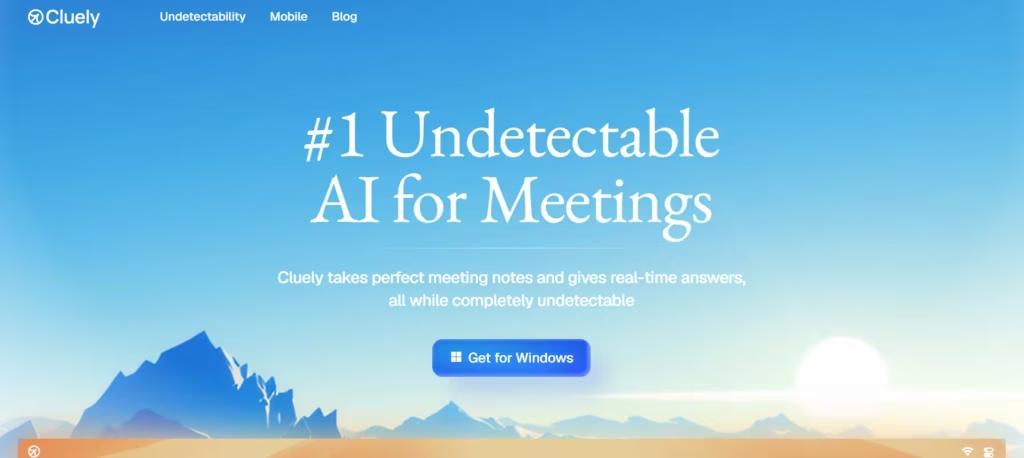
Cluely markets itself on staying invisible during screen shares. It had a viral debut in mid-2025, and it’s still one of the more recognizable names in the category. But its own trajectory tells a story worth flagging: Google Trends data shows search interest in Cluely peaked around its April 2025 launch and has declined steadily since.
That doesn’t mean the tool stopped working. The company had gained 70,000 signups in its first week due to a viral “Cheat on Everything” marketing campaign. And as with all things, the hype died down, and user interest waned.
It is also partly due to the brand’s move away from “cheating” to standard AI meeting notes and corporate assistant positioning by late 2025. Worth trying if the brand recognition matters to you, but don’t pick it on hype alone.
4. Parakeet AI
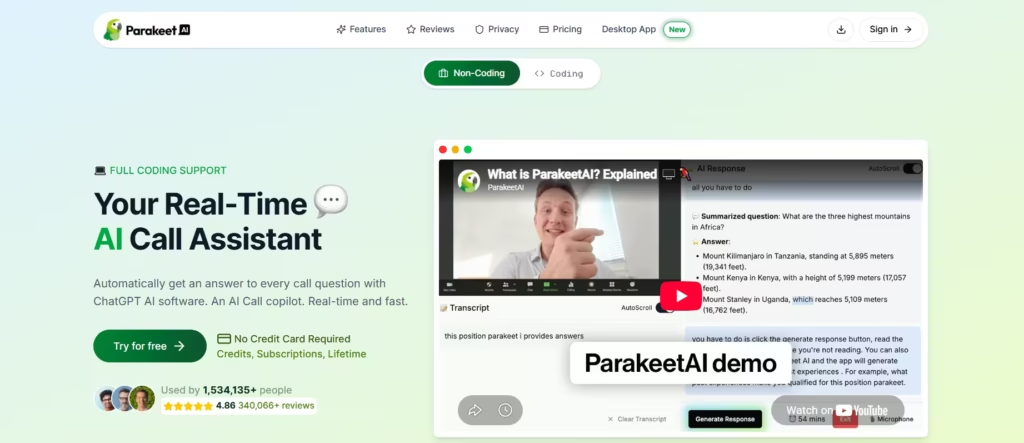
Parakeet AI reads problems directly off LeetCode and HackerRank through screen capture, then drafts full solutions with syntax highlighting. It also lets you pick your underlying model, GPT-5, GPT-4.1, or Claude Sonnet, which none of the others in this list offer.
That flexibility costs close to $149.90 a month or $59.00 if buying credits alone. For a behavioral interview, that’s overkill. For a technical screen where coding accuracy is the whole game, it’s the strongest option on this list. I should mention that Parakeet also provides non-coding assistance.
5. Verve AI
Verve AI’s pricing is lower than Final Round AI’s. Its paid plans land somewhere between $39.99 – $59.99 amonth, depending on the tier. Compared to Final Round’s roughly $150 a month for its base plan, this could be a better financial decision.
Even at the higher end of that range, Verve AI comes in well under half the price for comparable features: stealth mode, coding support, and unlimited mock interviews. If budget is the deciding factor and you don’t need Parakeet’s model selection or LockedIn’s speed, Verve AI is the pick.
Also read: Best AI Tools for Mass Applying to Jobs
Best AI Interview Prep and Mock Interview Tools
1. Pramp (Now Part of Exponent)
Pramp pairs you with another job seeker for live, structured mock interviews; you interview them, then they interview you. It’s free, covers both coding and behavioral formats, and Exponent (its parent platform) layers paid courses and a coach marketplace on top without touching the free core. Start here before you pay for anything.
2. Yoodli
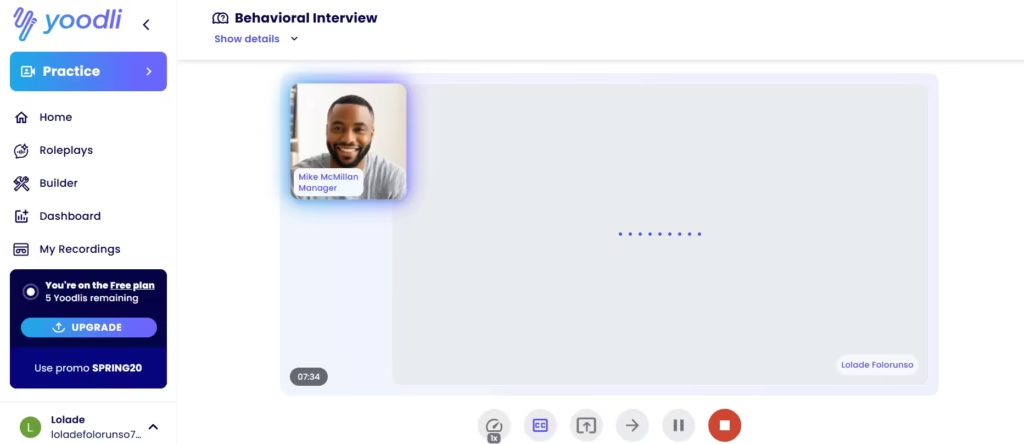
Yoodli doesn’t touch content but scores pacing, filler words, and clarity, then shows you the breakdown after each session. So if you already know what to say but ramble or say “um” too often, this is the tool built for that specific problem. A free tier is available, and paid plans run roughly $15–$39 a month.
I tested out the free plan and found it really helpful. For one, it made me realize how interviewers tend to explore answers to propel the interview along and really get acquainted with the candidate’s work style without being too obvious.
For the mock AI interview, the AI interview coach asked routine questions. Then, as time passed, the nature of the questions narrowed down into specifics.
3. Big Interview
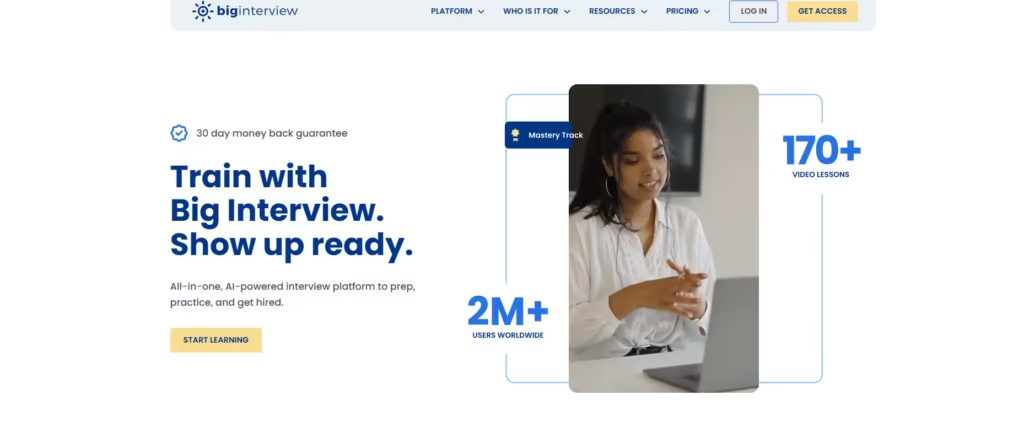
Big Interview is structured more like a curriculum than a single feature. It pairs a video-practice library with lessons on interview strategy, which makes it a better fit for someone new to interviewing than for someone polishing an existing skill set. The caveat is that there is no free plan; still, entry-level candidates get the most out of it.
4. Interviewing.io
A real engineer from a major tech company runs your mock interview here, not an AI model. That’s why the feedback tends to be sharper than anything automated. It’s also why sessions start around $179. For a high-stakes technical job prospect, it’s worth giving a shot.
5. Huru
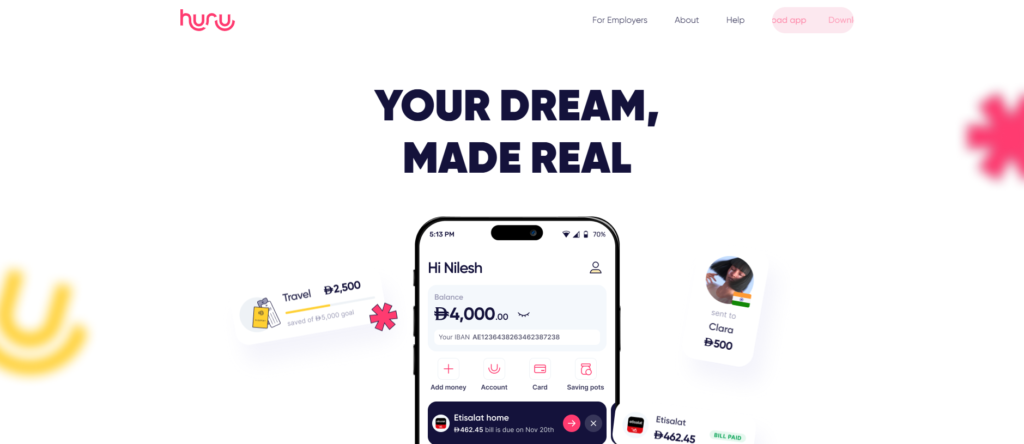
Huru records your answers and scores delivery, specifically body language, eye contact, and vocal tone. That makes it the right tool for one-way video interviews, which have become a standard first step in a lot of hiring pipelines. Its plans run around $25 a month.
The Ethics of Using Live Interview Copilots
1. Stealth and Detection
Copilots market themselves on staying invisible during screen shares. However, interviewers have adapted. Trained hiring teams now watch for a second monitor, eyes that drift off-camera, or answers that sound too polished too quickly. Many companies now ask candidates directly whether they’re using AI assistance. Getting caught usually means an instant rejection.
2. Latency and Timing
Every copilot introduces a delay between the question and the generated answer. Even the fastest tools take a fraction of a second to over a second. That pause can look like hesitation, or worse, like you’re reading from a script. Faster tools shrink this time gap, but none can really compete with the immediate answer a human gives.
3. Fairness and Policy Violations
Some employers explicitly prohibit AI assistance during interviews. Violating that policy, even after you’ve accepted an offer, is enough grounds for termination. There is also a question of fairness: other candidates are answering without AI help, so a copilot changes the baseline of the comparison.
4. Privacy
Live copilots stream your interview audio and video to external servers for live processing. That means a third party has a complete record of a conversation you likely consider confidential. Although some tools, such as Yoodli, are SOC and GDPR compliant, you should check any tool’s data retention and privacy policy before you use it in a real interview.
5. Skill Atrophy
A copilot gets you through one interview. It doesn’t teach you anything for the next one. Prep tools, on the other hand, build a skill you keep. Copilots create a dependency that you have to renew every time you interview.
Which Tool Should You Choose?
If you have interviews scheduled and want a safety net, a copilot like LockedIn AI (speed) or Verve AI (budget) covers most needs without Final Round AI’s price tag. But go in with your eyes open about detection and policy risk. If you want to actually improve, start with the prep tools; Pramp adds to your skillset for free, Yoodli fixes delivery, and Interviewing.io sharpens technical rounds with expert feedback.
Most serious candidates end up using a small stack rather than one single tool: a peer-practice platform for volume, a delivery coach for polish, and, only if they accept the risk, a live copilot as a last resort. Whichever path you choose, the best interview performance still comes from genuine preparation, not a tool feeding you lines live.
