


Meta just admitted that its new AI app, Muse, was heavily inspired by OpenClaw.
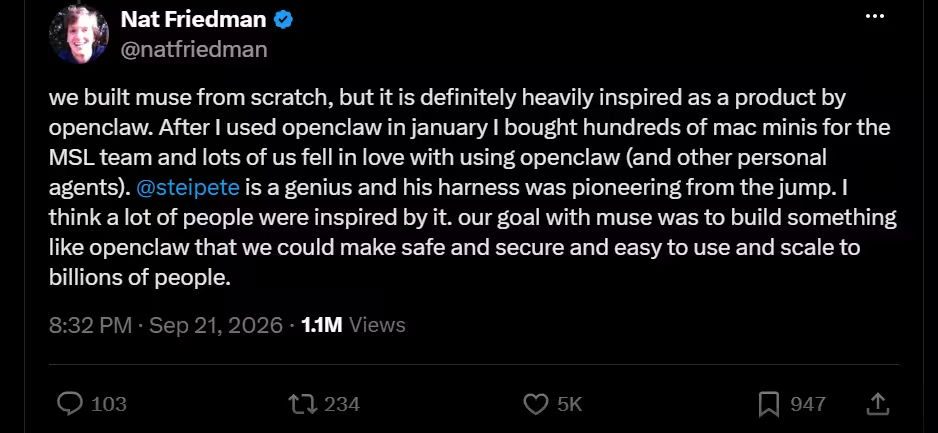
The confirmation came straight from Nat Friedman, head of product at Meta’s Superintelligence Labs.
Nat Friedman
Friedman posted on X that Muse was “definitely heavily inspired as a product by OpenClaw.” But he quickly added that Muse was “built from scratch.”
He had used OpenClaw back in January, and he liked it so much that he bought hundreds of Mac minis for his team at Meta.
Many team members fell in love with using OpenClaw and similar personal AI agents.
Friedman called Peter Steinberger, the creator of OpenClaw, a genius.
Comparison
Ansh Nanda, a co-founder of an AI app, posted that Muse was basically “OpenClaw for normies.”
He backed up his claim with a conversation he had with Muse itself. The AI agent admitted that similarities between its own system files and OpenClaw’s were a match.
One user pointed out that Muse has a file called SOUL.md, just like OpenClaw does. This file is a simple text document written in Markdown.
It defines things like an AI agent’s personality, tone, values, and areas of expertise. And the actual content inside those files was nearly identical.
Borrowing Big Ideas
Meta has a long track record of spotting hot products, then folding their best features into its own apps.
The most famous example involves Snapchat. Years ago, Snapchat invented the Stories format; Meta later copied it across Instagram, Facebook, and WhatsApp.
That became one of the most talked-about examples of Meta’s copy-and-scale strategy.
So when people noticed Muse borrowing heavily from OpenClaw, it didn’t seem out of the ordinary.
When asked directly why Muse copied OpenClaw’s exact file names and nearly identical SOUL.md content, Friedman said the Meta team thought Steinberger “got those things exactly right.”
Muse
Friedman framed Meta’s mission a bit differently than plain copying. He said the team wanted to build something like OpenClaw.
But they also wanted it to be safe, secure, and easy for anyone to use. The main goal, he explained, was scale.
Meta wanted an AI agent that could reach billions of people. OpenClaw is powerful, but it’s more of a tool for tech-savvy early adopters.
Muse aims to bring that same magic to a much wider audience.
OpenClaw
OpenClaw had a breakout year. Its popularity exploded, especially among people looking for a smart, personal AI assistant.
OpenAI actually hired OpenClaw’s creator, Peter Steinberger, earlier this year. That alone signaled just how much buzz the project had generated across the AI industry.
Because OpenClaw is open source, its code and design choices are publicly visible. Anyone can study it.
Anyone can learn from it. So it’s not shocking that Meta’s team looked closely at what made OpenClaw so effective.
Muse
Whatever people think about the inspiration behind it, Muse is performing well. The app recently hit the number one spot on the U.S. App Store.
Data also shows Muse is outpacing ChatGPT’s early mobile launch.
