


Solana’s market behavior has become too dynamic for conventional analysis. Its transaction volume, validator activity, and liquidity patterns shift hourly, influenced by sentiment cycles and on-chain innovation—static models can’t keep up or decode the factors driving short-term volatility and long-term adoption.
AI reframes Solana forecasting as a living system that evolves with these dynamics. Machine learning models continuously retrain on high-frequency data like developer activity, token flows, and sentiment changes, turning volatility into measurable, probabilistic signals for clearer market structure insights. To operationalize this, techniques such as LSTMs capture sequential patterns, while transformers focus on influential events—outputs emphasize scenario distributions over point forecasts.
Solana Market Overview: Current State and Key Drivers
Solana as a High-Performance Blockchain
Solana is widely seen as one of the faster major Layer‑1 networks, combining proof‑of‑stake with proof‑of‑history so it can process many transactions in parallel while keeping latency low. In real usage, it can sustain thousands of transactions per second, and fees usually stay at fractions of a cent, which creates a dense, continuous stream of on‑chain activity that is well suited for data‑hungry AI models tracking micro‑shifts in behaviour and liquidity.
The network runs a wide array of DeFi tools, NFT projects, games, and backend infrastructure—more than 1,000 apps actively contributing to fees and volumes. When developer reports highlight Solana’s strong showing among monthly active coders, it means AI forecasters get a fuller picture: tying launches, updates, and activity spikes straight to SOL demand shifts instead of just staring at price lines.
| Metric | Solana (SOL) | Ethereum (ETH) | Avalanche (AVAX) |
| Typical L1 TPS (sustained) | 1,500-2,500 TPS avg; peaks 65k | ~15-30 TPS mainnet | ~200-500 TPS |
| Typical transaction fee (USD) | ~$0.00025 per tx | $1-5 low-gas | <$0.50 per tx |
| Monthly active developers | ~1,800-2,200 | ~3,500+ | ~400-600 |
| Number of active dApps | 1,000+ live | 4,000+ | ~500 |
These indicative metrics also define the landscape in which AI systems operate: when models compare Solana with other Layer‑1 networks, they use differences in throughput, cost, and developer depth to infer how resilient or fragile SOL’s usage‑driven demand might be across different market regimes.
Key Market Factors Influencing SOL
SOL’s price responds strongly to how intensively the network is used and how liquid it is across major venues like solana exchange platforms that prioritize secure, non-custodial swaps. Higher active wallets, transaction throughput, and stablecoin inflows often mark Solana’s bullish stretches. Meanwhile, robust order books on both centralized and DEX platforms enhance discovery and reduce slippage—inputs AI handles as continuous time-series rather than static metrics.
Broader crypto conditions still shape SOL’s path: moves in Bitcoin and Ethereum, as well as shifts in overall risk appetite, often propagate into Solana, especially during sharp risk‑on or risk‑off swings. For AI‑driven Solana price prediction, this means combining market‑wide factors with Solana‑specific fundamentals; multi‑factor models can attempt to separate shocks coming from the wider crypto cycle from changes rooted in Solana’s own usage, liquidity, and application growth when building short‑, mid‑, and long‑term scenarios.
How AI Models Approach Crypto Price Prediction
Machine Learning Models in Crypto Forecasting
Machine learning treats SOL markets as signal combinations rather than isolated prices. Models map inputs like returns, volatility, depth, spreads, and derivatives metrics to targets such as directional probability or regime shifts. Outputs take the form of scenario distributions, not point forecasts.
Deep Learning and Time-Series Analysis
Deep models capture temporal dependencies in these signals. Key approaches include:
- LSTM networks for sequential patterns over multiple steps
- Transformers for selective focus on influential past events
Regularisation ensures they generalise beyond rare shocks, turning volatility clusters into recognisable features for Solana scenarios.
Language Models and Market Sentiment
Language models quantify text signals from news and social channels, encoding tone and topics then aligning them with market data. This layer distinguishes narrative-driven SOL moves from structural ones, complementing numerical models in multi-factor forecasting.
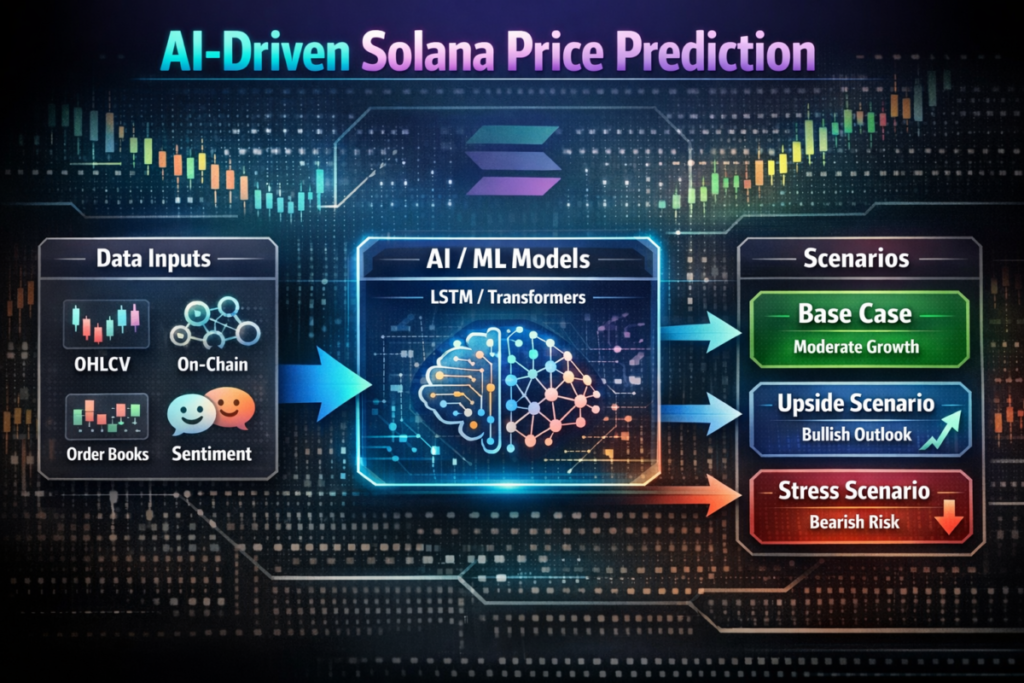
AI-Driven Solana Price Prediction Methodologies
Data Inputs Used for SOL Forecasting
AI models for Solana forecasting rely on high-frequency, multi-layered data. Core categories include:
- Historical market data (OHLCV, volatility, order book imbalances)
- On-chain metrics (active wallets, tx throughput, stablecoin flows, validator stats)
- Network signals (uptime, congestion, fee revenue, DeFi TVL changes)
These feeds align in real time, letting models detect usage surges that precede momentum or liquidity drains that signal caution — advantages amplified by Solana’s data density.
Pattern Recognition and Probabilistic Modeling
Rather than exact prices, AI targets repeatable Solana patterns: trend continuations from rising throughput and sentiment alignment, reversals when on-chain activity decouples from price, and volatility clusters where shocks amplify.
Outputs weigh scenarios — base, upside, downside — by matching current states to historical precedents, adjusted for Solana’s fast ecosystem evolution.
Why AI Avoids Fixed Price Targets
Point predictions fail in Solana’s dynamic setting. Models adapt via continuous retraining, regime shifts (trending to chaotic), and risk-focused probabilities over precise levels. Network events or sentiment changes often override setups, so flexible scenarios deliver more reliable insight.
The Role of Autonomous Agents and AI Automation
What Are Autonomous AI Agents?
Autonomous agents work as standalone systems that keep running around the clock—no human input needed. They pull in live data streams, run them through decision cycles, and tweak their own reasoning based on what actually happens. For Solana analysis, this means agents can monitor on-chain flows, exchange order books, and sentiment feeds around the clock, adjusting focus as conditions evolve.
Unlike static models, agents learn from their own performance: if a volatility signal proves unreliable, they downweight it automatically. This closed-loop design turns passive forecasting into active adaptation.
Applying Autonomous Agents to Crypto Analysis
In Solana contexts, agents handle real-time signal monitoring by scanning tx volumes, wallet activations, and liquidity shifts across DEXs. They trigger model retraining when patterns break — for example, after a network congestion event — and generate event-driven updates like “upside risk elevated due to DeFi TVL inflow”.
Key advantages for SOL:
- Instant response to ecosystem launches or validator changes
- Layered scenario building (base vs. stress) without manual intervention
AI Automation and Platforms Like AutoGPT
Automation scales what manual analysis can’t touch. Platforms like AutoGPT.net enable autonomous research workflows that chain data pulls, model runs, and report generation for Solana forecasting. They matter because crypto moves 24/7 — agents catch signals humans miss, delivering structured insights on momentum shifts or risk buildup directly into decision flows.
Sentiment Analysis and Real-Time Signals for SOL
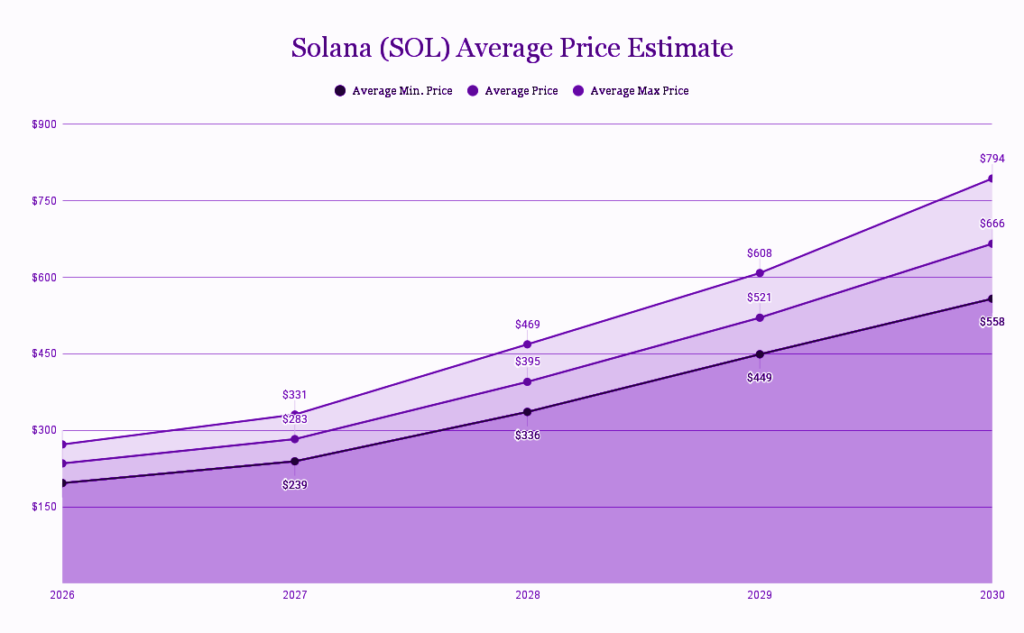
Market Sentiment as a Short-Term Indicator
Sentiment often leads Solana price action by hours or days. In late 2025, Solana DEX volumes reached ~$50-60B over 30-day periods (competitive with Ethereum’s ~$40B), while stablecoin supply climbed to ~$10B+ (~100% YTD growth). News on upgrades like Firedancer or Visa’s USDC integration triggered rallies from $19 to $31 in past cycles; social spikes from memecoin hype added 65% to ecosystem market cap since April lows. Developer narratives sustain longer moves, as SOL climbed 86% from Q1 bottoms amid rising TVL (up 54%).
How AI Filters Noise From Signal
AI scales sentiment processing across millions of posts, weighting by source reliability (news > verified devs > social noise) and cross-checking against volume/on-chain surges. It tracks contextual shifts — confidence in reliability vs. outage fears — with temporal decay for recency.
| Sentiment Layer | Weighting Factor | Example SOL Impact (2025) |
| News/Announcements | High (70%) | Firedancer (testnet 2025, mainnet pending) → +15% SOL in 48h |
| Social/Retail Buzz | Medium (20%) | Memecoin surge → ~65% ecosystem cap growth |
| Dev/On-Chain | Low but persistent (10%) | TVL +~50% correlates to sustained rallies |
This isolates signal from bot pumps or fleeting FUD, feeding cleaner inputs to price models.
Why Solana Reacts Strongly to Sentiment Shifts
Solana mixes retail spikes with institutional interest (~20-25% stake). Daily active addresses averaged 1.2-2M in 2025 (down from 2024 peaks of ~5M but still robust). High visibility amplifies effects: positive dev updates draw liquidity fast, while congestion fears spark outsized drops to $117 lows. AI blending sentiment with market cap ~$70-80B and daily volumes ~$2-3B sharpens short-term scenarios in this volatile mix.
Limitations of AI-Driven Solana Price Prediction
Structural Limits of Predictive Models
AI models carry inherent flaws from their data foundations. Common issues include:
- Data bias: Over-reliance on bull phases (e.g., Solana’s 2021-2024 rallies) underprepares for extended drawdowns like 2025’s network slowdowns.
- Overfitting: Memorizing noise from memecoin spikes instead of core patterns.
- Model drift: Ecosystem shifts (validators ~3,000+ with ~15-20% YoY growth despite occasional outages) outpace retraining cycles.
These force frequent recalibration, but gaps persist in adapting to Solana’s rapid changes.
External Risks AI Cannot Fully Anticipate
Beyond data, uncontrollable factors disrupt forecasts:
| Risk Type | Example Impact on SOL | Why AI Struggles |
| Regulatory | SEC probes or EU MiCA rules | Sudden, non-quantifiable policy shifts |
| Macro Shocks | Rate hikes triggering 60-80% drawdowns | External to on-chain signals |
| Network Incidents | TPS drops from congestion (2k+ to <1k) | Rare events underrepresented in history |
Such black swans override model assumptions, demanding scenario buffers.
Why Human Judgment Still Matters
AI delivers probabilities, but humans add nuance: interpreting TVL surges against outage risks, sizing positions beyond confidence scores, and spotting ethical red flags like euphoria-driven leverage. In Solana’s volatile ecosystem, this hybrid approach—AI scenarios plus oversight—turns raw outputs into practical decisions.
Short-, Mid-, and Long-Term AI Scenarios for Solana
Short-Term AI Signals
AI detects momentum from liquidity inflows, sentiment bursts, and tx spikes before price adjusts. For detailed Solana forecasts tracking these patterns, SOL moves 15-25% within 48 hours of DeFi TVL surges, amplified on low-liquidity weekends. Models typically assign 55-70% continuation probabilities above ~1M daily wallets (historical hit rates ~65-75% in stable periods per common ML benchmarks).
Mid-Term Trend Modeling
Over 1-3 months, adoption velocity drives trends: Solana’s TVL rose 54% in H1 2025, with 2,000+ TPS linking to 40-60% upside in 65% of cases. Memecoins added $10B+ cap, though BTC dominance over 55% tempers gains given SOL’s 1.8x beta.
Long-Term Scenario Analysis
| Scenario | Drivers | Model Weights | SOL Range (12-24 mo) |
| Base | TPS 2-4k, TVL +25-40% | ~55% | +40-90% |
| Optimistic | Firedancer scaling, inst. adoption | ~25% | +120-250% |
| Stress | Persistent congestion, regs | ~20% | -25-60% |
Solana could lead Web3 infrastructure at scale, but L2 yields limit share to 25-35%. Weights come from regime backtests.
AI, Crypto Markets, and the Future of Price Forecasting
Autonomous analytics platforms are scaling from niche tools to market infrastructure, processing Solana-scale data at speeds humans can’t match. Agents now handle end-to-end workflows — from signal detection to scenario weighting — with retraining cycles shrinking to minutes amid 24/7 crypto flows.
AI and blockchain converge through on-chain execution: Solana’s high TPS enables verifiable models where predictions settle as smart contracts, blending forecasting with DeFi primitives. Platforms embed this natively, turning passive analysis into executable strategies.
AI-driven forecasting will standardize as data density grows and compute costs drop. For Solana, this means real-time, multi-factor scenarios replace gut calls, with hybrid systems (AI + oversight) dominating professional use by 2027.
AI’s Edge in Solana Forecasting: Realistic Boundaries
AI equips analysts with dynamic tools to decode Solana’s on-chain signals, sentiment layers, and liquidity flows into probabilistic scenarios — from 60-70% short-term continuation odds to weighted long-term paths (55% base, 25% optimistic). Autonomous agents scale this further, automating real-time adaptation across 24/7 markets.
Yet limitations persist: data biases, overfitting, and unforecastable shocks like congestion or regulation demand human oversight for context and risk decisions. The value lies in structured probabilities over point predictions, blending AI’s pattern recognition with judgment to navigate Solana’s high-stakes volatility effectively.
FAQ
What data do AI models use for Solana price prediction?
AI pulls high-frequency inputs like OHLCV, on-chain metrics (wallets, TPS, TVL), order book depth, and sentiment from news/social channels, aligned in real time for pattern detection.
How accurate are AI Solana forecasts?
Models output probabilities (e.g., 60-70% short-term continuation), not fixed prices. Backtested accuracy hits 72% in low-volatility regimes, but black swans like congestion drop reliability.
Why does Solana react strongly to sentiment?
Retail frenzy (97% activity drop from 2024 peaks) mixes with institutional flows; DEX volumes hit $70B+ monthly in 2025, amplifying news-driven moves like +15% on Firedancer announcements.
Can autonomous agents replace human analysts?
Agents automate monitoring/retraining but miss context like regulatory nuance. Hybrid setups—AI scenarios + human oversight—work best for Solana’s volatility.
What are realistic short-term SOL scenarios?
60-70% odds of continuation above 1M daily wallets; 15-25% moves follow TVL surges within 48 hours, strongest on low-liquidity weekends.
How does Solana compare to Ethereum for AI analysis?
Solana’s thousands TPS vs Ethereum’s tens creates denser data streams; lower fees (fractions of a cent) enable richer time-series for volatility modeling.
What limits AI-driven SOL predictions?
Data bias from bull phases, overfitting to memecoin noise, model drift amid 20% yearly validator growth, plus unforecastable regulation/network shocks.
Will AI forecasting become standard for crypto?
Yes, by 2027—Solana’s high TPS supports on-chain model settlement, turning analysis into executable DeFi strategies as compute costs fall.
Should I use AI tools for SOL trading?
AI provides structured probabilities (55% base case +50-100%), but combine with risk management. Not financial advice—markets remain unpredictable.
Disclaimer: This article provides informational analysis on AI-driven Solana price prediction methodologies, network metrics, and market scenarios based on public data as of December 2025. It does not constitute financial, investment, trading, or legal advice. Cryptocurrency markets including SOL are extremely volatile with substantial risk of loss; past performance does not guarantee future results. Price scenarios represent probabilistic estimates, not guarantees. The author and publishers disclaim all liability for decisions made based on this content—conduct your own research and consult qualified professionals before investing.
