


Sales teams have spent the last decade fighting the same losing battle: static contact databases that go stale the moment someone changes jobs.
A prospect list downloaded in January is often half wrong by June — titles change, people move companies, and emails bounce. This is the exact problem that AI people search and AI prospecting tools were built to solve, and in 2026 they’ve become the default starting point for any go-to-market team trying to build pipeline without burning hours on manual research.
This article breaks down what an AI-powered contact search actually does, how it differs from traditional prospecting databases, what to look for in a modern AI prospecting tool, and how platforms like Lev8 approach the problem by searching the live web instead of relying on a fixed dataset.
From a Job Title Guess to a Verified, Real-Time Contact
Say a rep needs to reach the VP of Sales at a specific company. The old way meant checking LinkedIn, guessing an email format, and hoping it landed. AI people search replaces that guesswork with automated, live web research: machine learning models locate, verify, and enrich information about a specific person — their job title, company, seniority, and contact details like a business email or phone number — pulling from multiple live sources at once instead of one static index.
The distinction that matters most is live versus static. Traditional contact databases are built by scraping and storing data on a schedule, sometimes updated monthly or quarterly. A search tool that queries the live web, by contrast, can catch a title change or a new hire announcement within days of it happening — which matters enormously when timing a cold outreach around a role change or a company milestone.
For sales reps, recruiters, and marketers, this means AI people search isn’t just a faster Rolodex. It’s a way to answer a very specific question — “who holds this role at this type of company right now, and how do I reach them?” — without needing to know the person’s name in advance.
Where the Search Ends and Prospecting Begins
Finding one verified contact solves one problem. Building a pipeline is a different job entirely — and that’s the gap AI prospecting fills. It describes the broader workflow that sales and marketing teams use to turn individual contacts into an active pipeline, typically through four connected steps:
- Defining the ideal customer profile (ICP) — industry, company size, role, region, and other firmographic filters.
- Searching and enriching contacts that match that profile, often using a people search engine as the underlying data layer.
- Scoring leads based on intent signals — funding news, hiring activity, product launches, or website engagement.
- Launching outreach, usually through email or multi-channel sequences, directly from the same platform.
In other words, AI prospecting is the end-to-end system; finding and verifying a contact is just one component inside it. A tool that only surfaces names and emails without scoring or enrichment leaves a sales team doing the qualification work by hand. A true prospecting platform closes that gap by combining discovery, enrichment, and outreach in a single workflow.
Why Live-Web Data Changes the Prospecting Game
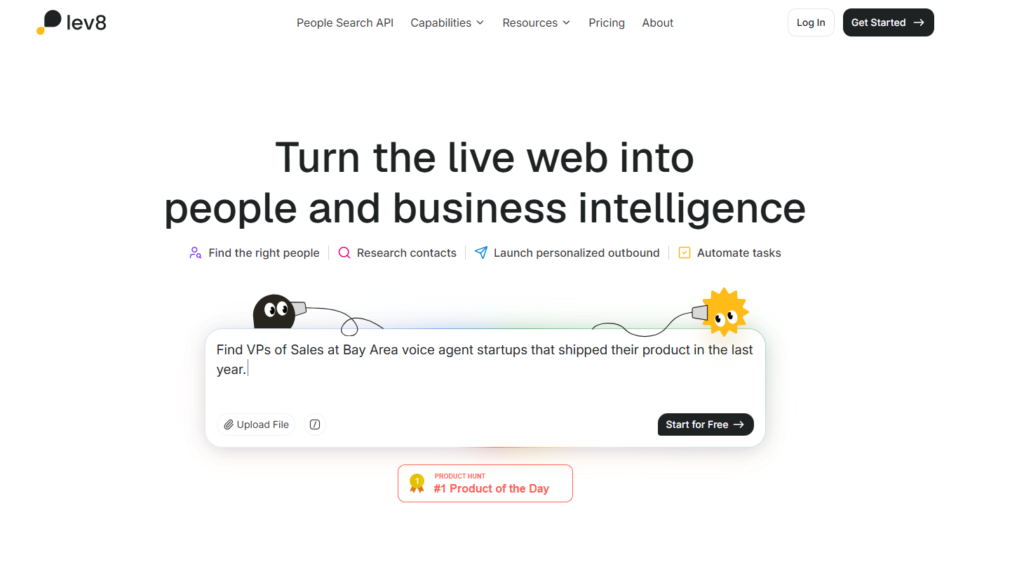
The biggest shift in this space over the past two years has been the move away from purely static databases toward tools that run AI agents against the live web in real time. This matters for three reasons:
- Freshness. A static database can’t tell you that a prospect was promoted last week. A live-web search engine can.
- Coverage of niche segments. Static databases are strongest for large, well-known companies and weaker for early-stage startups or narrow verticals. Real-time web search fills those gaps because it isn’t limited to a pre-built index.
- Context, not just contact details. Because these agents read public web content directly — funding announcements, product launches, team pages — they can surface the “why now” reasoning a rep needs to write a relevant first message, not just a name and an email address.
This is precisely the gap Lev8 was built to close. Rather than maintaining a fixed contact database that ages the moment it’s compiled, Lev8 runs parallel AI agents that search the live web, enrich each record with verified contact details, and track ongoing signals about a prospect’s company — so a sales team’s list stays accurate without a manual refresh.
What to Look for in a Prospecting Tool
Not every platform labeled “AI-powered” delivers the same value. When evaluating your options, a few criteria consistently separate the useful ones from the noise:
Data accuracy over data volume. A database of 800 million contacts is only as useful as its verification rate. A smaller, accurately scored list of decision-makers will outperform a massive list of outdated ones every time.
Natural-language ICP search. The best tools let a user describe their ideal buyer in plain English — for example, “VPs of Sales at Series B fintech startups that raised funding in the last six months” — rather than clicking through a dozen filter dropdowns.
Built-in scoring and signal tracking. Good platforms don’t just deliver a static list; they continuously monitor a saved ICP for public updates, flagging major company changes so a rep can reach out at the right moment instead of guessing.
An end-to-end workflow. Switching between a search tool, a separate enrichment tool, and a third platform for sending emails adds friction and increases the chance of losing context between steps. A single workflow that goes from ICP definition to verified contact to a sent email reduces that friction significantly.
Both personal and company data. Firmographic details — company size, industry, funding stage — matter just as much as an individual’s title and email. The strongest tools return both, so a rep isn’t reaching the wrong decision-maker at the right company, or vice versa.
Who Actually Uses These Tools
While sales development reps are the most obvious users, AI prospecting has become genuinely cross-functional:
- Sales teams use it to fill the pipeline with qualified targets, build territory-specific lists, and automate the first stage of outreach.
- Marketing teams use contact discovery tools to build account-based marketing lists and identify the right people for targeted campaigns.
- Recruiting teams apply the same live-web search logic to sourcing candidates, spotting job changes that signal someone might be open to a new role.
- Founders and early-stage teams, who often don’t have a dedicated SDR function yet, use these platforms to do the work of an entire outbound team without hiring one.
This is the same set of users Lev8’s free B2B lead generator is built around: describe an ideal buyer, get a scored and enriched prospect list, and send cold email outreach directly from the platform, without switching between separate tools for each step.
How Lev8 Approaches AI People Search and AI Prospecting
Lev8 positions itself around a simple idea: turn the live web into people and business intelligence, rather than relying on a database that’s already outdated by the time it’s queried. In practice, that means three things work together inside one platform:
- A search layer that finds and verifies contacts based on a described ICP, not a fixed set of filters.
- Continuous ICP tracking that watches for company changes — funding, hiring, product launches — so a saved prospect list stays relevant over time instead of going stale after the first export.
- A built-in outreach step, so a verified, scored list can move directly into a cold email campaign without exporting to a separate tool.
For a team that wants to try this without committing to a full platform first, the B2B lead generator tool offers a free, three-step way to build an ideal prospect list, see how the scoring works, and test the enrichment quality firsthand.
Frequently Asked Questions
Q: Is AI people search the same as a B2B contact database?
A: Not quite. A traditional B2B contact database is static and updated on a schedule. Tools that use live-web agents can surface more current information, including recent job changes that a static database hasn’t caught yet.
Q: Does AI prospecting replace manual research entirely?
A: It removes the repetitive parts — searching, verifying, and enriching — but reps still add value through personalization and judgment about which signals actually matter for a given deal.
Q: What’s the difference between a lead generator and a full prospecting platform?
A: A lead generator typically handles the search and list-building step. A full AI prospecting platform, like Lev8, extends that into scoring, ongoing signal tracking, and outreach, so a team isn’t stitching together multiple tools.
Q: Is this kind of tool only useful for large sales teams?
A: No. Founders and small teams often get the most value, since it replaces work that would otherwise require hiring a dedicated researcher or SDR.
The Bottom Line
AI people search and AI prospecting are often used interchangeably, but they describe different layers of the same problem. One is about finding and verifying the right individual; the other is the full workflow of turning that search into a scored, enriched, outreach-ready pipeline. As more sales, marketing, and recruiting teams shift away from static databases toward live-web tools, the platforms that combine both — accurate discovery and a connected outreach workflow — are becoming the practical default. Teams that want to see this in action can start with Lev8’s free B2B lead generator to build a first prospect list in minutes.
